Why Tracking AI Visibility Matters in 2026
Discover why monitoring AI visibility is crucial for your brand's growth and success. Learn strategies to stay ahead in a competitive landscape. Read more!

Your brand might already be showing up in AI answers.
The real question is whether you know where, how often, and in what context. Tracking AI visibility matters because it shows whether your brand is appearing in AI-generated answers at the exact moments people are comparing options, forming opinions, and deciding whom to trust.
For years, marketers have built measurement systems around familiar signals like keyword rankings, organic traffic, impressions, backlinks, click-through rates, conversions, and share of voice. Those metrics still matter. Traditional SEO is not disappearing, and smart marketers should not treat AI search as a replacement for everything that came before it.
But something important is changing.
People are no longer only searching by search engine queries, they are moving toward conversational discovery powered by modern AI search technology. What is happening now is they are asking AI assistants for recommendations, comparisons, summaries, options, explanations, and buying guidance, and AI platforms synthesize information into direct answers to those queries.
Those answers may mention your brand. They may mention your competitors. They may even describe your business accurately, vaguely, or incorrectly.
And if you are not measuring that visibility, you are making decisions with a blind spot. Brands that are not cited in AI responses can become effectively invisible to users.
AI visibility is becoming an important metric alongside traditional search analytics, especially as the latest AI search visibility statistics show how much behavior is shifting toward answer-first experiences. It tells marketers whether their brand is part of the conversation when people ask AI systems about their category, services, products, competitors, or areas of expertise.
That matters because visibility is not only about traffic anymore. It is also about awareness, authority, trust, competitive positioning, and whether your brand is being surfaced accurately at the moment people are forming opinions.
In this article, you will see what AI visibility means, how it differs from traditional SEO, why it matters now, which metrics to track, where competitors can gain an edge, why accuracy matters, and how to start measuring it.
What Does AI Visibility Actually Mean?
AI visibility refers to how often, where, and how your brand appears in AI-generated answers, helping organizations track brand presence in AI-generated responses and measure brand visibility. I share this in detail on my article on the Brandesis Blog.
That may include platforms and experiences such as ChatGPT, Gemini, Perplexity, Google AI Overviews, Google AI Mode, and other AI-assisted search tools, which means monitoring brand mentions across large language models and ai search engines. The exact platforms will continue to evolve, but the core question remains the same:
When people ask AI systems about your services ro product, does your brand appear?
This is different from ranking number one for a keyword.
A traditional SEO report might tell you that you rank for a specific keyphrase. That is still valuable. But an AI visibility report asks a slightly different set of questions about your brand’s ai visibility:
- Does an AI assistant recommend your brand when someone asks for options?
- Does it cite your content when summarizing a topic?
- Does it mention competitors more often than you?
- Does it understand what your brand actually does?
- Does it associate you with the right expertise, location, audience, and value proposition?
Those questions move measurement beyond rankings and clicks.
They help you understand whether your broader digital presence is strong enough to be recognized, interpreted, and recommended by AI systems.
Why This Matters Now
AI search experiences are increasingly influencing how people research and decide, reflecting broader AI search trends shaping visibility and trust by 2026. AI Overviews now appear in 25.11% of Google searches.
A potential customer may ask an AI assistant:
- “What are the best digital marketing consultants for tourism businesses?”
- “What should I look for in a web hosting provider?”
- “Which brands are known for strong SEO strategy in Southern Africa?”
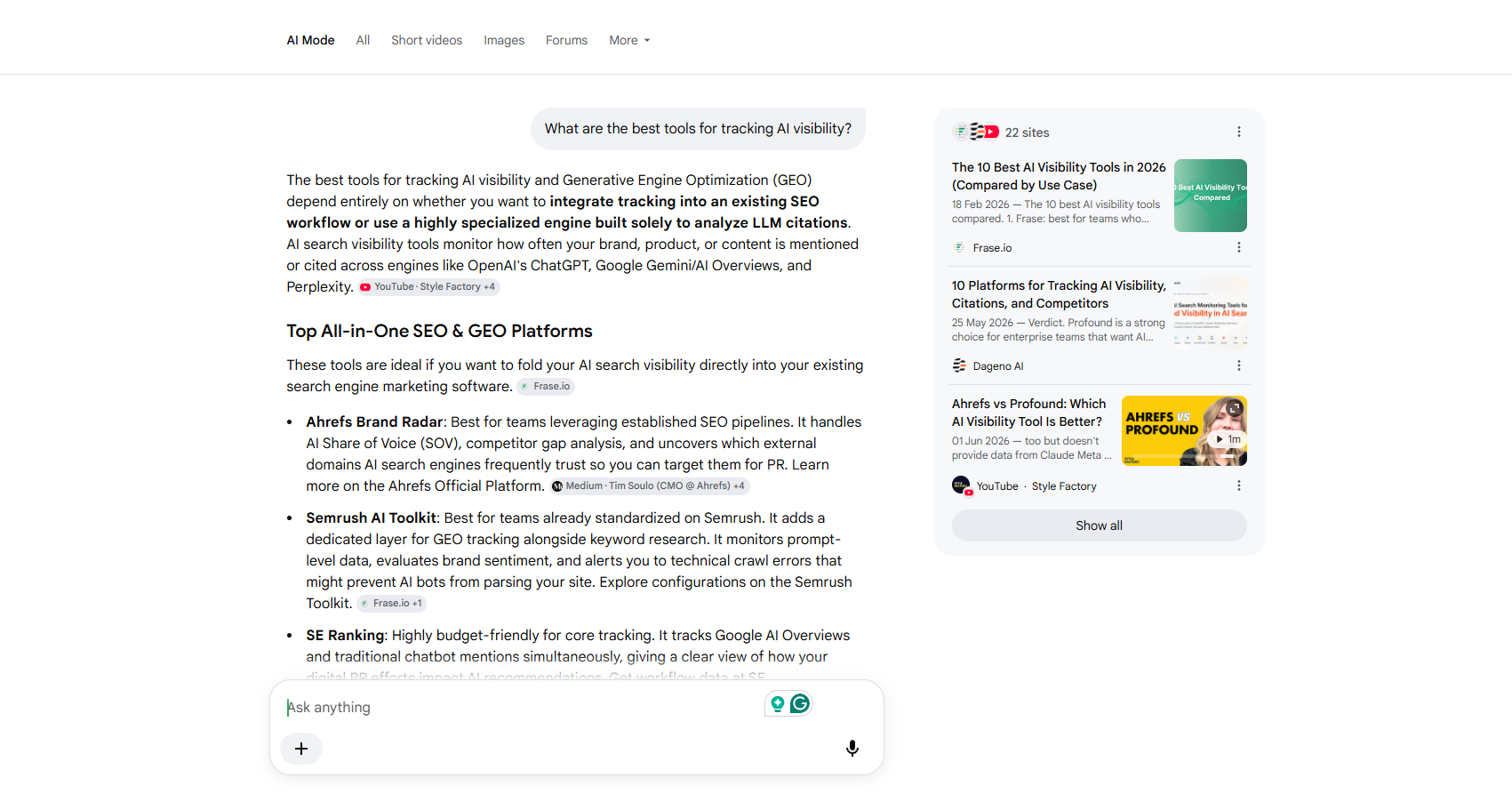
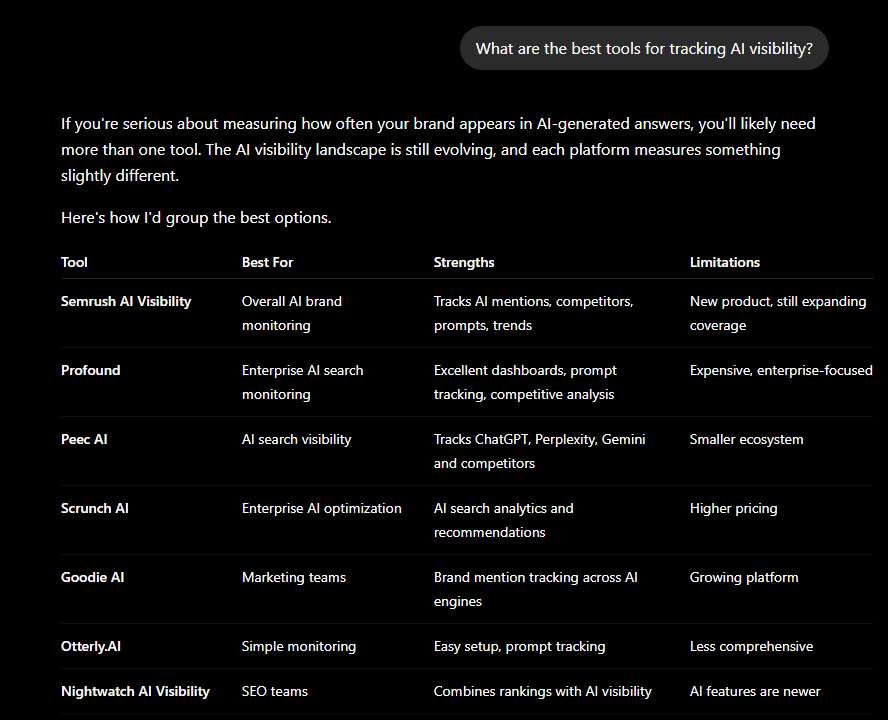
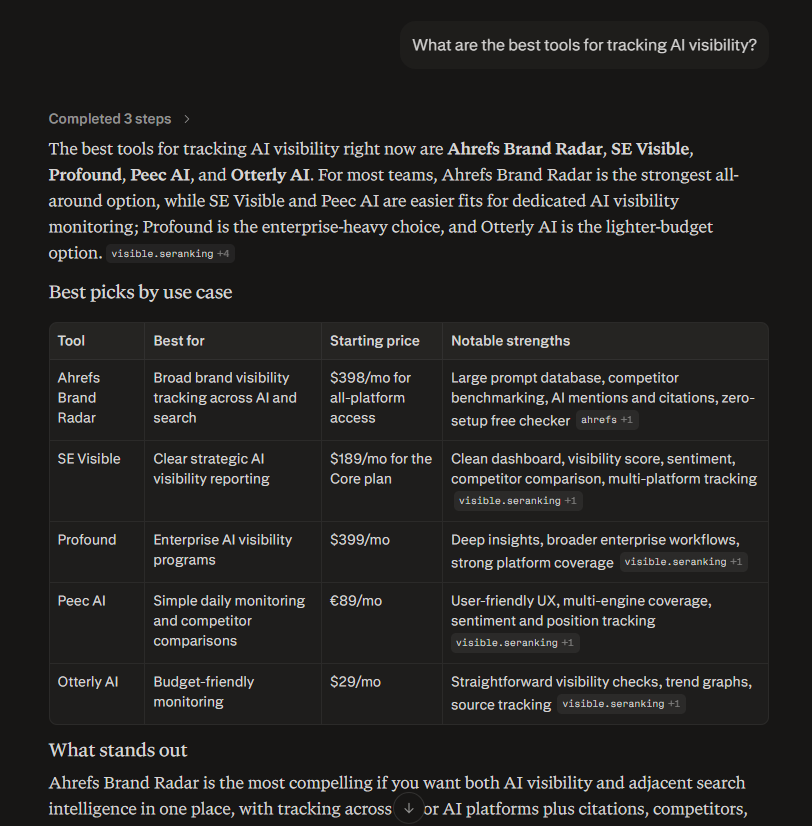
- “What are the best tools for tracking AI visibility?”
Check out these 3 different results from Google ai overviews, ChatGPT and Peplexity for the same question.
Googel Ai Mode
ChatGPT
Peplexity
In a traditional search journey, the person may have clicked through several websites, compared pages manually, and made their own shortlist from google search results.
In an AI-assisted journey, the shortlist may begin inside the answer, and 60% of Google searches now end without a click due to AI overviews, which is why optimizing content for answer engines is becoming critical.
But what does this mean for your brand?
This does not mean every AI mention leads directly to a sale. It does mean however that brand discovery is starting to happen inside AI summaries rather than only in search results, and brands not included in AI answers may be excluded from consideration.
This is why tracking AI visibility matters. It gives marketers another lens for understanding how brands are discovered, compared, and framed.
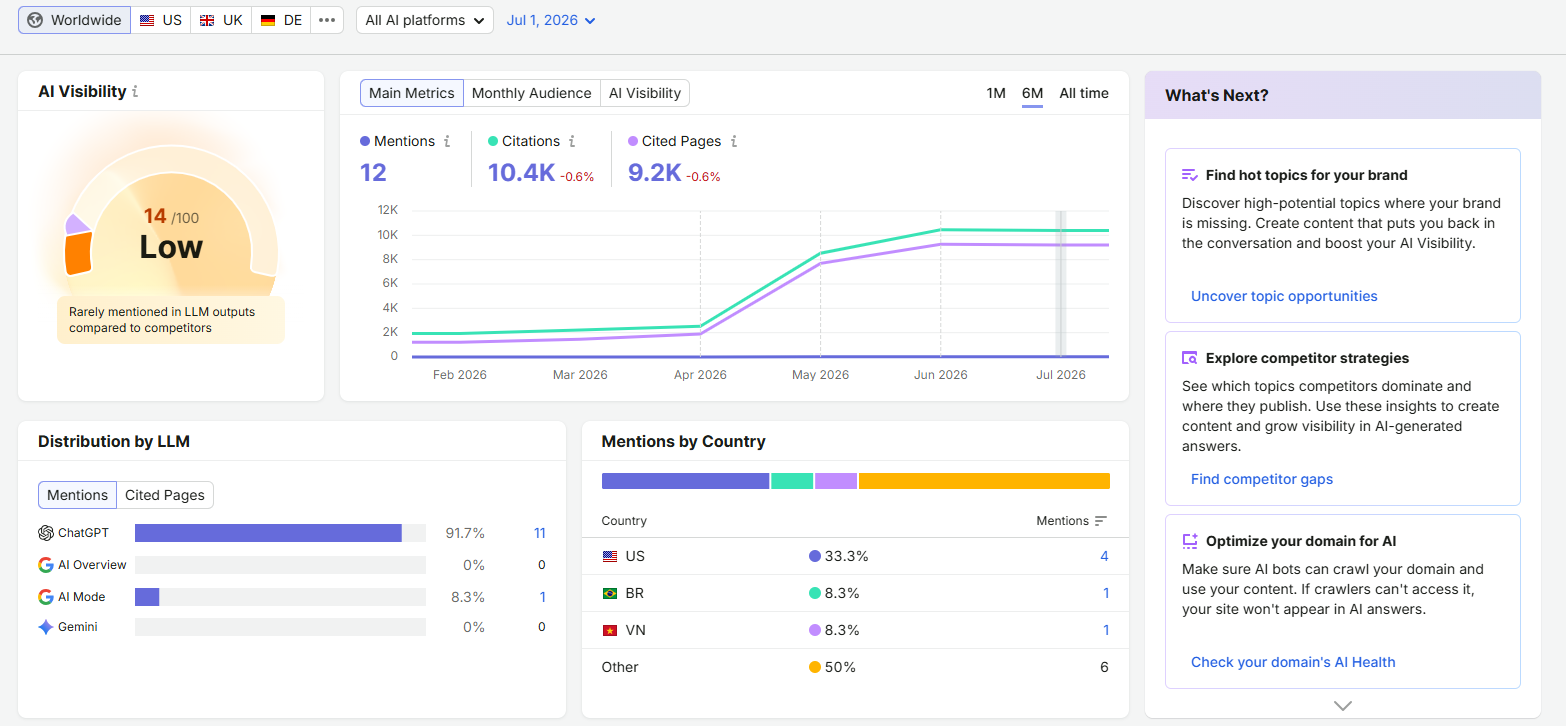
Semrush’s AI visibility study make this point clearly, brands need to monitor brand mentions, competitor presence, prompt-level visibility, sentiment, cited pages, and changes over time. In other words, the work is not just “Are we ranking?” It is also “Are we showing up in the answers that shape perception?”
Why Should you Track Ai Visibility?
Rankings Tell Part of the Story. AI Search Visibility Tells Another.
Traditional SEO metrics are still importatn because they show how your site performs in search engines. You still need to understand search demand, ranking movement, content performance, technical health, backlinks and their influence on AI visibility, and conversion paths.
But AI visibility adds another layer, including a way to benchmark your AI presence against competitors.
A page may rank well and still not be cited or mentioned in AI responses. A brand may have strong organic traffic but weak search visibility in AI-generated recommendations. A competitor may not dominate every traditional keyword, yet appear more often in AI answers because their brand is consistently mentioned across authoritative sources, comparison pages, reviews, directories, community discussions, and topical content. That makes ai search performance and broader search performance worth measuring beyond traffic alone.
That is the shift marketers need to understand.
AI systems do not only evaluate a single page in isolation. They may draw from a wider pattern of signals like content clarity, entity consistency, third-party mentions, structured information, topical authority built through topic clusters, trusted citations, and how clearly the web understands what a brand is known for.
So the question is not whether SEO still matters.
The better question is whether your SEO, content, brand, and digital PR signals are strong enough to support visibility across both traditional search and AI-assisted discovery.
The Real Risk: Your Competitors May Already Be Recommended
One of the most useful reasons to track AI visibility is competitive comparison.
If AI assistants consistently recommend your competitors and ignore your brand, that is worth understanding.
It may mean competitors have stronger topical authority or their content answers buyer questions more clearly. It may also mean they are mentioned more often in trusted third-party sources as ai mentions or their brand positioning is easier for AI systems to interpret.
Simply, it could mean you have not yet built enough visible evidence around the topics you want to own or are an authority in.
Either way, the insight is useful.
AI visibility tracking turns a vague concern into a practical question:
Where are our competitors appearing that we are not?
Tracking specific industry prompts helps businesses identify content gaps and visibility gaps.
That question can lead to better content strategy, stronger comparison pages, improved brand messaging, better digital PR, more structured information, and clearer topical coverage.
The point is not to panic every time a competitor appears in an AI answer. The point is to notice patterns. Only 30% of brands appear consistently across multiple AI responses, so repeat patterns matter more than single checks, and the same brand list rarely holds in the same order.
If competitors keep appearing for prompts that matter to your market, many of those appearances are ghost citations without the brand name, accounting for 73% of AI brand presence, so visibility analysis matters even more. They are strategic clues, and the right SEO tools for modern AI-driven search can help you uncover them at scale.
Accuracy Matters as Much as Visibility
Being mentioned by AI platforms is useful only if the mention is accurate.
If an AI search platfrom like ChatGPT describes your brand incorrectly, that is not visibility you can celebrate. It is a signal that your digital presence may be unclear, inconsistent, or underdeveloped.
For example, AI tools may misunderstand:
- Your service offering
- Your geographic focus
- Your ideal customer
- Your pricing position
- Your industry specialization
- Your relationship to competitors
- Your credibility or experience
- They can even confuse you with another brand with a similar name
This is especially important for businesses with nuanced positioning. A tourism marketing consultant, for example, does not want to be described as a generic social media freelancer if the real value is strategic digital growth, SEO, content systems, and direct booking infrastructure.
That kind of misrepresentation can weaken trust before a person ever reaches your website.
Tracking AI visibility helps you see not only whether your brand appears, but how it is being framed by assessing the accuracy, sentiment, and context of brand mentions, including whether ai describes your business correctly and where your brand shows up in AI-generated answers.
That is a different kind of brand audit. Stronger visibility and accuracy also help users get more reliable ‘best-of’ recommendations.
What Marketers Should Track
You do not need to overcomplicate AI visibility measurement at the beginning. Start with a practical set of AI-specific signal set and use it for repeated measurement and trend analysis alongside traditional search analytics.
Track which AI platforms mention your brand. This helps you understand where you are visible and where you are absent.
Track how often your brand appears for important prompts. Prompts are becoming similar to keywords in strategic value, but they are usually more conversational and intent-rich.
Track competitor mentions. If competitors are appearing more often, study the topics, sources, and phrasing connected to their visibility.
Track the topics that trigger mentions. This shows whether AI systems associate your brand with the areas you actually want to own.
Track cited pages and sources. If AI systems are referencing certain pages, those pages may deserve more investment. If competitors are being cited from sources where you are absent, that may reveal partnership, PR, directory, or content opportunities.
Track accuracy and sentiment. Visibility is not enough. You want your brand to be understood correctly and positioned in a way that reflects your actual value.
Track changes over time. One-off checks are useful, but trends are more powerful. You want to know whether visibility is improving, declining, or shifting by topic. AI-referred sessions convert 4.4x better than traditional organic traffic, which is why AI visibility is becoming an important metric alongside traditional search analytics.
This is where tools like Semrush’s AI Visibility Toolkit can be useful, because they give marketers a more structured way to benchmark brand mentions, compare competitors, review prompts, and monitor movement over time using visibility metrics, key metrics, visibility data, ai referral traffic, referral traffic, and ai referred sessions, similar to how I use Semrush to drive real SEO growth in day-to-day work.
AI Visibility Is a Strategy Signal, Not Just a Reporting Metric
The mistake would be treating AI visibility as another vanity metric.
The real value is not simply saying, “We appeared in AI answers 17 times this month.”
The real value is asking what that visibility tells you about your market position. It is also critical for managing risk and building competitive advantage through stronger business outcomes.
If you are absent from important prompts, you may need stronger content around buyer questions.
If competitors are mentioned more often, you may need to improve topical authority or third-party credibility across the AI models shaping search experiences.
If AI platforms misunderstand your brand, you may need clearer entity signals across your website, profiles, schema, bios, service pages, and external mentions, while monitoring AI interactions can also surface security, compliance, or risky AI behavior issues in AI outputs.
If certain pages are cited often, you may have content assets that can be expanded, refreshed, or connected more deliberately to conversion paths, and that same monitoring can show which tools or workflows are driving the most useful results.
If visibility is growing, it may indicate that your brand is becoming more recognizable across the digital ecosystem.
This is why AI visibility should sit close to strategy. It connects content, SEO, brand positioning, technical clarity, public relations, and audience trust, and continuous monitoring can also reveal declines in performance over time.
How to Start Measuring AI Visibility
A practical starting point is to build a simple AI visibility audit.
Choose 10 to 20 prompts your ideal audience might ask. These should include informational, comparison, recommendation, and decision-stage questions.
For example:
“Who are the best providers for [service]?”
“What should I look for when choosing a [category]?”
“Which companies help with [specific problem]?”
“What are the best tools for [task]?”
“How do I improve [outcome]?”
Then test those prompts across relevant AI platforms and record what happens.
Note whether your brand appears. Note which competitors appear. Note whether any sources are cited. Note how your brand is described. Note whether the answer is accurate, incomplete, or misleading.
From there, group the findings into practical actions:
- Content gaps to fill
- Pages to improve
- Topics to strengthen
- Brand descriptions to clarify
- Third-party sources to pursue
- Technical issues to investigate
- Competitor patterns to study
This does not need to become a heavy reporting exercise immediately. The first goal is awareness. You are trying to see what AI systems already “believe” about your brand and where your visibility is weak.
Once you see the pattern, you can build a smarter plan.
What This Means for Your Content Strategy
AI visibility changes the way we think about content.
A strong content strategy is no longer only about publishing articles that target keywords. It is about building a clear, consistent body of evidence around what your brand knows, does, solves, and stands for.
That means your website should explain your expertise clearly. Your service pages should be specific. Your blog should answer real buyer questions. Your author profiles should reinforce credibility and your external mentions should support the same positioning. As for your content architecture it should make your topical focus easy to understand.
Thats because AI systems need clarity.
If your brand is scattered, vague, or inconsistent, it becomes harder for AI tools to confidently associate you with the right topics, which is why building a strong, intentional online presence matters so much.
But if your digital presence is consistent, useful, and well-structured, you give both people and machines a better chance of understanding your authority.
That is not a shortcut. It is good strategy made more urgent by a new search environment.
The Marketer’s Mindset Shift
The most important shift is this:
You cannot optimize what you do not measure, and AI search visitors can buy at 2x the rate of organic search visitors accordign to searchable.
For years, marketers learned to ask, “Where do we rank?”
Now we also need to ask:
- Where are we mentioned?
- Where are we missing?
- How are we described?
- Who is being recommended instead?
- Which prompts matter most?
- Which topics are strengthening or weakening our visibility across ai traffic, direct traffic, and traditional organic traffic?
That is a more complete view of modern discovery, and trusted AI-generated content can also strengthen customer engagement.
AI visibility will not replace SEO measurement. But it will expand the measurement conversation.
Brands that understand this early will be better prepared to protect their presence, improve their authority, and spot competitive gaps before they become obvious in revenue reports.
The Takeaway
Your brand may already be appearing in AI answers.
It may also be missing from important conversations. It may be described inaccurately and losing visibility to competitors in prompts that shape awareness and consideration.
The only way to know is to measure it.
AI visibility is still an emerging performance signal, but it is already useful. It will help you see how brands are being interpreted inside AI experiences, where competitors are gaining ground, and which content or positioning gaps need your attention.
Traditional SEO still matters. Rankings, traffic, and conversions still matter.
But rankings tell part of the story.
AI visibility may tell another.
And for marketers who care about sustainable digital presence, that story is becoming too important to ignore.
Is your brand showing up in AI answers today?
FAQ: Why Tracking AI Visibility Matters
What is AI visibility?
AI visibility refers to how often, where, and in what context your brand appears in AI-generated answers across platforms like ChatGPT, Google AI Overviews, Gemini, and other AI answer engines. It measures your brand presence within AI-driven discovery.
Why is tracking AI visibility important?
Tracking AI visibility helps you understand whether your brand is being recommended, cited, and described accurately at the moments people are researching and making decisions with AI systems. It reveals gaps, competitor presence, and how AI systems interpret your brand.
How does AI visibility differ from traditional SEO?
Traditional SEO focuses on ranking pages and driving organic traffic, while AI visibility focuses on brand mentions inside AI-generated answers, which often synthesize information without requiring clicks. AI visibility metrics include mention frequency, sentiment accuracy, and citation share rather than rankings alone.
Which AI platforms should I monitor for visibility?
Major AI platforms to track include ChatGPT, Google AI Overviews, Gemini, Claude, and Perplexity. Monitoring multiple platforms provides a comprehensive view since AI visibility can vary across different engines and answer tools.
Can AI visibility impact conversions even without clicks?
Yes. AI visibility influences brand awareness, trust, and consideration before users visit your website. AI-referred sessions convert at higher rates than traditional traffic, making visibility in AI-generated answers a valuable factor in driving revenue.
How do I start tracking my brand’s AI visibility?
Begin by identifying key prompts your audience uses, then test those prompts across relevant AI platforms to see if and how your brand appears. Use AI visibility tools or trackers to monitor mentions, citations, sentiment, and competitor comparisons over time.