Google Search in 2026: The Latest Statistics Every SEO and Business Owner Should Know

Google Search is no longer just a list of blue links.
It is now a search engine, answer engine, shopping assistant, local discovery tool, visual search platform, and AI-powered research layer. That does not mean SEO is dead. It means the work of SEO has become more strategic.
The latest Google Search statistics show two truths at the same time: Google remains the dominant gateway to online discovery, but the way people interact with Google is changing quickly.
For brands, publishers, tourism businesses, nonprofits, service providers, and digital marketers, this matters because visibility is no longer only about ranking. It is about being found, trusted, cited, clicked, remembered, and chosen across a more complex search experience.
This article breaks down the latest Google Search statistics and, more importantly, explains what they mean for practical SEO, content strategy, AI search visibility, and digital growth.
Quick Summary: Latest Google Search Statistics
| Statistic | Latest figure |
| Google searches per year | More than 5 trillion |
| Brand-new daily searches | 15% of searches |
| Google global search host share | 88.67% in May 2026 |
| Google mobile search host share | 93.88% in May 2026 |
| Google Search & other revenue | $224.5 billion in 2025 |
| Google Search paid clicks growth | 6% in 2025 |
| Google Search cost-per-click growth | 7% in 2025 |
| AI Overviews monthly active users | More than 2.5 billion |
| AI Mode monthly active users | More than 1 billion |
| Google Lens visual searches | Nearly 20 billion per month |
| Lens searches that are shopping-related | 20% |
| U.S. Google searches ending without a click | 68.01% in early 2026 |
| AI Overview impact on top organic CTR | 58% lower CTR, according to Ahrefs |
| Pew study: clicks with AI summary present | 8% of visits |
| Pew study: clicks without AI summary | 15% of visits |
The lesson is clear: Google still matters enormously. But the old mental model of ranking highly and getting traffic is no longer enough.
Google Handles More Than 5 Trillion Searches Every Year
Google has stated that it sees more than 5 trillion searches every year, and that 15% of daily searches are brand new. In other words, even after more than two decades of search, people are still asking questions Google has never seen before.
That is a powerful reminder for content strategy.
Search is not static.
Your audience is not only typing the same obvious keywords into Google. They are asking longer, more specific, more situational questions. They are comparing options. They are looking for reassurance. They are trying to make decisions.
For a business, this means keyword research cannot stop at high-volume phrases. Some of the most valuable searches are specific, low-volume, high-intent questions that reveal what a customer is trying to do next.
A tourism business, for example, should not only chase a phrase like safari lodge Botswana. It should also answer the questions a real traveler asks before they are ready to book.
- Best time to visit the Okavango Delta for first-time travelers
- family-friendly safari lodge near Maun
- What to pack for a Botswana safari in July
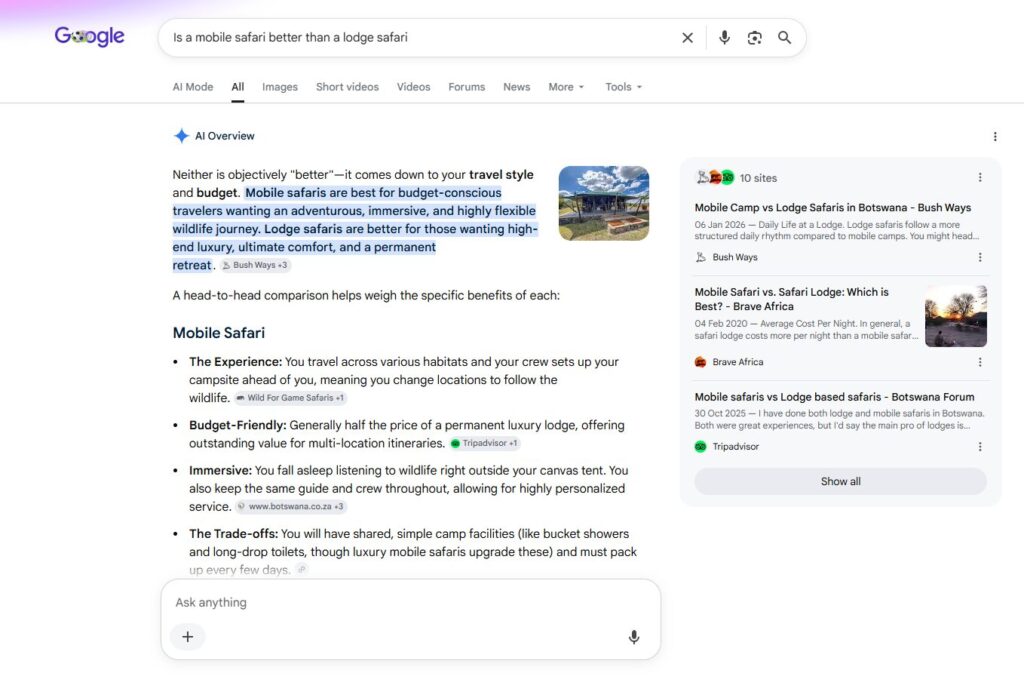
- Is a mobile safari better than a lodge safari
Google Still Dominates Global Search
According to StatCounter, Google held 88.67% of worldwide search engine host market share in May 2026, while Bing was at 4.82% and DuckDuckGo at 0.71%. On mobile, Google was even stronger, with 93.88% of worldwide mobile search engine host share in May 2026.
This matters because most businesses do not have unlimited marketing attention. You can and should think beyond Google, especially as AI platforms, social search, YouTube, Reddit, TikTok, marketplaces, and industry platforms influence discovery. But Google is still the platform most businesses cannot afford to ignore.
The practical takeaway is simple: build for a broader discovery ecosystem, but keep Google Search as a central pillar of your digital presence.
Google Search Is Still a Revenue Machine
Alphabet’s 2025 annual report shows that Google Search & other generated $224.5 billion in revenue in 2025, up from $198.1 billion in 2024. Alphabet also reported that Google Search & other revenue increased by $26.4 billion year over year.
The same filing reports that Google Search & other paid clicks increased 6%, while cost-per-click increased 7% in 2025. That tells us something important: search behavior may be changing, but commercial search is still extremely valuable.
People still go to Google when they are researching, comparing, shopping, booking, hiring, visiting, and deciding. The challenge is that Google is capturing more of that journey inside its own interface.
So the strategic question is no longer only, How do we get more traffic from Google? A better question is: How do we make our brand visible and credible wherever Google answers, summarizes, ranks, recommends, maps, cites, or monetizes the customer journey?
AI Overviews Have Reached Massive Scale
Google’s AI-powered search features are no longer experimental side projects. At Google I/O 2026, Sundar Pichai said AI Overviews now have more than 2.5 billion monthly active users, while AI Mode has surpassed 1 billion monthly active users.
Google also said AI Mode queries have been more than doubling every quarter since launch, and that Search queries reached an all-time high in the previous quarter.
This is one of the biggest shifts in search history. AI Overviews change the search results page from a navigation page into an answer page. Instead of simply showing links, Google often summarizes the topic directly and cites selected sources.
That creates a new visibility layer. Ranking still matters, but being cited, summarized, and trusted by AI-powered search features is becoming part of modern SEO.
Google’s own Search Central guidance says its generative AI features are rooted in core Search ranking and quality systems, and that the fundamentals of SEO still apply. Google specifically points to valuable, non-commodity content, technical accessibility, crawlability, page experience, and clear business or product information as important foundations.
This is where many brands will make a mistake. They will chase AI SEO hacks instead of strengthening the actual substance of their digital presence.
AI Overviews Reduce Clicks
The most uncomfortable Google Search statistic for publishers and marketers is not about market share. It is about clicks.
Pew Research Center analyzed 68,879 Google searches and found that 18% produced an AI summary. When users encountered an AI summary, they clicked a traditional search result in 8% of visits. When no AI summary appeared, they clicked a traditional result in 15% of visits.
Pew also found that users clicked a link inside the AI summary itself in only 1% of visits, and that users were more likely to end their browsing session after seeing an AI summary: 26% versus 16% for traditional search results pages.
Ahrefs found a similar pattern from an SEO performance perspective. In a February 2026 update, Ahrefs reported that AI Overviews correlated with a 58% lower average click-through rate for the top-ranking page.
This does not mean organic search has no value. It means the value has changed. A page can influence a buyer without receiving the click. A brand can be cited in an AI answer.
A helpful article can shape the language Google uses to explain a topic. A local business can be discovered through Maps, reviews, images, snippets, and business profile data before a user ever visits the website.
This is why SEO reporting needs to mature. Traffic still matters, but it is no longer the only signal of search value.
Zero-Click Search Is Accelerating
SparkToro’s 2026 analysis, using Similarweb panel data, estimated that 68.01% of U.S. Google searches in the first four months of 2026 ended without a click. The report notes that the dataset covered desktop and mobile web searches, not the Google mobile search app, so the exact number should be read with that limitation in mind.
This is part of a larger trend. Google is increasingly answering questions directly through AI Overviews, featured snippets, knowledge panels, local packs, product results, maps, images, videos, and other result features.
For brands, this creates a strategic tension. On one hand, fewer clicks can mean less website traffic. On the other hand, Google remains one of the most powerful environments for brand discovery and decision support.
So the goal is not simply to fight zero-click search. The goal is to adapt your content and measurement model.
- Build content that is worth citing, not just content that targets keywords.
- Strengthen brand demand so people search for you by name.
- Use Google Business Profile, product feeds, structured data, images, video, and reviews where relevant.
- Track leads, bookings, branded search, assisted conversions, and direct enquiries, not only organic sessions.
- Treat your website as the source of truth that supports visibility across search, AI, social, and sales conversations.
Longer Queries Trigger More AI Summaries
Pew found that longer and more conversational searches are more likely to produce AI summaries. Only 8% of one- or two-word searches generated an AI summary, but 53% of searches with 10 words or more did.
This is a major clue for content strategy. AI search is not only changing where answers appear. It is changing the kind of queries that matter. People are asking fuller questions because the search experience can now handle them.
Instead of typing SEO statistics, a user may ask: what are the latest Google search statistics for SEO strategy in 2026? Instead of typing Botswana safari lodge, a traveler may ask: which Botswana safari lodge is best for a first-time visitor who wants wildlife, comfort, and easy transfers?
This rewards content that is clear, specific, well-structured, and genuinely helpful. Thin pages built around exact-match keywords are less useful in this environment. Expert-led pages that answer real questions with nuance are more likely to survive.
Visual Search Is Now a Serious Discovery Channel
Google Lens is also changing how people search. Google has said Lens is used for nearly 20 billion visual searches every month, and that 20% of Lens searches are shopping-related.
This matters for ecommerce, local businesses, tourism, hospitality, fashion, food, interiors, destinations, and any business where visuals influence trust.
Search is no longer only text. People can search with a camera, screenshot, product image, landmark, menu, outfit, room, or object.
For businesses, that means visual content is not decoration. It is a discoverability infrastructure. A hotel’s room photos, a tour operator’s destination images, a restaurant’s menu photography, a product brand’s image quality, and a local business’s visual consistency all influence how discoverable and persuasive the business becomes.
If your visuals are poor, outdated, generic, or missing, you are not just weakening your brand. You may also be weakening your search presence.
What These Google Search Statistics Mean for SEO Strategy
The big mistake is to look at these numbers and conclude that SEO is finished. It is not. But shallow SEO is under pressure.
The old approach was often: find keywords, write articles, build links, rank, and get clicks. That still works in some categories, especially for branded, local, commercial, and high-intent searches. But it is no longer enough on its own.
Modern SEO needs to operate more like a digital visibility system.
A Practical SEO Framework for 2026
- Search intent architecture: Build content around the real stages of decision-making: problem awareness, comparison, planning, buying, booking, implementation, and troubleshooting.
- Topical authority: Do not publish isolated articles. Build connected content clusters that show depth around your core expertise.
- AI-citable content: Write clear, specific, well-supported explanations that AI systems can confidently summarize or cite.
- Technical clarity: Make sure Google can crawl, render, index, and understand your pages. Technical SEO is still the foundation.
- Brand signals: Invest in reputation, reviews, mentions, social proof, author credibility, and consistent positioning.
- Visual and multimodal content: Use high-quality images, video, diagrams, product visuals, destination photography, and structured media where relevant.
- Conversion paths: Do not obsess over traffic if your website fails to convert. Make enquiries, bookings, calls, downloads, and next steps clear.
- Better measurement: Track branded search, lead quality, assisted conversions, AI visibility, Google Business Profile interactions, direct traffic, and sales outcomes.
Recommended SEO Actions After Reading These Statistics
- Audit your top organic pages for AI Overview exposure and declining click-through rates.
- Update important informational content with clearer definitions, stronger examples, expert commentary, and source-backed claims.
- Create content clusters around your most commercially important topics instead of publishing disconnected blog posts.
- Improve your Google Business Profile, reviews, images, products, services, and location data if local discovery matters to your business.
- Add original visuals, screenshots, charts, product images, and destination photos where they genuinely help the reader.
- Measure branded search, enquiries, assisted conversions, and lead quality alongside organic sessions.
- Build direct audience assets such as email lists, lead magnets, community touchpoints, and owned content hubs so your growth does not depend entirely on search clicks.
FAQ: Google Search Statistics and SEO in 2026
How many searches does Google process every year?
Google has said it sees more than 5 trillion searches every year. That works out to billions of searches every day, although daily estimates vary depending on methodology and source.
What percentage of Google searches are brand new?
Google has said 15% of searches each day are brand new. This means people continue to ask new, specific, and unusual questions, which is why content strategy should go beyond obvious high-volume keywords.
What is Google’s search market share in 2026?
StatCounter reported Google at 88.67% of worldwide search engine host market share in May 2026. On mobile, Google was stronger at 93.88%.
Are AI Overviews reducing organic traffic?
Multiple studies suggest that AI Overviews reduce clicks to traditional organic results. Pew found users clicked traditional results less often when AI summaries appeared, and Ahrefs found a 58% lower average click-through rate for the top-ranking page when AI Overviews were present.
Does SEO still matter with AI Overviews?
Yes. Google’s own guidance says generative AI features in Search are rooted in core ranking and quality systems. Foundational SEO still matters, but content now needs to be more useful, structured, credible, and worthy of being cited or summarized.
What is zero-click search?
Zero-click search happens when a user searches Google but does not click through to a website. This can happen because Google answers the query directly, the user refines the search, or the session ends on the results page.
How should businesses adapt to Google Search in 2026?
Businesses should build content around real intent, strengthen topical authority, improve technical SEO, invest in brand signals, use strong visual assets, and measure both influence and traffic.
The Strategic Takeaway
The latest Google Search statistics tell a clear story.
Google is still dominant. It still processes searches at a scale no competitor has matched. It still drives commercial discovery. It is still one of the most important platforms for business visibility.
But Google Search is becoming more answer-driven, AI-powered, visual, conversational, and zero-click. That means your digital strategy has to mature.
You are no longer creating content only to win a blue link. You are creating assets that help your brand become part of how people learn, compare, decide, and trust.
The brands that win from here will not be the ones publishing the most content. They will be the ones publishing the most useful content, supported by strong technical foundations, clear positioning, credible expertise, visual depth, and a system that turns visibility into real business outcomes.
SEO is not dead. But the easy version of SEO is fading. And for serious brands, that is not bad news. It is an invitation to build something stronger.
Sources
Statistics in this article were verified against the following public sources.
- Google remarks on annual searches and new daily searches
- StatCounter global search engine host market share
- StatCounter mobile search engine host market share
- Alphabet 2025 Form 10-K
- Google I/O 2026 Sundar Pichai keynote
- Google Search I/O 2026 updates:
- Google Search Central guidance for generative AI features:
- Pew Research Center study on AI summaries and clicks
- Ahrefs study update on AI Overviews and CTR
- SparkToro 2026 zero-click search analysis
- Google Lens and AI Overviews for marketers