How I Structure Topic Clusters for SEO and AI Visibility
A step-by-step guide to building topic clusters that improve SEO performance and AI visibility using Semrush.


SEO is no longer just about ranking pages.
It’s about building systems of content that search engines and now AI systems can understand, trust, and surface.
That’s where topic clusters come in.
In this guide, I’ll break down exactly how I structure topic clusters using Semrush to build topical authority, improve rankings, and increase AI visibility.
But more importantly, I’ll show you how to think about clusters the way search engines and AI actually see them.
What Are Topic Clusters (And Why They Matter Now)
A topic cluster is a structured group of content built around a central theme.
But more than that, it’s a way of organizing your website so that both search engines and AI systems can clearly understand what you’re an authority on.
Instead of publishing disconnected articles, you’re building a connected ecosystem of content that reinforces itself.
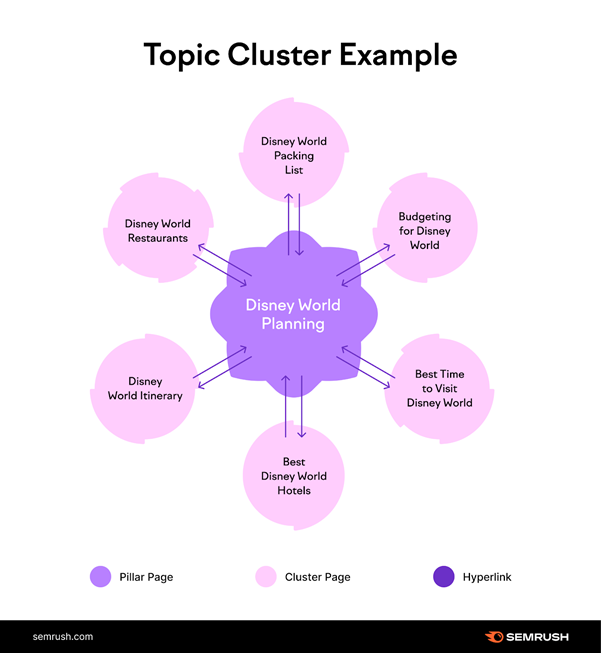
- At a high level, a cluster is made up of three core components:
- A pillar page covers the main topic broadly
- Cluster pages cover specific subtopics in depth
- Internal links connect everything into a clear structure
This structure creates context.
- And context is what both Google and AI models rely on to decide:
- What your site is about
- Whether you’re credible
- Whether your content should be surfaced or cited
This does two things:
- Helps Google understand your expertise
- Helps AI systems (like ChatGPT, Perplexity, and Google AI Overviews) understand your authority and context
Why Topic Clusters Matter More in the AI Era
AI systems don’t just rank pages.
They interpret, summarize, and extract information.
That means they need structured, well-connected content to confidently pull from.
What AI search engine does is:
- Extract answers
- Identify trusted sources
- Pull from structured content ecosystems
- If your content is scattered, you might rank… but you won’t get cited.
If your content is clustered, you increase your chances of:
Being referenced in AI answers
Owning a topic (not just a keyword)
The Real Shift: From Keywords to Topics
Traditional SEO:
Find keyword
Create page
Rank
Modern SEO and AIEO is more like:
- Define topic
- Build ecosystem
- Earn visibility
This is the shift most people are missing.

My Topic Cluster Workflow (Step-by-Step)
Here’s the exact system I use.
Step 1: Start With a Core Topic
I don’t start with keywords.
I start with a business-aligned topic.
Ask:
What do I want to be known for?
What topics drive revenue or authority?
Examples:
- “Wildlife Photography”
- “Safari Planning”
- “CRM Software”
This becomes your pillar page.
Step 2: Validate Demand With Semrush
Once I have a topic, I don’t jump into content creation immediately.
I validate whether that topic actually has search demand and visibility potential.
This is where most people go wrong: they assume a topic is valuable without checking the data.
Next, I validate the topic using:
- Keyword Overview
- Keyword Magic Tool
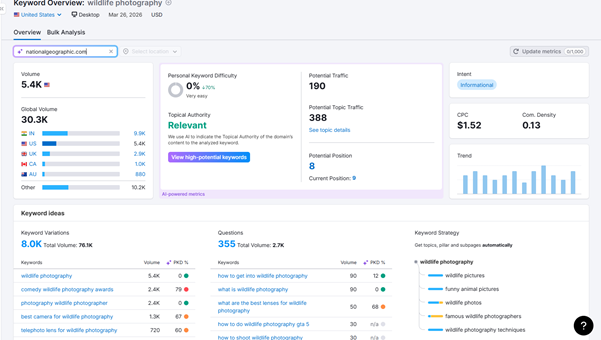
I check for:
- Search volume
- Keyword difficulty
- Intent
- SERP structure
This step helps me understand:
- Is this topic worth pursuing?
- Is it too competitive?
- Are there gaps I can realistically win?
If there’s no demand or weak intent, I pivot early.
This saves months of wasted content production.
Step 3: Group Keywords by Intent (Not Just Similarity)
This is where topic clustering becomes strategic.
Most SEO workflows stop at collecting keywords.
But the real advantage comes from how you group them.
This is the biggest upgrade in my workflow.
Most people group keywords like this: (Similar wording = same page) sometimes leading to keyword stuffing
I group like this ( Same intent = same page)
Why? Because Google and AI rank intent, not wording.
They’re trying to understand what the user actually wants, not just match keywords.
Example:
“Best camera for wildlife photography”: commercial
“How to photograph wildlife”: informational
These should NEVER be on the same page.
When you get this right, your content becomes:
- More relevant
- Easier to rank
- Easier for AI to interpret
That’s the difference between content that ranks and content that dominates.
Step 4: Map the Cluster Structure
Before writing anything, I map the cluster.
Structure:
- 1 Pillar page
- 5–20 Cluster pages
Each cluster must:
- Target a unique intent
- Answer a specific question
- Support the pillar
This step turns random content into a strategy.
Step 5: Build the Pillar Page
The pillar page:
- Covers the topic broadly
- Introduces all subtopics
- Links to every cluster page
Key elements:
- Clear headings
- Summary sections
- Internal links
- High-level coverage
Think of it as:
The homepage for your topic.
Step 6: Create Cluster Pages
Each cluster page goes deep.
It should:
- Solve one problem
- Answer one intent
- Be better than competitors
Example cluster pages:
- Best cameras for wildlife photography
- Wildlife photography tips for beginners
- Camera settings for wildlife photography
Each page focuses on one angle, one purpose.
Step 7: Internal Linking Strategy (Critical for AEO)
This is one of the most underestimated parts of SEO.
You can have great content, great keywords, and still fail… because nothing is connected.
Internal linking is what turns individual pages into a cluster system.
This is where most SEO strategies break.
My linking system:
- Pillar links to all clusters
- Clusters link back to pillar
- Clusters cross-link where relevant
Why it matters:
- Helps Google understand relationships
- Helps AI understand context
- Distributes authority across pages
It also improves:
- Crawlability
- User navigation
- Engagement signals
- IF there are no internal links you do not have a cluster.
Step 8: Optimize for SEO + AI
Now I optimize content using:
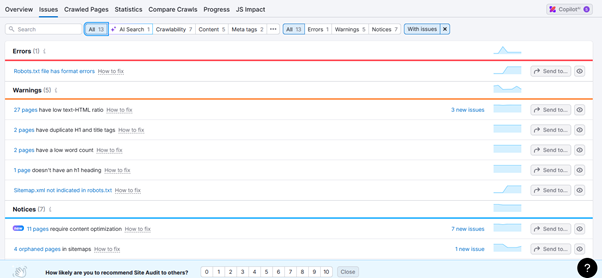
The Semrush SEO Writing Assistant is a great tool for achieving this.
On-page SEO recommendations in the SEO Audit also have great information for what’s truly missing for your site to outperform your competitors.
But I also optimize for AI:
- Clear answers (for extraction)
- Structured headings
- Concise summaries
- Context-rich explanations
Ask yourself this question when writing and optimizing your content:
Would an AI easily quote this section?
Step 9: Track Performance by Cluster
I don’t track keywords in isolation anymore.
I track:
- Topic performance
- Cluster visibility
- Ranking distribution
Using:
Position Tracking (tagged clusters)
AI visibility insights
Because:
One-page ranking doesn’t mean you own the topic.
Step 10: Expand and Refine Continuously
Clusters are living systems.
To always stay ahead of my search competitors, I continuously add missing subtopics, improve weak content, and update outdated content. Doing this ensures you are always ahead.
Using Semrush:
- Keyword gaps
- Content gaps
- Competitive analysis
This is how clusters turn into authority over time.
Here are some Common Mistakes to Avoid
Even with a solid strategy, there are a few mistakes that can completely break your cluster performance.
Most of these come from treating content as isolated pieces instead of a connected system.
Here’s where most people go wrong:
- Creating isolated blog posts (Orphaned Posts)
- Ignoring search intent
- Weak or no internal linking
- Overlapping content (keyword cannibalization)
- Not updating clusters
Each of these weakens your authority and confuses both search engines and AI systems.
Fix these, and your results improve fast.
The Biggest Shift: From Pages to Systems
The biggest change in SEO right now is that we’re no longer optimizing pages.
We’re building content ecosystems.
That’s because building topic clusters improves rankings, strengthen topical authority and results in an increase in AI visibility.
Final Thoughts
If you’re still creating content page-by-page, you’re already behind.
The real advantage now comes from:
- Structure
- Intent mapping
- Internal linking
- System-level optimization
That’s what topic clusters give you.
Frequently Asked Questions
What is a topic cluster?
A topic cluster is a group of related content built around a central pillar page, connected through internal links.
Why are topic clusters important for AI search?
They help AI systems understand context, relationships between content, and authority on a subject.
How many pages should a topic cluster have?
Typically 5–20 cluster pages supporting one pillar page, depending on topic depth.
What tool can I use to build topic clusters?
Semrush provides keyword research, clustering, and performance tracking tools to structure and optimize clusters.