What is Agentic Commerce? What to Know in the Ecommerce Industry
Discover how agentic commerce can enhance your shopping experience by empowering choices and personalizing interactions. Learn more in the article!

The ecommerce industry has spent the last two decades optimizing for one thing: discovery.
Brands invested heavily in SEO, paid advertising, marketplaces, content marketing, and social media because the goal was straightforward get your product in front of potential customers and convince them to buy.
That model is beginning to change.
Artificial intelligence is introducing a new layer between consumers and products. Instead of searching, browsing, comparing, and evaluating products themselves, consumers are increasingly relying on AI systems to do the work for them.
Today, AI assistants can summarize reviews, compare products, answer buying questions, and recommend solutions. Tomorrow, they may handle the entire purchasing process.
This shift is giving rise to what many are calling agentic commerce.
For ecommerce businesses, marketers, and SEO professionals, agentic commerce represents one of the most important changes in online shopping since the emergence of search engines themselves.
The question is no longer simply:
“How do customers find my products?”
The question is becoming:
“How do AI systems decide my products are worth recommending?”
What Is Agentic Commerce?
Agentic commerce refers to commerce experiences where AI agents actively participate in product discovery, evaluation, recommendation, and purchasing decisions.
Rather than manually researching products, users can delegate these tasks to intelligent systems.
For example, a customer may ask:
- What is the best laptop for graphic design under $1,500?
- Which CRM platform is best for a small business?
- Find me a highly rated standing desk with free shipping.
- Order replacement ink cartridges for my printer.
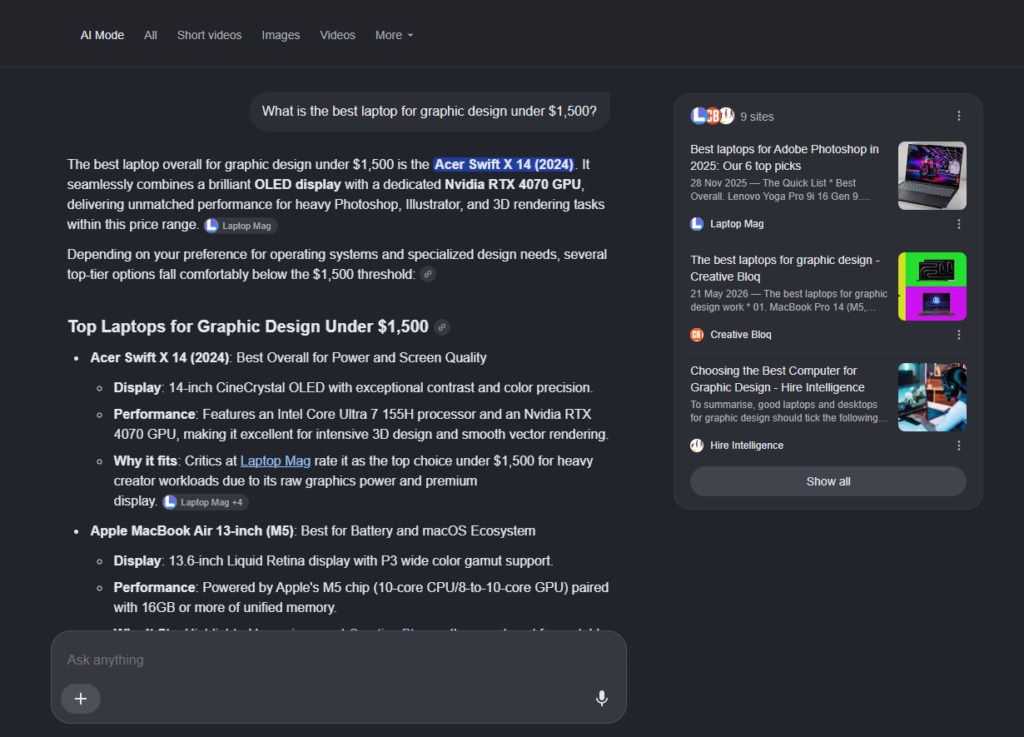
Instead of displaying ten blue links, AI systems can:
- Research options
- Compare features
- Analyze reviews
- Evaluate pricing
- Consider user preferences
- Recommend products
- Complete purchases
The user receives recommendations rather than search results.
That distinction matters.
Traditional ecommerce optimized for visibility.
Agentic commerce optimizes for recommendation.
Why This Matters More Than Most Businesses Realize
Many ecommerce companies still view AI through the lens of content generation.
They think about AI writing product descriptions or creating marketing copy.
The bigger disruption is happening elsewhere.
AI is beginning to influence buying decisions.
Historically, customers controlled most of the decision-making process.
They searched.
They compared.
They read reviews.
They visited websites.
They made decisions.
Agentic commerce transfers much of that responsibility to AI systems.
As a result, the criteria for visibility are changing.
Products are no longer competing only for customer attention.
They are competing for algorithmic confidence.
AI agents must be able to understand, trust, and justify recommendations.
That changes everything.
The Shift From Product Discovery to Product Selection
One of the most important insights from studying AI search and ecommerce is that product discovery is slowly being replaced by product selection.
In traditional search:
- User enters query.
- Search engine returns options.
- User evaluates results.
- User makes decision.
In agentic commerce:
- User states goal.
- AI evaluates options.
- AI recommends products.
- User approves decision.
Notice what disappears.
The evaluation phase.
The customer may never see hundreds of available products.
They may only see three.
Or one.
This creates a dramatic shift in competitive dynamics, especially as modern AI search systems interpret user intent and evaluate products differently from traditional keyword-based search.
Previously, ranking on page one might have been enough.
Now businesses may need to become one of a handful of products that AI systems actively recommend.
That is a much smaller opportunity set.
The Rise of Winner-Takes-Most Markets
Agentic commerce naturally creates concentration.
Search engines provide many opportunities for visibility.
AI assistants provide fewer.
If an AI system recommends:
- Three accounting platforms
- Two CRM systems
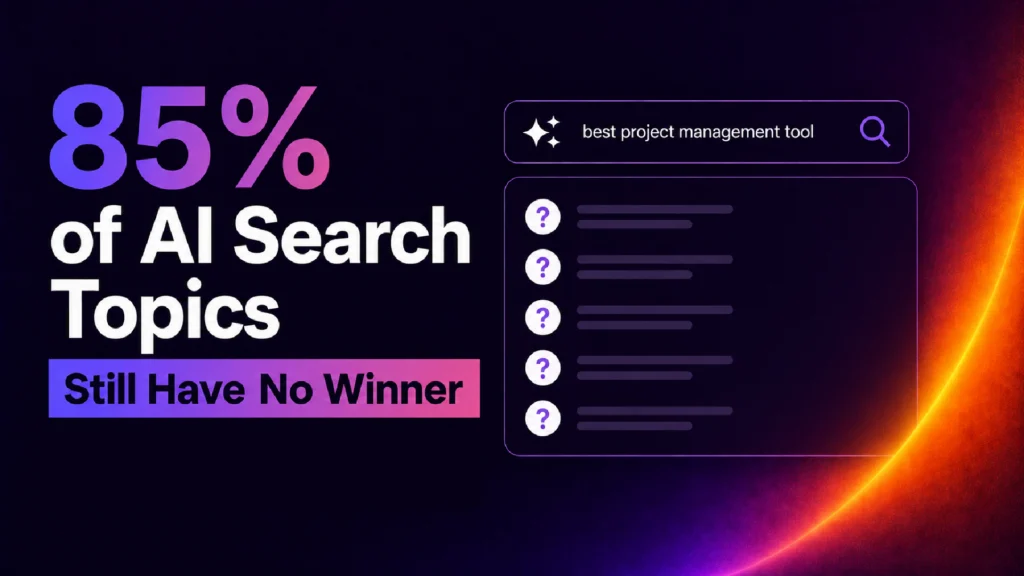
- Four project management tools
- One ecommerce solution
The market becomes more concentrated around those recommendations.
This creates winner-takes-most dynamics.
Businesses that become trusted recommendations may capture disproportionate market share.
Businesses that fail to earn recommendations may become effectively invisible.
This is why AI visibility is becoming a strategic business issue rather than just a marketing issue.
Why Structured Product Data Is Becoming Essential
Humans can fill information gaps.
AI systems cannot.
When AI evaluates products, it relies heavily on structured, machine-readable information, and many businesses are now thinking in terms of optimizing content for answer engines so those systems can reliably surface and cite their product data.
This includes:
- Product specifications
- Technical attributes
- Pricing
- Availability
- Shipping information
- Product categories
- Compatibility information
- Manufacturer details
The same structured product and inventory data can also support predictive inventory and logistics management, helping retailers improve real time availability across digital commerce systems.
The more structured and accessible this information is, the easier it becomes for ai powered systems to understand products.
Many e commerce platforms still prioritize visual design over machine readability.
That approach becomes risky in an AI-driven environment, especially as commerce platforms depend more on customer data to support autonomous decisions.
Product pages increasingly need to serve two audiences:
- Human buyers
- AI systems
The businesses that optimize for both will gain an advantage, especially when they organize their content into topic clusters for SEO and AI visibility that clearly signal expertise around key product categories.
Reviews Are Becoming Recommendation Signals for AI Shopping Assistants
Reviews have always mattered.
In agentic commerce, they matter even more.
AI systems often evaluate customer feedback when determining recommendations.
They can analyze:
- Review volume
- Review quality
- Sentiment patterns
- Common complaints
- Product strengths
- Customer satisfaction trends
A product with thousands of positive reviews creates stronger recommendation confidence than a product with limited feedback.
This means customer reviews are no longer simply conversion assets.
They are visibility assets.
Reviews influence not only human purchasing decisions but also AI purchasing recommendations.
Entity Clarity Will Separate Winners From Losers
One concept that continues to grow in importance is entity clarity.
AI systems understand the world through entities rather than keywords alone.
An entity can be:
- A product
- A brand
- A company
- A category
- A location
- A person
The clearer your product and brand entities are, the easier it becomes for AI systems to understand:
- What your company does
- What products you sell
- Which categories you belong to
- How your products compare to competitors
Entity confusion creates recommendation risk.
Entity clarity creates recommendation confidence.
This is one reason why consistent brand information across websites, directories, marketplaces, social platforms, and review sites has become increasingly important.
Why Brand Reputation Matters More in an AI-Driven Market
Trust has always influenced purchasing decisions.
AI systems are now becoming trust evaluators.
When AI agents recommend products, they often assess signals tied to the broader customer experience, such as:
- Brand mentions
- Review quality
- Industry authority
- Expert opinions
- Customer sentiment
- Third-party validation
Reputation now shapes the entire customer journey, not just the final conversion moment.
Strong brands create stronger recommendation signals.
Weak brands create uncertainty.
This means brand building is no longer separate from SEO or ecommerce strategy, and it increasingly overlaps with building a strong online presence that reinforces trust signals across every channel.
Brand authority is becoming an input into AI recommendation systems, where signals like backlinks and link-based authority still help AI decide which brands are most trustworthy.
The Emergence of Agentic Commerce Protocol and Agent-Ready Commerce
One of the most overlooked concepts in ecommerce today is agent readiness.
Most ecommerce experiences were designed for humans.
AI agents have different requirements. Autonomous agents need both machine-readable commerce data and payment systems built for delegated decision-making.
Agent-ready businesses focus on aligning their infrastructure with broader AI search trends shaping visibility and trust:
Existing payments infrastructure was built for human-led checkout and now must adapt to support agent initiated transactions and agentic payments.
Clean Product Data
Structured information that machines can easily interpret, giving autonomous AI agents, shopping assistants, and commerce agents the clean product data they need to perform complex tasks with minimal human input, including when that data is exposed through the model context protocol so AI systems can access product context consistently.
This also helps enable agents to reason across product attributes with a deep understanding of the catalog.
Accurate Inventory Information
Real-time product availability across multiple systems so AI agents can validate stock before they complete transactions.
This is especially important for consistency across sales channels.
Consistent Pricing
Reliable pricing across platforms matters when a shopping agent or other agents compare options across AI channels. Automated agents may also evaluate loyalty discounts during recommendation and purchase flows.
Transparent Policies
Shipping, returns, warranties, and guarantees that are easy to understand, so transparent policies help ai shopping assistants and other ai shopping tools act on the user’s behalf with less need for human intervention, while helping users decide which payment credentials they are comfortable delegating to AI agents. Clear policies also support natural language interactions, since users can ask policy questions conversationally and get precise answers. Transparent policies also strengthen audit trails and fraud detection when agents complete purchases on a user’s behalf.
Machine-Readable Content
Clear information architecture and schema markup that make your content machine-readable also prepare your business for agent interactions across AI tools and agentic commerce tools, much like the fundamentals of how search engines crawl, index, and rank content.
Adoption of agentic commerce will also require this content layer to connect with open protocols and payment networks, as ai platforms and payment providers rely on an agent to agent protocol to exchange data and coordinate transactions across systems.
The easier it is for AI systems to understand your business, the easier it becomes for them to recommend it.
How SEO Is Evolving Because of Agentic Commerce
For years, SEO focused heavily on rankings.
While rankings still matter, AI-driven discovery introduces additional priorities. In this new era, SEO must account for how AI agents operate across buying journeys, not just how search engines index pages.
Today, I think about SEO through three lenses, informed by emerging AI search visibility statistics for 2026 that show how quickly behavior is shifting toward AI-generated answers:
Discoverability
Can search engines find your content?
Understandability
Can AI systems understand your content? Their interpretation increasingly depends on how well your content aligns with natural language, how behavioral data shapes context, how generative AI structures outputs, and how agentic AI reasons across those signals, especially when agents handle multi-step tasks across product, pricing, and checkout data.
Recommendability
Will AI systems recommend your products?
The third question is becoming increasingly important. Recommendability increasingly depends on whether ai agents acting as decision-makers are evaluating options rather than simply serving as search assistants.
Ranking alone may not guarantee visibility in agentic environments. Businesses must optimize for software-led buying journeys, not just humans. Recommendability increasingly depends on whether an agent completes the purchase flow reliably, not just whether it surfaces the product.
Businesses must also build trust, authority, and clarity.
How I Am Preparing for Agentic Commerce
One thing that has changed in my own approach is where I spend my optimization effort.
I still care about rankings.
But I increasingly focus on:
- Entity optimization
- Structured product information
- Brand authority
- Customer reviews
- Topical authority
- Consistent business data
- AI visibility signals
These efforts improve operational efficiency and can support faster time to market as ecommerce teams adapt to agentic commerce, while also strengthening the kind of technical SEO and AI visibility foundations that help agents reliably interpret your site.
That preparation also supports business development by freeing teams to focus more on growth and innovation.
The goal is no longer simply attracting traffic.
The goal is becoming the most trustworthy recommendation.
That subtle shift changes how content, SEO, branding, and ecommerce strategy come together.
Where Semrush Fits Into This Evolution
As AI-driven commerce grows, visibility analysis becomes even more important.
I use Semrush to, following a similar workflow to how I use Semrush to drive real SEO growth, to:
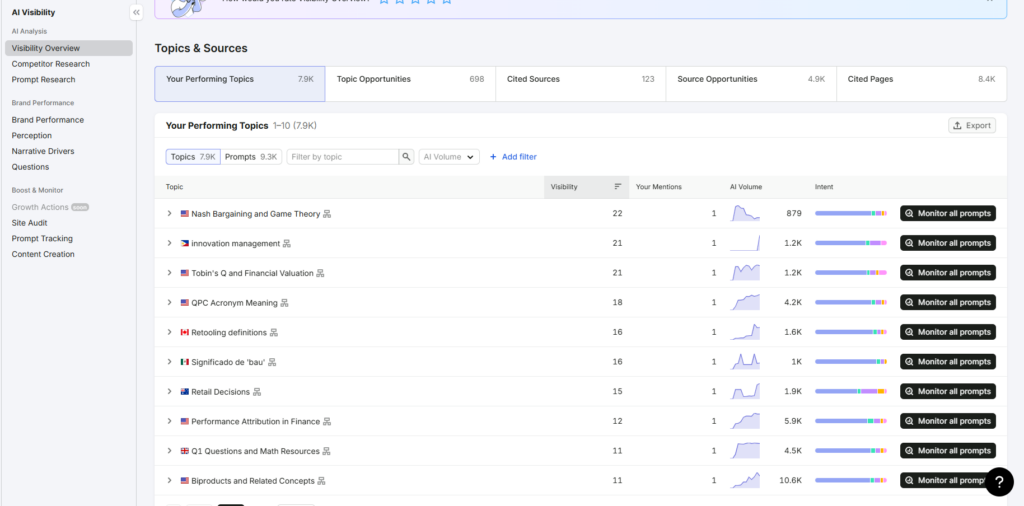
- Identify content gaps
- Analyze competitor visibility
- Monitor keyword trends
- Build topical authority
- Strengthen category coverage
- Discover opportunities for brand growth
Semrush insights can also help retail businesses understand how AI channels and commerce visibility are changing across digital commerce ecosystems, especially when combined with broader SEMrush-powered digital strategy across SEO, content, and paid acquisition.
The businesses that succeed in agentic commerce will likely combine traditional SEO fundamentals with stronger entity, authority, and trust-building strategies.
The future belongs to brands that are not only discoverable but also recommendable.
Final Thoughts
Agentic commerce is still in its early stages.
Its future outlook is significant, with forecasts suggesting it could generate $3 trillion to $5 trillion globally by 2030.
But the direction is clear.
AI systems are moving beyond information retrieval and becoming active participants in buying decisions.
At the same time, security risks grow as AI agents can be manipulated into unauthorized purchases and introduce new attack vectors for fraud, making fraud prevention a strategic priority.
As that happens, ecommerce visibility will become less about earning clicks and more about earning recommendations.
Brands that focus on structured data, entity clarity, customer trust, reputation management, authoritative content, and compliance readiness, including stringent transparency requirements in the EU, will be better positioned for this future.
The companies that continue optimizing solely for search rankings may find themselves competing in yesterday’s market, especially as AI-driven search and the latest SEO tools for 2026 reshape how visibility is measured.
Because in the age of agentic commerce, getting found is no longer enough.
The real challenge is getting chosen.
FAQ
What is agentic commerce?
Agentic commerce is a form of online shopping where autonomous AI agents act on behalf of users to research, recommend, and complete purchases, creating a more personalized and efficient shopping experience.
How does agentic commerce impact ecommerce businesses?
It shifts the focus from traditional product discovery to AI-driven product selection, requiring businesses to optimize for AI recommendation systems through structured data, entity clarity, and transparent policies.
Why is structured product data important in agentic commerce?
Structured product data enables AI agents to accurately understand, compare, and recommend products, making it essential for visibility and recommendability in AI-driven shopping environments.
What are the security risks associated with agentic commerce?
AI agents can be manipulated to make unauthorized purchases or introduce new fraud attack vectors, making robust fraud prevention and trust frameworks critical for safe agentic commerce.
How can businesses prepare for agentic commerce?
Businesses should focus on optimizing machine-readable product information, building brand authority and trust, ensuring compliance with transparency regulations, and adapting payment and checkout systems for agent-initiated transactions.