How to Conduct a Five-Prompt AI Topic-Authority Audit
A single AI mention tells you very little. This practical five-prompt audit shows how to test brand visibility across the buyer journey, diagnose missing prompts and turn the results into a focused content plan.

A useful AI visibility audit should end with a decision.
It should tell you which topic deserves investment, where your brand disappears, which competitors keep replacing it, what sources shape the answers and what to improve first.
Checking one prompt cannot do that. A single answer is too narrow and too volatile. You need a compact set of related questions that follows the buyer from initial understanding to a decision.
That is the practical value of the five-prompt structure used in the Semrush and Kevin Indig topic-authority study. Each topic was represented by five buyer questions: definition, comparison, alternatives, use case and buying question. A formal topic owner had to be the most-mentioned brand, appear in at least four of five prompts and lead the runner-up by at least five percentage points.
This guide turns that benchmark into a repeatable audit you can use for your own brand or a client.
The audit is not a hunt for a flattering screenshot. It is a diagnostic system.
Key Takeaways
- A five-prompt audit should cover definition, comparison, alternatives, use case and buying intent.
- Record brand mentions, citations, competitors and message accuracy as separate signals.
- Use Semrush Visibility Overview, Topic Opportunities, full responses, Cited Sources and Brand Performance to move from metrics to diagnosis.
- A manual spot-check is directional and should not be presented as equivalent to a tracked share-of-mentions dataset.
- Score each AI platform separately and repeat the same benchmark prompts over time.
- Translate every missing prompt into a specific content, evidence, distribution, positioning or technical action.
What is a Five Prompt Audit?
A five-prompt audit is a structured way to test your brand’s visibility across a small cluster of related questions.
Instead of asking one question and checking whether your brand appears, you ask five different questions around the same topic.
What the Audit Should Produce
Before opening a tool or writing prompts, define the output. A strong five-prompt audit should give you:
- A clear topic boundary and the buyer audience it serves.
- Five distinct prompts representing the journey through that topic.
- A record of brand mentions, citations, recurring competitors and message accuracy.
- A directional classification: likely leader, emerging signal, isolated visibility or absent.
- A diagnosis of whether the gap is content, evidence, distribution, brand clarity or technical accessibility.
- A short action plan tied to the prompts and sources that matter most.
If the audit ends with “we need more content,” it has not gone far enough. It should specify which question is missing, which competitor or source is filling the gap and what evidence would make your brand a stronger answer.
Before You Start, Fix the Rules of the Test
AI answers change. The model, reasoning mode, location, retrieval settings and date can all affect what appears. Comparability therefore matters more than perfect control.
Write down these rules before the first prompt:
- The AI platform and, where visible, model or mode.
- The market, language and audience context.
- Whether web retrieval or search is active.
- The exact prompt wording.
- The testing dates and repeat schedule.
- The brand variants, products and domains counted as the same entity.
- The competitor set you expect to see, while remaining open to unexpected competitors.
For a manual audit, use a fresh conversation for each prompt so one answer does not influence the next.
Run the same set again on a second date. If you test ChatGPT, Perplexity and Google AI experiences, score each platform separately rather than blending them into one fictional average.
8 Steps to Conduct a Five Prompt AI Topic Authority Audit
1. Choose a Topic You Can Act On
The topic should sit at the intersection of buyer demand, commercial relevance and credible expertise. Broad labels such as “marketing,” “tourism” or “fundraising” create weak audits because the prompts do not belong to one coherent decision space.
A better topic is specific enough to describe an outcome for an audience:
- Direct-booking growth for independent safari lodges.
- Donor retention systems for small community nonprofits.
- AI visibility measurement for professional-service firms.
Use four filters before selecting the topic:
- Business value: Would stronger visibility support a real service, sale, booking, funding goal or strategic position?
- Buyer activity: Do people ask multiple questions while evaluating the subject?
- Evidence readiness: Can the brand support its claims with experience, examples, research or expert judgement?
- Actionability: Can the organisation improve content, positioning or distribution within the next quarter?
Audit one topic first. Trying to test every adjacent subject usually produces a large spreadsheet and no strategic choice.
2. Write Five Prompts That Test Different Intent
The prompts must belong to the same topic but perform different jobs. Rewording one question five times only tests phrasing sensitivity. It does not test topic authority.
Prompt 1: Definition
Tests whether the brand appears when the buyer is understanding the problem or category.
Template: What is [topic], how does it work and when does it matter for [audience]?
Prompt 2: Comparison
Tests whether the brand enters the consideration set when options are evaluated.
Template: What are the best approaches, tools or providers for [topic] for [audience]?
Prompt 3: Alternatives
Tests whether the brand appears when a buyer rejects a common route or looks for another solution.
Template: What are the best alternatives to [common approach or provider] for achieving [outcome]?
Prompt 4: Use Case
Tests whether the brand is associated with a specific operating context.
Template: How should [audience] use [solution or method] to solve [specific problem]?
Prompt 5: Buying Question
Tests whether the brand survives at the point where the user wants a recommendation.
Template: Which [provider, product or method] is best for [audience] that needs [constraint or outcome]?
Add enough context to make the question commercially meaningful, but avoid naming your own brand. The audit should test whether the system reaches the brand without being prompted to do so.
3. Capture the Same Evidence for Every Prompt
Create one row per prompt and record the same fields. Consistency makes the differences visible.
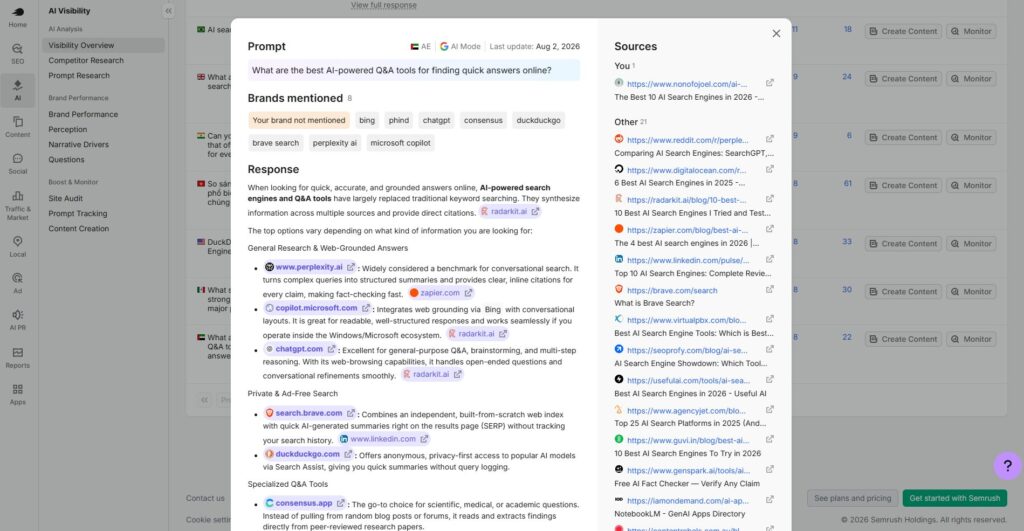
Your audit sheet should include:
- Prompt type and exact wording.
- Brand mentioned: yes or no.
- Position and context: recommended, compared, referenced, criticised or incidental.
- Message accuracy: accurate, partly accurate or inaccurate.
- Brand domain cited: yes or no, plus the cited URL.
- Other sources cited, especially publications, communities, directories and review platforms.
- Competitors mentioned and the language used to describe them.
- Platform, model or mode, date, market and retrieval setting.
- Immediate content or distribution gap suggested by the result.
Copy the relevant answer excerpt into your working notes, but keep your report focused on the pattern. The goal is not to preserve every word an AI system generated. It is to understand where the brand repeatedly enters or leaves the conversation.
4. Run the Audit in Semrush
If your plan includes the AI Visibility Toolkit, begin in the Visibility Overview report. Semrush documents this report as the workspace for reviewing mentions, cited pages, missed prompts, topic opportunities, competitors and source opportunities across supported AI platforms.
1. Establish the Baseline
Enter the brand domain and record its visibility score, mentions, citations and cited pages. Treat the overall score as context; the audit itself remains anchored to the selected topic and five prompts.
2. Find the Topic and Prompt Gaps
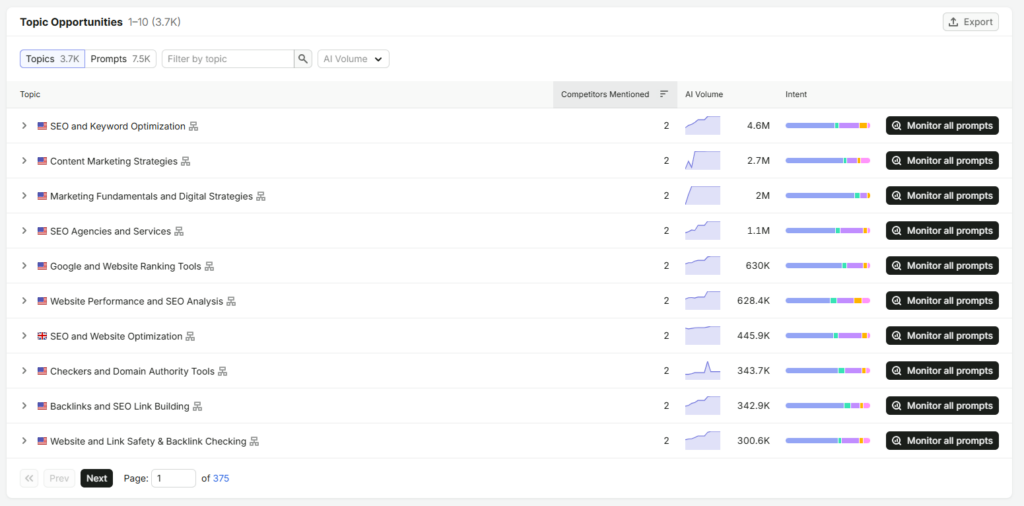
Review Your Performing Topics to see where the brand already appears. Then open Topic Opportunities to find prompts where competitors are visible and your brand is absent. Filter and search for the topic you selected, and refine the competitor set so irrelevant brands do not distort the picture.
3. Inspect the Full Responses
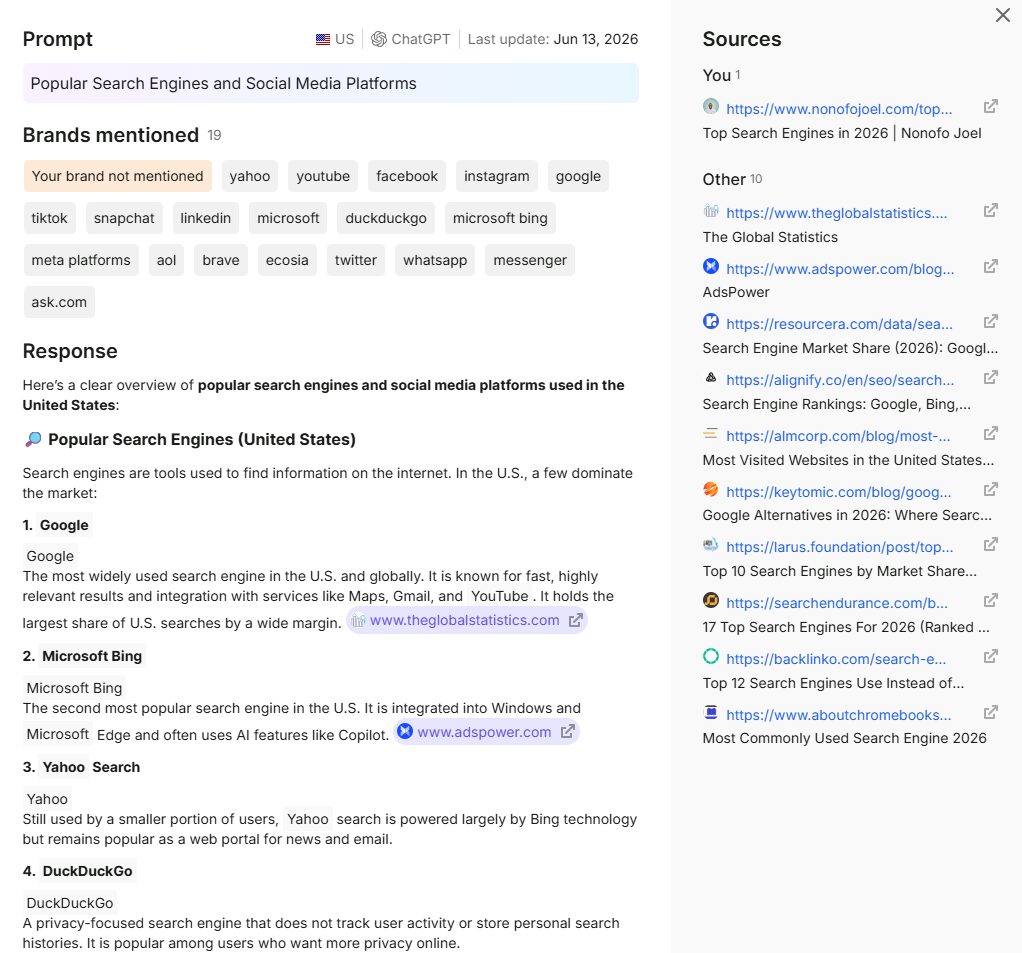
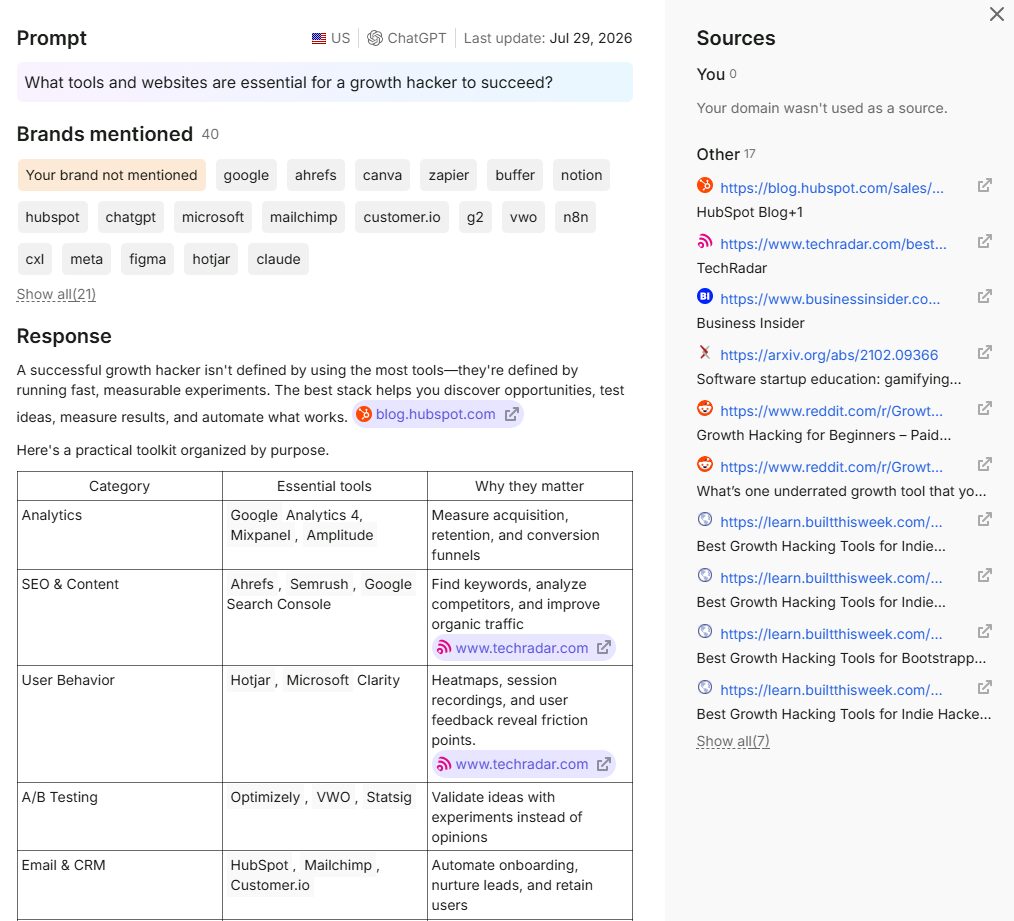
Open the detailed response for each relevant prompt. Record the brands mentioned, the way your brand is described and the sources attached to the answer. This is where a visibility metric becomes an editorial diagnosis.
4. Separate Citations from Mentions
Use Cited Pages to see which of your URLs support AI answers. Then review Cited Sources and Source Opportunities to find the external domains that appear for competitors or shape the topic without featuring your brand.
A cited page without a brand mention is useful evidence, but it is not topic ownership. A brand mention without a citation may place the brand in consideration while revealing that other domains supply the supporting authority. Record both signals.
5. Review the Narrative
Use Brand Performance and the available sentiment or perception reports to examine how AI systems frame the brand. A mention can still be a weakness if the answer uses outdated positioning, omits the core offer or repeatedly presents a competitor as the specialist.
5. Run a Manual Audit Without the Toolkit
A manual audit follows the same structure but has a smaller sample. Run each prompt in a fresh conversation, capture the evidence fields and repeat the set on another date. If possible, have a second reviewer code the answers so judgement about “mentioned” or “recommended” remains consistent.
The manual audit is directional. It cannot reproduce a study that tracked share of mentions monthly across a larger prompt database. Use careful language in the report:
- Likely leader: The brand appears in four or five prompts and is the most consistent name in the sample.
- Emerging signal: The brand appears in three prompts but lacks broad or stable coverage.
- Isolated visibility: The brand appears once or twice.
- Absent: The brand does not appear in the five-prompt sample.
Reserve the formal term “topic owner” for data that can establish both parts of the Semrush benchmark: presence in at least four prompts and a five-percentage-point lead over the runner-up.
6. Calculate the Audit Scorecard
Do not force every signal into one score. A compact scorecard is clearer when each dimension remains visible.
- Mention coverage: Number of prompts containing the brand, from zero to five.
- Citation coverage: Number of prompts citing the brand domain, from zero to five.
- Competitive position: Leading, close runner-up, distant challenger or absent.
- Message accuracy: Percentage of brand mentions coded as accurate.
- Source gap: Number of recurring third-party sources that support competitors but not the brand.
- Commercial coverage: Presence in the comparison and buying prompts, not only the definition prompt.
A brand with four mentions but no comparison or buying visibility may look strong while missing the prompts closest to revenue. A brand with two citations and no mentions may be supplying information without entering the buyer’s consideration set. The dimensions tell you what kind of work is needed.
An Illustrative Audit Result
Consider a fictional consultancy auditing the topic “direct-booking growth for independent safari lodges.” The results below are illustrative, not a real visibility claim:
- Definition prompt: mentioned and cited.
- Comparison prompt: absent; two specialist competitors mentioned.
- Alternatives prompt: cited but not mentioned.
- Use-case prompt: mentioned accurately but not cited.
- Buying prompt: absent; an industry directory and two agencies mentioned.
The summary is not “publish more.” It is more precise: the consultancy has educational authority but weak commercial consideration.
The comparison and buying gaps need stronger decision content, clearer service positioning, independent proof and visibility in the directory or publications shaping those answers.
That is what a useful audit does. It converts five answers into a focused explanation of the competitive gap.
7. Diagnose the Gap by Prompt Type
Missing from the Definition Prompt
Strengthen the cornerstone explanation, definitions, topical structure and entity clarity. Make the brand’s relationship to the subject explicit without turning the page into an advertisement.
Missing from the Comparison Prompt
Create honest decision content: comparison criteria, use-case fit, trade-offs and evidence. Review which third-party comparison pages AI systems cite and determine whether the brand should earn inclusion there.
Missing from the Alternatives Prompt
Explain the situations in which different approaches work. Address adjacent solutions and switching considerations. Avoid thin “alternative to” pages that exist only to name competitors.
Missing from the Use-Case Prompt
Publish implementation guidance, examples, workflows, templates and case evidence tied to the audience’s operating reality.
Missing from the Buying Prompt
Strengthen service or product pages, proof, pricing context, qualification criteria, reviews and third-party validation. This gap often belongs to positioning and trust as much as content depth.
8. Turn the Findings into a 90-Day Plan
Choose no more than three actions for the first cycle. Prioritize them by business value, size of the prompt gap, competitive distance and your ability to produce credible evidence.
Fix Clarity and Coverage in the first 30 days by updating the cornerstone page and the weakest high-value prompt page. Correct inaccurate entity, author, service, and organization information. Improve internal links so the five buyer questions form one coherent journey.
Build Evidence and Distribution until day 60 by:
- Publishing one asset worth citing: original analysis, a framework, benchmark, calculator, template or field guide.
- Pursuing a relevant inclusion in the publications, directories, communities or review sources revealed by the audit.
- Improving proof on comparison and buying pages through examples, reviews, methodology and clear selection criteria.
From days 61-90 re-run your program and decide which ones work best, here is how you can do this:
- Repeat the same five prompts under the same documented conditions.
- Compare mention coverage, citation coverage, competitors, narrative accuracy and source gaps with the baseline.
- Decide whether to defend the topic, close a narrow gap, continue building or redirect resources elsewhere.
Do not change the benchmark prompts halfway through the cycle because a new wording makes the brand look better. Keep exploratory prompts separate. The audit only becomes useful over time when the core test remains comparable.
Common Audit Mistakes
- Testing five synonyms instead of five distinct buyer intents.
- Prompting the AI with the brand name and then treating the answer as unaided visibility.
- Combining citations and mentions into one number.
- Pooling ChatGPT, Perplexity and Google AI results into one score.
- Calling a brand the owner after one manual run.
- Ignoring inaccurate or unfavourable brand descriptions.
- Auditing a topic that has no meaningful relationship to the offer.
- Ending with a list of content ideas instead of prioritised business decisions.
Your Five-Prompt Audit Checklist
- Define one commercially important topic and audience.
- Write one definition, comparison, alternatives, use-case and buying prompt.
- Document platform, model or mode, market, retrieval setting, date and brand variants.
- Run each prompt in a fresh conversation.
- Record mentions, citations, competitors, message accuracy and source gaps.
- Repeat the set on another date.
- Score each platform separately.
- Classify the result without overstating a manual sample.
- Diagnose the gap by prompt type.
- Select no more than three actions and schedule the next comparable audit.
The Value Is in the Decision
A five-prompt audit is deliberately small. That is its strength. It is narrow enough to run, structured enough to compare and broad enough to expose whether your brand survives across the buyer journey.
The objective is not to prove that you appear somewhere. It is to learn where the association between your brand and the topic becomes weak, who replaces you and what evidence could change the result.
Five prompts. One topic. A clear decision about what to build next.
Use the benchmark in the Semrush and Kevin Indig topic-authority study, then run the audit on one topic that matters to your business.