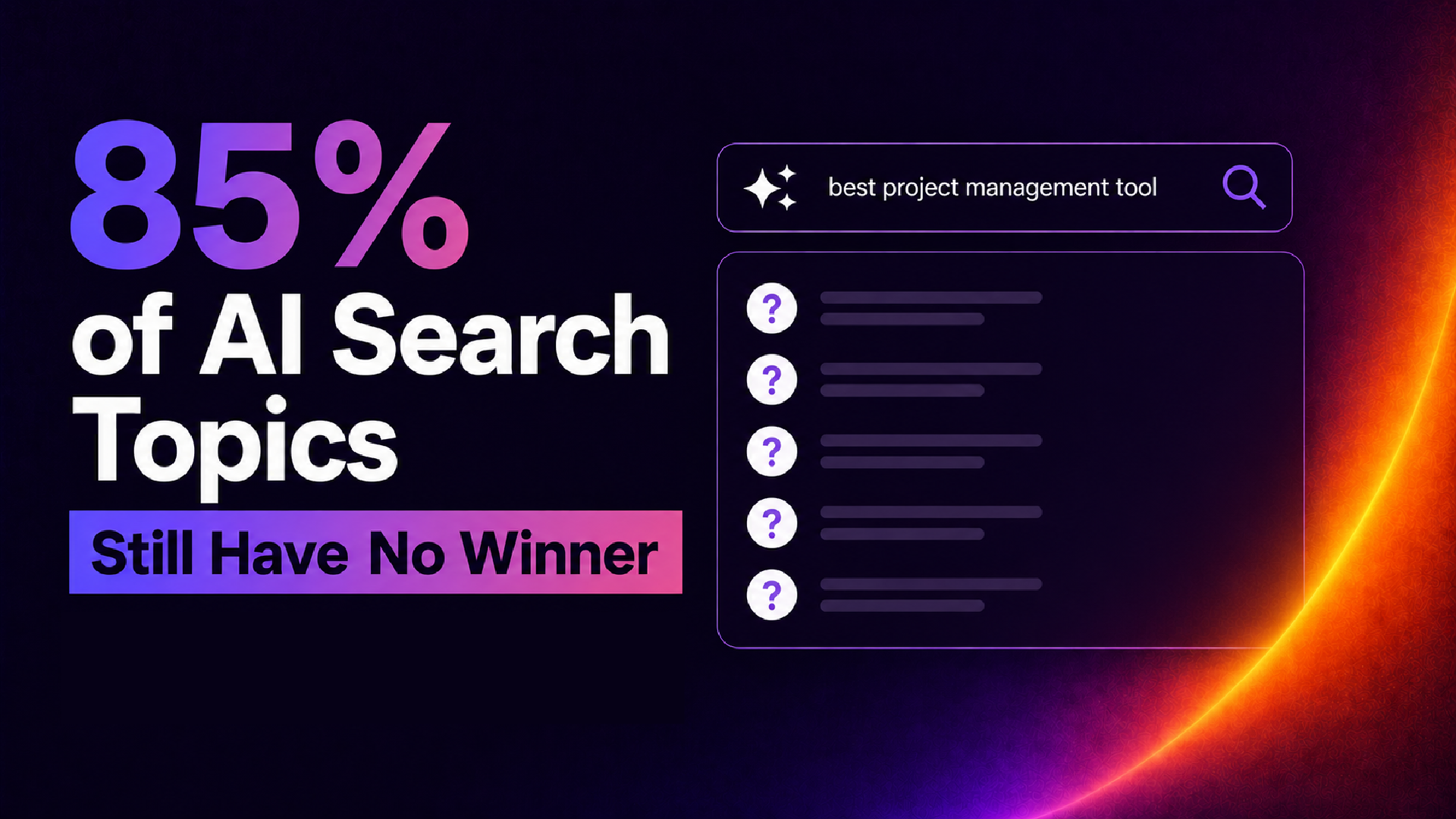
85% of AI Search Topics Still Have No Winner
Semrush found that 85% of AI search topics still have no clear winner. That creates an important opportunity for focused brands to build topical authority, strengthen their visibility across related prompts and become the trusted sources AI systems consistently recommend.

Everyone wants to win in AI search.
But many brands are asking the wrong question.
They ask, “How do I get my brand mentioned in ChatGPT?”
A better question is: “Does my brand consistently own the topic?”
That distinction looks small. Strategically, it changes everything.
Semrush’s latest AI visibility study found that 85% of the topics it analyzed in ChatGPT still had no clear winner. In other words, most of the topic areas in the study were not consistently dominated by one brand across related prompts.
The important qualification is that this figure describes the topics and prompts in the study dataset. It should not be read as a universal census of every subject a person could ask about. Even with that boundary, the signal is hard to ignore: AI search is far less settled than many businesses assume.
The field is open, but it will not remain open forever.
Brands that build clear, connected and well-supported expertise now have an opportunity to become the names AI systems repeatedly surface when a topic comes up. The competitive advantage will not come from appearing once. It will come from becoming difficult to discuss the subject without encountering the brand.
In this article, I share some interesting insights from the Semrush study I came across on AI visibility.
Key Takeaways
- Showing up in one AI response does not mean a brand owns the topic.
- Topic ownership is built through coverage, clarity, corroboration and consistency.
- The 85% figure points to an unsettled competitive landscape, not a permanent guarantee.
- Traditional SEO remains essential, but performance should also be measured across related prompts.
- Focused brands can compete by choosing credible territory and building a connected body of evidence.
- Qualified visibility matters more than mention volume: the brand must be associated with the right topic and the right audience.
Winning One Prompt Is Not the Same as Owning a Topic
There is a particular thrill in seeing your company appear in a ChatGPT response, a Google AI-generated answer or another conversational search experience. It feels like proof that the work is paying off.
It may be progress. It is not yet authority.
A single AI response is only one observation. The result may change when the prompt is reworded, when the user adds context, when the model or retrieval index changes, or when another source becomes more relevant to the question.
Imagine that an AI platform mentions a company for the prompt “best AI SEO tools” but leaves it out for all of these closely related questions:
- Which AI SEO platform is best for agencies?
- What are the best tools for measuring AI visibility?
- Which AI tools help with technical SEO?
- How can a brand improve its mentions in AI answers?
- What software tracks citations in generative search?
That company has won a prompt, not the topic.
Its visibility is brittle because the association between the brand and the broader problem is not yet strong enough to survive changes in wording and intent.
Topic ownership begins when visibility becomes repeatable across a meaningful group of related questions. It is not permanent, exclusive ownership in the legal sense.
Here we are referring to a practical measure of whether a brand repeatedly earns presence when people explore the subject from different angles.
What Topic Ownership Really Means in AI Search
For strategy purposes, topic ownership is the consistent association between a brand and a defined area of expertise across related AI prompts, relevant sources, and stages of the customer journey.
That consistency rests on four foundations.
1. Coverage
The brand answers the full range of important questions around the topic, not only the obvious high-volume keyword. Its content covers definitions, comparisons, methods, risks, use cases, implementation decisions and follow-up questions.
2. Clarity
The website makes the relationship between the brand and the topic explicit. Pages use clear language, sensible information architecture and consistent descriptions of what the organisation knows, offers and serves.
An AI system should not have to infer the brand’s area of expertise from scattered clues.
3. Corroboration
Other credible sources reinforce the association.
Relevant publications, industry directories, expert contributions, customer reviews, interviews, research citations and partner pages all help show that the brand’s claimed expertise exists beyond its own website.
4. Consistency
The association holds across prompt variations and over time.
The brand does not appear only for a narrow phrase or during a short-lived campaign. It remains visible when the user changes the audience, use case, geography, level of sophistication or buying stage.
Together, these four elements turn topical authority from a vague ambition into an operating model: cover the subject properly, state your expertise clearly, earn external support and measure whether the association persists.
Why AI Search Makes Topical Authority More Important
Traditional SEO taught marketers to organize performance around rankings: one keyword, one page and a race to obtain a spot in the top three positions on SERPs.
That model was never the whole of SEO, but it was easy to report and easy to understand.
AI search makes the limitations of that model more visible.
A conversational answer can synthesize information from several sources, respond to a long and specific prompt, and adapt its recommendation to the context a user supplies.
Depending on the product and query, the answer may draw on learned patterns, retrieved web documents, or both. The unit of competition is therefore broader than a single blue link.
This does not mean SERP no longer matters. In fact, traditional search engines like Google have to index you first before AI search can find you.
Technical accessibility, on-page relevance, internal links, backlinks (including Mentions), and traditional rankings still influence whether content can be discovered and trusted.
What changes is the strategic frame: individual pages must work together to establish a coherent brand-topic relationship.
Prompt Variation Exposes Weak Authority
People do not ask identical questions about AI systems.
They refine, compare and add constraints. A hotel owner may begin with “how to increase direct bookings” and then ask about email capture, metasearch, website speed, local SEO, rate parity or booking-engine friction.
A brand with one broad article may appear at the beginning and vanish as the conversation becomes more specific. A brand with a connected body of useful content has more ways to remain relevant throughout the journey.
AI Visibility Is Also Brand Visibility
The strongest AI-search strategies sit at the intersection of SEO, content and brand. Search systems need accessible evidence. Readers need useful answers. The market needs a clear reason to associate the organisation with the subject.
That is why generic content is such a weak foundation. If ten websites publish interchangeable summaries, none gives an AI system or a potential customer a strong reason to remember the source. Distinct expertise is built through clearer explanations, original frameworks, first-hand operational knowledge, transparent authorship, and a consistent point of view.
Why the 85% Finding Is Good News for Focused Brands
At first glance, 85% sounds like a warning. It is better understood as evidence of an unsettled market.
If most topics in the study do not yet have a dominant brand, then many categories still offer room for a focused organization to build an advantage.
Global scale helps, but it is not the only path. A smaller brand can compete by defining a narrower territory, covering it more intelligently and reinforcing its relevance more consistently.
A regional tourism consultancy, for example, does not need to own the entire subject of digital marketing. It could aim to become the most consistently useful source on direct-booking growth for independent safari lodges in Southern Africa.
That territory is smaller, but the association is clearer, the audience is more valuable, and the expertise is easier to demonstrate convincingly.
Focus is not a concession. It is how authority becomes believable.
Here is a Six-Step Framework for Building Topic Ownership
Topic ownership is not created by publishing random articles at a faster pace. It is built through deliberate content architecture and repeated evidence. The following framework turns the idea into a practical programme.
Step 1: Define the Topic Territory You Can Credibly Own
Begin with the overlap between three things: what your audience needs, what your business wants to be known for, and what you can support with genuine expertise.
A topic such as “marketing” is too broad to guide meaningful execution. “Digital marketing for tourism” is better. “Direct-booking growth systems for independent tourism businesses” is sharper still.
A useful topic should be:
- Commercially relevant to the services, products or outcomes the organization provides.
- Specific enough for the brand to develop recognizable depth.
- Broad enough to support a connected body of content rather than one article.
- Supported by experience, expertise, data or access to credible contributors.
I tried these
Step 2: Map the Prompt Universe, Not Just a Keyword List
Keyword research remains useful, but AI-search planning requires a wider view of how people frame problems in conversation. Map the questions around the topic by intent and context.
At minimum, include six prompt groups:
- Understand: What is it? Why does it matter? How does it work?
- Diagnose: Why is this happening? What is causing the problem?
- Compare: Which approach, platform or provider is better for a specific situation?
- Implement: What steps, tools, templates or resources are needed?
- Evaluate: How should success, cost, risk or quality be measured?
- Choose: Who can help? What should a buyer look for? Which option fits the context?
Then vary the prompts by audience, industry, location, budget, maturity and constraint. This exposes gaps that a conventional list of head terms can miss.
Step 3: Build a Connected Content Architecture
Once the prompt universe is visible, organise it into a content system. A strong topic cluster typically includes a central guide, supporting articles, decision content and proof.
- A cornerstone guide that explains the topic and links the major subtopics together.
- Supporting articles that answer specific questions in depth.
- Comparison and decision pages for readers evaluating approaches or providers.
- Practical assets such as templates, checklists, calculators, glossaries or process guides.
- Your evidence pages such as research, case studies, methodology notes or expert commentary.
Internal links should reflect the reader’s next question, not merely satisfy a checklist.
Each page should help people move naturally from understanding the issue to choosing and implementing a solution.
Step 4: Make the Brand-Topic Relationship Explicit
When creating content, do not assume it automatically communicates your brand’s positioning. Your website must clearly state who the brand helps, what it helps them achieve, and how you help your audience.
To ensure there is no gap, reinforce that relationship through consistent service descriptions, author biographies (to help the user understand your team’s expertise), a clear about page, category pages, navigation labels, and organization information.
Remember to use structured data to accurately describe the page and entity but remember that markup cannot manufacture expertise that the visible content does not support.
The goal is semantic consistency, that is, the same clear story should appear across the website without becoming repetitive or forced.
Step 5: Earn Independent Corroboration
Self-published expertise matters, but third-party validation gives the association more weight. Build a distribution and authority plan alongside the editorial calendar.
Useful signals may include:
- Expert contributions to reputable industry publications.
- Interviews, podcasts, webinars and conference participation.
- Relevant links and citations earned through genuinely useful resources.
- Consistent organisation profiles and trusted industry directories.
- Customer reviews that naturally describe the problems the brand solves.
- Partnerships, research collaborations and professional associations.
This is not a licence to chase mentions everywhere. Relevance matters more than noise. Ten credible references within the right professional ecosystem can be more useful than a hundred unrelated placements.
Step 6: Refresh, Consolidate and Defend the Territory
Topical authority is not a one-time publishing project. Information changes, competitors improve and user questions evolve. Review the cluster regularly to identify outdated claims, overlapping pages, weak internal links and new questions that deserve coverage.
Consolidate articles that compete with one another without adding distinct value. Strengthen pages that already perform. Update examples and evidence. Build new material only when it closes a real gap.
A mature content system becomes more coherent over time, not merely larger.
How to Measure Topic Ownership
Rankings and traffic still belong in the dashboard, but they cannot describe AI visibility on their own. Topic ownership is a pattern: the brand needs to appear across a meaningful set of related prompts, remain competitive as the wording and context change, earn support from credible sources and turn that visibility into business value.
That means the unit of measurement is not one keyword or one flattering screenshot. It is a defined topic, a stable portfolio of prompts, a named competitor set and a consistent observation schedule.
Build a Topic-Ownership Scorecard
A useful scorecard should measure four layers presence, competitive position, supporting evidence and business impact. Track the following indicators together:
- Prompt coverage rate: the percentage of tracked, relevant prompts in which the brand is mentioned, recommended or cited.
- AI share of voice: the brand’s visibility compared with a defined group of competitors across the same prompt portfolio.
- Recommendation consistency: whether the brand remains visible when the audience, use case, location, constraint or wording changes.
- Citation and source presence: how often the brand’s pages appear as supporting sources, and which third-party domains AI systems repeatedly rely on instead.
- Message accuracy and sentiment: whether AI answers describe the brand, offer, expertise and market position correctly and in the intended context.
- Search authority signals: organic rankings, impressions, branded demand, backlinks and engagement across the wider content cluster.
- Business outcomes: qualified enquiries, assisted conversions, direct bookings, sign-ups or other outcomes connected to the topic.
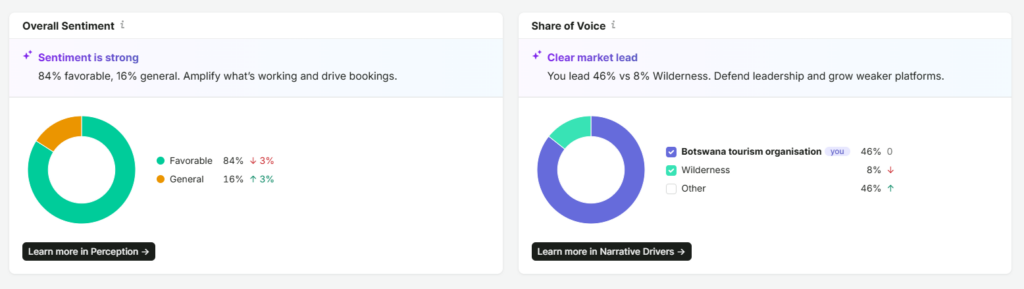
Use Semrush as the Measurement Hub
Semrush provides a practical starting point because it can bring AI visibility, competitor comparison and traditional search signals into one working environment.
Its AI visibility tools can help teams research relevant prompts, monitor brand and competitor presence, review the sources or citations appearing in supported AI answers and identify where a brand is visible or absent across a topic.
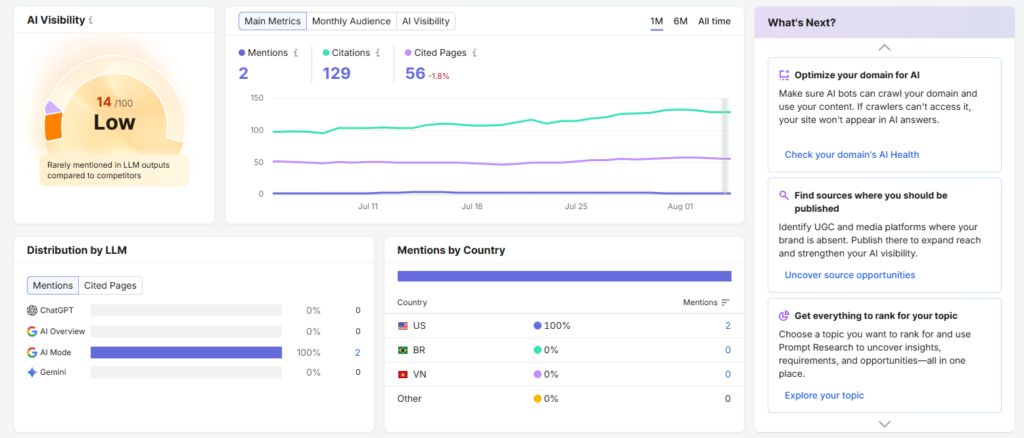
Exact reports, platform coverage and feature names can vary by subscription and product updates, so the measurement design should be built around the signals you need.
A sensible Semrush measurement stack looks like this:
- AI visibility and prompt research: use Semrush’s AI visibility workspace to build the prompt set, observe brand mentions, and group prompts by topic, intent, audience or use case.
- Competitive topic share: use the competitor and share-of-voice views to compare visibility across the same prompts instead of comparing isolated answers.
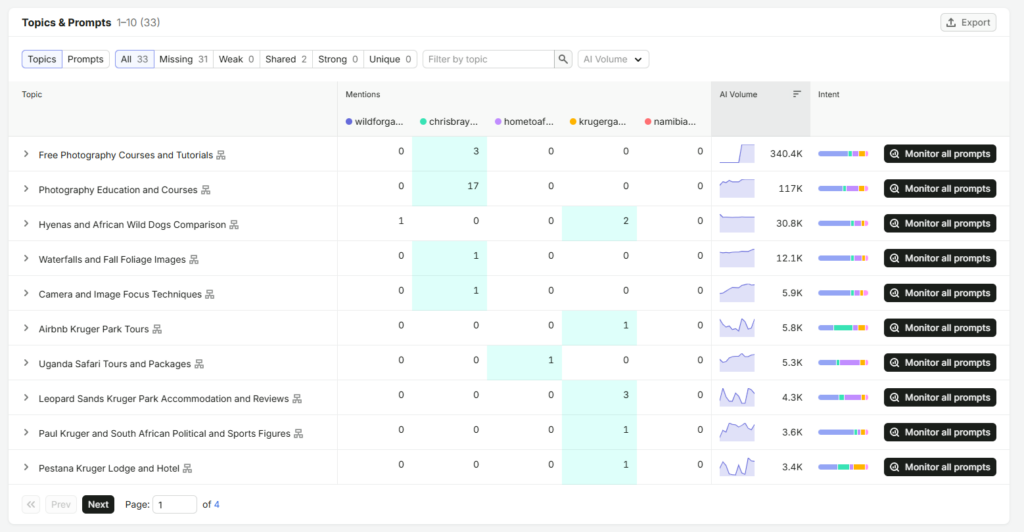
- Citation opportunities: review cited and frequently referenced domains to see which sources shape the answer set, where your website already earns inclusion and where independent corroboration is missing.
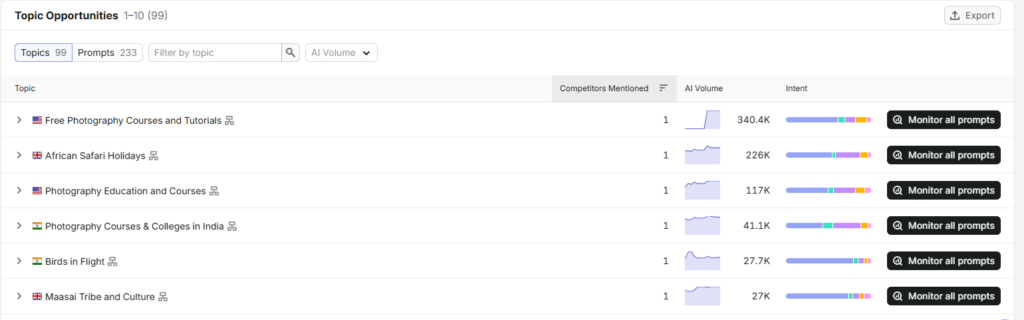
- Search demand and organic support: use Keyword Overview and Keyword Magic Tool for demand discovery, Position Tracking for cluster rankings, Organic Research for competitor coverage and Backlink Analytics for external authority signals.
- Traffic and conversion context: connect Search Console and analytics data where appropriate, then use your analytics platform, CRM, enquiry system or booking engine to judge whether topic visibility contributes to real outcomes.
Semrush can make collection and comparison far more efficient, but software cannot make every judgement for you. A person still needs to review whether the mention is relevant, whether the recommendation is accurate, whether the cited source is credible and whether the visibility supports the brand’s commercial position.
Measure Patterns, Not Noise
Track the same representative prompt set weekly or fortnightly, then review the trend monthly. Because generative answers can vary, one test run is not enough.
Record the AI product, model or experience, date, market or location, and whether web retrieval was active whenever those details are available. Keep the core prompt set stable so the comparison remains meaningful; add exploratory prompts separately rather than changing the benchmark every week.
Most importantly, do not confuse mention volume with commercial value. A brand can be widely mentioned for an irrelevant subject, appear only in low-value informational answers or be described inaccurately. The objective is qualified visibility: being associated with the right topic, for the right audience, in a way that supports trust and action.
Common Mistakes That Prevent Topic Ownership
Publishing Volume Without Architecture
More articles do not automatically create more authority. Without a clear territory, cluster structure and internal journey, volume often produces duplication and dilution.
Treating Every Prompt as a Separate Page
Prompt research should reveal needs and subtopics, not generate hundreds of thin pages. Group questions by intent and answer closely related variations within substantial, useful resources.
Copying the Existing Search Results
A summary of what everyone else has already said may rank temporarily, but it gives neither readers nor AI systems a compelling reason to associate the insight with your brand. Add experience, judgement, examples, frameworks and evidence that improve conversation.
Ignoring Off-Site Signals
A website cannot establish market authority entirely by talking about itself. The brand needs relevant recognition from sources outside its own domain.
Tracking Screenshots Instead of Patterns
One favorable AI answer makes a good internal update. It does not make a strategy. Measure a defined topic across a prompt set and overtime.
Forgetting the Customer Journey
Topical visibility has little business value if the reader cannot understand the offer, trust the brand or take the next step. Content architecture, service positioning and conversion paths must work together.
Can Smaller Brands Really Win?
Yes, if they resist the temptation to compete at the broadest possible level.
Large brands often possess stronger domains, larger content teams and more mentions. They can also be diffused. A specialist brand can build an advantage through precision: a well-defined audience, a specific problem, deeper operational knowledge and a more coherent body of evidence.
The winning move is not to claim more territory than the organization can support. It is to choose valuable territory and become exceptionally useful within it.
For a tourism business, that might mean owning the questions around family-friendly safari planning in one region. For nonprofit, it might mean becoming the clearest source on donor retention for small community organizations. For a software company, it might mean owning one difficult workflow for a defined type of team.
Narrow enough to be credible. Deep enough to be valuable. Connected enough to be recognized.
The Next SEO Battleground Is the Topic Authority Not the Prompt
The most important lesson in Semrush’s finding is not that AI search is easy. It is that the market is still forming.
With 85% of the topics in the study lacking a clear winner, brands have a window to establish strong associations before competitors harden their positions. That window rewards focus, clarity, and disciplined execution.
The winners will not be the organizations that optimize for one cleverly worded prompt.
They will be the ones that repeatedly demonstrate useful expertise across the full shape of a problem, make that expertise easy to understand, and earn recognition beyond their own websites.
In the age of AI search, owning a conversation is more valuable than winning a keyword.
Frequently Asked Questions
What is topical authority in AI search?
Topical authority is the strength and consistency of the association between a brand and a subject across useful content, related prompts and credible external sources. In practical terms, it means the brand remains relevant as users ask different questions about the same broader problem.
Does appearing in ChatGPT mean a brand has topical authority?
No. A single appearance is one data point. Stronger authority is indicated by repeated, accurate visibility across a representative set of related prompts and over multiple observations.
Is topical authority the same as publishing a topic cluster?
A topic cluster is one way to organise content, but architecture alone is not enough. Topic ownership also depends on content quality, clear brand positioning, technical accessibility, independent corroboration and consistent visibility.
Do traditional SEO rankings still matter?
Yes. Rankings, discoverability, links and technical SEO still help content become accessible and credible. AI search adds another layer of measurement; it does not erase the foundations of search performance.
How long does it take to build topic ownership?
There is no universal timetable. The answer depends on competition, existing authority, content quality, distribution and how narrowly the topic is defined. A 90-day sprint can improve the foundation and establish measurement, but durable authority is built through sustained work.