What Does Brand Strategy Look Like in the Age of AI Search?
Brand strategy in the age of AI is no longer only about identity, messaging, and perception. It is about whether AI systems can clearly understand, cite, and recommend your brand. This article explains how brands can build visibility through positioning, content, authority signals, and measurable AI search performance.

Brand Strategy Has Always Been About Meaning.
Not just the logo. Not just the colors. Not just the message on the homepage.
A real brand strategy answers deeper questions:
Who are we for?
What do we want to be known for?
Why should people trust us?
What do we say consistently enough that the market remembers it?
But in the age of AI, there is a new question every brand must ask:
What does AI think we are?
Brand strategy in the age of AI search is no longer only about shaping human perception. It also means making sure AI systems can understand, mention, cite, and describe your brand correctly by finding clear, consistent, and verifiable evidence of what you stand for across the web.
That shift matters because people are no longer discovering brands only through Google search results, social feeds, referrals, or ads. They are asking AI systems for recommendations, comparisons, summaries, explanations, and buying guidance, which means AI visibility now affects whether your brand is found, trusted, and chosen.
They are asking questions like:
“What is the best safari lodge for a family trip in Botswana?”
“Which digital strategist can help with AI visibility and SEO?”
“What are the top nonprofit marketing strategies for donor growth?”
“Which web hosting provider is best for a small tourism business?”
In the past, the battle was largely about ranking, reputation, and recall. Today, those still matter. But there is another layer: whether AI systems understand, mention, cite, and describe your brand correctly.
That is where brand strategy is changing. For brand strategists, marketers, digital businesses, and smaller brands trying to stay visible and competitive in AI-mediated search, the work now includes sharper positioning, stronger consistency, better signals for AI systems to interpret, technical accessibility, and new ways to measure how your brand appears in AI answers.
The strongest brands in the AI era will not be the loudest. They will be the clearest, most consistent, most trusted, and most easily understood across the web. This article shows how that shift changes positioning, visibility, measurement, practical frameworks for building brand meaning and authority, and tools such as Semrush’s AI Visibility Toolkit, including how smaller players can compete by being easier for both people and AI to understand.
Brand Strategy Is No Longer Only Human-Facing
Traditional brand strategy was built around human perception.
You defined your positioning. You shaped your messaging. You designed your identity. You created campaigns, content, and experiences to influence how people saw you.
That still matters.
But in an AI-first world, AI-powered search environments now sit between brands and buyers, interpreting user intent and context, not just keywords.
AI systems do not “feel” your brand the way a person does. They interpret signals. AI assistants and AI agents retrieve, summarize, and present information during discovery. They connect mentions, content, reviews, citations, descriptions, comparisons, and third-party references into an answer.
So your brand is no longer shaped only by what you say about yourself. AI models often prioritize third-party references over brand claims.
It is shaped by:
- what your website says
- what other websites say
- how clearly your content explains your expertise
- whether your pages are technically accessible
- how often your brand is mentioned in relevant contexts
- how competitors are described alongside you
- whether AI systems can find enough evidence from multiple sources to trust you
- whether your positioning is consistent across platforms
This is a major shift.
Brand strategy in the age of AI is not just about creating a brand identity. It is about creating a clear, verifiable, machine-readable body of evidence around what your brand stands for.
The New Brand Strategy Question is Are You Understandable?
Many brands are visible but not understandable.
They post content, run ads, publish websites, appear in directories and may even rank for some keywords.
But when you look closely, their market meaning is scattered.
One page says they are affordable. Another says premium. Their social media says they are innovative. Their website says they are trusted. Their service pages are vague. Their blog posts are generic and testimonials mention outcomes the brand never emphasizes.
Their competitors have clearer language and are winning in the space of AI search.
For humans, this creates confusion and for AI systems, it creates weak association.
If an AI model is trying to answer, “Who are the best companies for X?” or “What brand is known for Y?”, it needs enough reliable signals to connect your brand with that topic.
This is why brand strategy now needs to become more disciplined because, unlike traditional SEO, AI discovery depends more on being clearly associated with an answer than simply winning a page-level ranking.
A brand must know:
- the category it wants to be associated with
- the problems it wants to be known for solving, answering the jobs your clinets are using your products for
- the audience it wants to serve
- the phrases and concepts it wants repeated around its name
- the proof points that support its claims
- the content ecosystem that reinforces its authority. The Semrush AI Search Operating System (OS) can give you a head start by helpign you understand brand visibility accross AI search platforms.
AI visibility rewards brands that are easy to understand and difficult to misrepresent, especially when they build structured knowledge around the brand and align content with relevant queries so AI discovery can interpret them correctly.
What AI Changes About Positioning
Brand positioning used to live heavily in boardrooms, brand documents, taglines, and campaign messaging.
It must live across your entire digital footprint in the evolving landscape of AI-driven discovery.
If you want to be known as a premium safari operator, that meaning should show up in your destination guides, guest experience pages, reviews, media mentions, partner profiles, FAQs, image metadata, structured content, and comparison content.
If you want to be known as an SEO and AI visibility strategist, that positioning should be clear in your articles, service pages, credentials, case examples, podcast bios, guest posts, LinkedIn content, and the language other sites use when referencing you.
AI does not rely on one tagline. It looks for patterns.
That means modern positioning must be:
Clear enought for the market to immediately understand what you do and who you help.
Have Consistent messaging accross channels.
Be Specific because generic claims like “we help businesses grow” are too weak.
Supported by evidence, emotional resonance, and support through authoritative content, credentials, results, reviews, examples, and third-party references that reflect experience, expertise, authoritativeness, and trustworthiness.
Distributed beyond your own website because AI seach uses multiples sources to trust your brand.
This is where many brands struggle. In fact, research shows that upwards of 40-69% of startup failures tie directly back to marketing and branding missteps, such as failing to articulate their core value, target the right buyer, or stand out from competitors.. They treat brand strategy as a creative exercise, when it is also an information architecture exercise that strengthens brand credibility, and AI systems respond better to real human experience than generic marketing copy.
Brand Strategy Now Includes AI Search Visibility
AI visibility is the degree to which your brand appears, gets cited, and is accurately represented in AI-generated answers, AI summaries, and Google AI Overviews.
The Semrush AI Visibility Toolkit is a way you can see how brands appear in AI-generated answers and measure visibility beyond traditional search. I use it for all as a start to all our Brand Starategy projects at Brandesis. That matters because traditional SEO metrics do not tell the full story anymore, and visibility in AI includes shaping decision-making in ai powered discovery even when no click occurs.
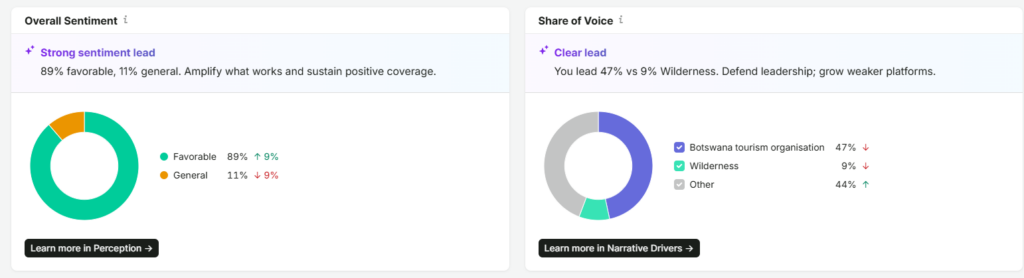
See this brand sentiment measure from Semrush AI visibility Toolkit
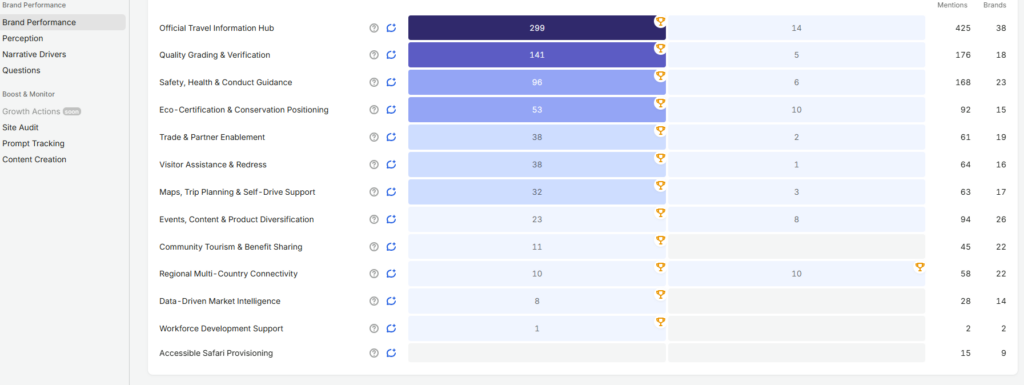
Yo can even see narrative drivers and Key Business Drivers by Frequency as you deeper into understanding how buyers percieve your brand.
Remember, you may rank on Google but not appear in AI answers, which is why generative engine optimization is now part of brand visibility work.
Getting traffic does not mean your are mentioned when buyers ask AI for recommendations.
The other thing you might be missing is you might believe you are known in your industry but described incorrectly by AI systems.
You might have strong content, but competitors may be cited more often because their content is clearer, better structured, or more widely referenced.
This is why AI visibility should become part of brand strategy measurement.
Not instead of rankings, not instead of traffic, not instead of brand awareness but alongside them. This way you will cover a lot fo ground in ensurign your brand is well represented.
The Brand Measurement Problem AI Helps Expose
Branding has often been treated as difficult to measure.
Some of that is fair. Brand equity is not always immediate. Trust compounds over time. Reputation is not a simple dashboard number.
But the danger is that “brand is hard to measure” can become an excuse for vague work.
AI visibility tools help change that. Organizations are now building measurement frameworks around AI visibility metrics.
They allow brands to observe how they are being surfaced in AI environments, including the large language models shaping visibility, and evaluate brands more consistently across AI discovery. Semrush’s AI Visibility Toolkit includes metrics designed to measure brand visibility, competitor presence, and AI-generated search performance. Its Brand Performance reports look at share of voice, sentiment, narrative drivers, and questions.
That gives brand strategists something valuable: a practical way to connect positioning with discoverability.
You can now ask:
- Are we being mentioned for the topics we want to own, knowing AI-generated answers are assembled from different inputs and measured across prompts?
- Are competitors being recommended where we are absent?
- Are AI systems citing our website?
- Are we described accurately?
- Is our sentiment positive, neutral, or negative?
- Which pages are earning citations, and do they use clear headings, definitions, and structured organization that improve whether they can be cited and measured?
- Which prompts reveal gaps in our brand authority?
These are not vanity questions. They are strategic questions that will help you determine a more precise positioning for your brand based on real user data.
A Practical Framework You Can Use.
The AI-Era Brand Strategy Stack
To make brand strategy useful in the age of AI, I like to think in layers.
1. Brand Meaning
This is the foundation.
Before you worry about AI tools, you need clarity on what your brand should mean in the market.
Define:
- your core category
- your primary audience
- your sharpest problem focus
- your strongest differentiator
- your proof points
- your tone and point of view
- your commercial priorities
A tourism brand might decide: “We want to be known as the most reliable family-friendly safari planning partner for first-time visitors to Botswana.”
A consultant might decide: “I want to be known for helping small businesses build SEO, AI visibility, and content systems that make our unique value legible to AI systems and turn expertise into discoverable authority.”
That level of clarity matters because AI visibility is not just about appearing. It is about appearing for the right thing.
2. Content Architecture
Once your meaning is clear, your content must reinforce it.
This means building your content strategy around the topics, natural language questions, and decisions your audience actually cares about, especially as conversational discovery pushes content to mirror how buyers actually ask.
For example:
- educational guides
- comparison pages
- service pages
- FAQ content
- glossary pages
- case-study-style explanations
- location or destination pages
- problem-solution articles
- buying guides
- expert commentary
- visual content when it helps explain expertise and build trust
In AI search, content needs to provide direct-answer content clearly to support ai powered recommendations. It should define terms, explain trade-offs, provide context, and show practical judgment.
Thin content will struggle because AI systems need useful material to summarize and cite. Well-structured content with schema markup can improve AI visibility, and content optimized this way can lift engagement by 30-40%.
3. Authority Signals
AI systems do not only look at what you publish. Authority grows when brands are cited in research reports and other trusted third-party sources, because AI systems also absorb signals from the wider web.
That includes:
- mentions on trusted sites
- reviews
- directories
- interviews on third party websites or channels
- guest articles
- social conversations
- industry profiles
- backlinks
- citations from relevant publications
- consistent business information
Authority grows when a brand shows up across multiple channels, not just its own site, and when credible brand signals also appear in research solutions; those trust signals get stronger with credible thought leadership and coverage in industry news, which 62% of decision-makers rely on for guidance.
This is where off-page SEO and brand-building become inseparable.
A brand that is never mentioned outside its own website gives AI systems fewer reasons to trust it.
4. Technical Accessibility
Your content must be discoverable and usable by search engines and AI systems.
This includes:
- crawlable pages
- clean site structure
- strong internal linking
- schema markup where appropriate
- fast, accessible pages
- clear headings
- indexable content
- no accidental blocking of important crawlers
- well-structured service and about pages
This matters because structured data is especially relevant here: 81% of web pages cited by AI engines include schema markup, and knowledge graphs are one way AI systems connect entities and relationships.
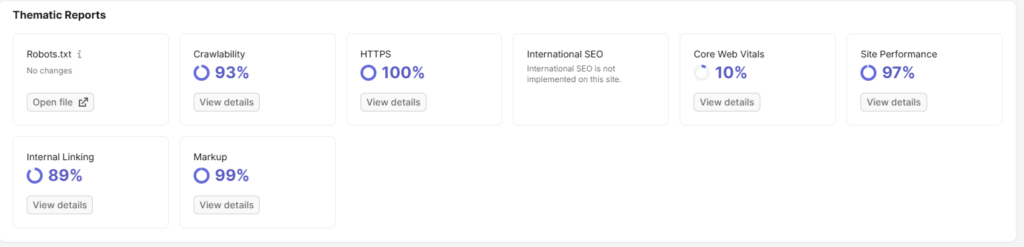
Semrush’s free AI visibility audit guidance points to technical optimization for AI engines, including whether AI platforms can access and use your content to support ai mediated discovery across platforms. This is often overlooked, but it matters. A brilliant brand message hidden behind poor technical structure is still hidden.
5. Measurement and Feedback
This is where the strategy becomes measurable. Measurement and improvement also require coordinated work across content, SEO, PR, and brand teams.
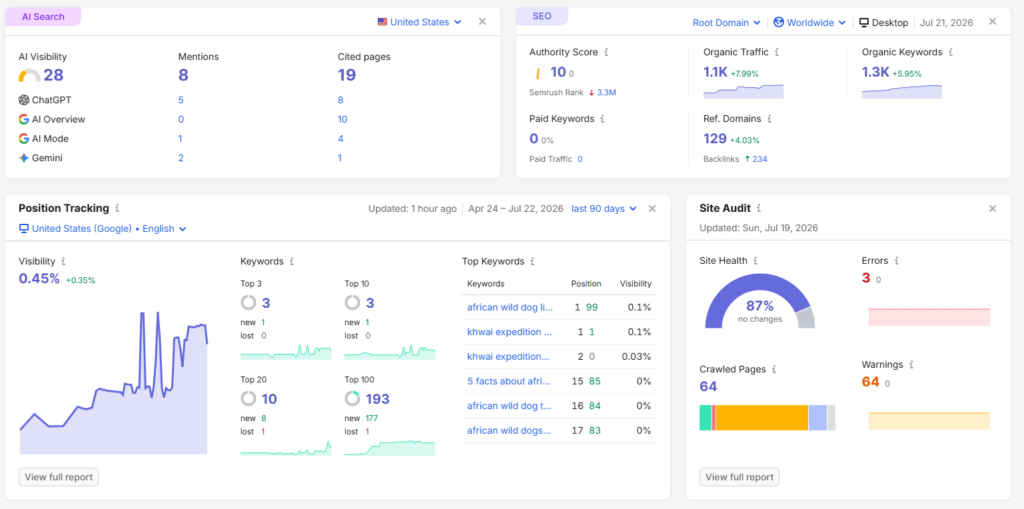
Using Semrush’s AI Visibility Toolkit, a brand can track:
- AI visibility score
- brand mentions in AI-generated answers
- citations from the brand’s domain
- cited pages
- share of voice
- sentiment
- competitor visibility
- prompt-level gaps
- topic opportunities
- questions people are asking
Semrush also notes that Brand Performance can compare your brand with competitors and review visibility across platforms such as ChatGPT, Google AI Mode, Perplexity, and Gemini.
That matters because visibility can vary by platform as buyers use AI assistants to research and evaluate solutions. A brand may perform well in one AI environment and poorly in another.
How to Use Semrush AI Visibility Tools for Brand Strategy
Here is a practical way to use Semrush without turning branding into dashboard theatre.
1.Establish a Baseline for Your Brand
Start by entering your domain into the Semrush AI Visibility Toolkit.
You want to know:
- Are you appearing in AI-generated answers?
- How often are you mentioned?
- Which pages are cited?
- Which competitors appear more often?
- Which topics are associated with your brand?
This baseline gives you your current reality. It matters more now because AI referral traffic increased 975%% in 2026, making ai driven discovery too important to track casually.
Not your aspiration. Not your internal brand document. Your actual market signal.
2. Compare Yourself Against Real SEO/ AEO Competitors
Brand strategy is always relative. Early visibility matters because 85% of B2B purchases go to vendors already on the day-one list according to 6sense.
You are not building your brand in an empty room. Buyers compare. Search engines compare. AI systems compare.
Use competitor visibility data to see:
- who appears more often than you
- what topics they dominate
- where they are cited
- how they are described
- how enterprise buyers discover and compare options
- what AI systems seem to trust about them
This can be uncomfortable, but it is useful.
If competitors are consistently mentioned for your most valuable topics, they are occupying mental and algorithmic space that you may need to earn back. Recognizable executives can also help, since 75% of decision-makers trust brands with recognizable executives when buyers compare competitors.
3. Study the Prompts and Questions
This is one of the most useful parts of AI visibility measurement. The Semrush AI Visibility platform does this for you well by structuring different measurement option you can use for your brand.
Prompt and question data helps you understand how people may be asking for solutions in your category.
Instead of only thinking in keywords, you start thinking in buying conversations.
For example, a traditional keyword might be:
“digital marketing consultant Botswana”
But an AI-style prompt might be:
“Who can help a small tourism business in Botswana improve direct bookings through SEO and content?”
That second query reveals more intent, more context, and more strategic opportunity.
Your content should be built for those deeper questions.
4. Audit Your Brand Narrative
Look at how AI systems describe your brand.
Are they accurate?
Are they specific?
Are they outdated?
Are they too generic?
Do they miss your strongest differentiators?
Do they associate you with the wrong category?
Do they mention competitors more confidently?
Semrush’s Brand Performance reports include perception and narrative drivers, which can help you understand not only whether you appear, but how you are framed.
This is where brand strategy becomes very practical.
If AI describes your brand vaguely, your website may be vague.
If AI misses your strongest service, your content may not support it clearly enough.
If AI favors competitors, they may have stronger topical authority or clearer third-party validation.
5. Turn Gaps Into Content and Authority Work
Measurement only matters if it changes execution.
When Semrush shows topic opportunities, competitor gaps, weak citations, low mentions, or shifting citation patterns, translate that into action.
For example:
- create a stronger service page for a topic you want to own
- publish a detailed guide answering a high-intent question
- improve an existing page that ranks but is not cited in AI Overviews
- add clearer proof points to your about and service pages
- build comparison content where buyers need help deciding
- earn mentions from relevant industry websites
- improve internal linking around your priority topics
- maintain freshness through regular updates and rechecks of cited pages and priority content so your positioning stays current
The goal is not to chase every AI mention.
The goal is to build a digital presence so clear and credible that AI systems have better evidence to work with.
What Brands Should Measure Now
In the age of AI, brand measurement should include both traditional and AI visibility metrics.
Traditional brand and SEO indicators still matter:
- branded search volume
- organic traffic
- rankings
- backlinks
- referral traffic
- direct traffic
- engagement
- conversions
- reviews
- social mentions
In some B2B categories, click through rates have dropped by 30% as zero click search behavior grows.
But now you should also measure:
- AI mentions
- AI citations
- cited pages
- AI share of voice
- sentiment
- competitor mentions
- platform-specific visibility
- prompt-level performance
- topic gaps
- accuracy of AI-generated brand descriptions
About 60% of searches now end without users clicking through, which is why AI mentions and citations deserve their own tracking.
Semrush’s AI Overview monitoring tools also allow brands to see where AI Overviews appear for tracked keywords, whether a domain is included, and how often competitors are cited. That helps connect SEO performance with AI-generated visibility.
This is the future of brand measurement: not one metric, but a connected view of visibility, authority, trust, and market meaning.
The Real Strategic Shift is From Messaging to Evidence
The biggest mistake brands will make in the AI era is thinking they can “prompt engineer” their way into authority.
You cannot build a durable brand by trying to manipulate AI answers. With 80% of consumers relying on zero-click results for answers, chasing clicks alone matters less.
You build it by creating better evidence.
Evidence that your brand is active. Evidence that you know your category. Evidence that customers trust you. Evidence that other credible sources mention you. Evidence that your website explains your value clearly. Evidence that your content answers real questions better than thin competitors.
AI search raises the standard for brand clarity.
If your brand is vague, AI may ignore you. If your brand is inconsistent, AI may misunderstand you. If your brand lacks authority, AI may recommend someone else in its ai responses. If your content is shallow, AI may have nothing useful to cite.
This is not just an SEO issue. It is a brand strategy issue, especially because 15-25% drops in organic web traffic are common in zero-click environments, which makes evidence and inclusion matter more.
What This Means for Smaller Brands
The age of AI is not only a threat to smaller brands. It is also an opening.
Large brands often have authority, but they can be slow, generic, and broad.
Smaller brands can compete by being sharper.
A smaller tourism business can become the clearest source on a specific destination, experience, or traveler need.
A nonprofit can become the most useful voice on a specific mission, community issue, or donor question.
A consultant can become known for a focused method, audience, or strategic discipline.
AI visibility does not only reward size. It rewards clarity, consistency, topical depth, and credible signals.
That is good news for brands willing to do the work properly.
A Simple AI Brand Strategy Checklist
If you want to strengthen your brand for the age of AI, start here:
- Define the topics your brand should be known for.
- Clarify your positioning in plain language.
- Build strong pages around your core services, products, or offers.
- Publish educational content that answers real buyer questions.
- Strengthen your about page, author profiles, and credibility signals.
- Use structured headings, FAQs, schema, and internal links.
- Earn mentions from relevant external sources.
- Track AI mentions, citations, sentiment, and share of voice.
- Compare your visibility against competitors.
- Turn AI visibility gaps into content, SEO, PR, and positioning work.
This is not a one-week campaign. It is a system, I go over it in detail on my guide A Brand Strategy Checklist for AI Search.
And the brands that treat it as a system will have an advantage.
Brand Strategy Is Becoming More Measurable
Brand strategy in the age of AI is still about trust, meaning, differentiation, and memory, but now AI-generated summaries shape a large share of interactions, with 80% of users relying on AI summaries for at least 40% of them.
But it is also a fundamental change in how brands are discovered and evaluated.
The question is no longer only, “What do we want people to think about us?”
The question is also, “What evidence exists online for AI systems to understand and recommend us correctly?”
That is why tools like Semrush’s AI Visibility Toolkit matter. They help turn brand visibility from a vague feeling into something you can observe, benchmark, and improve.
You can see whether your brand is mentioned. You can see whether your pages are cited. You can compare yourself with competitors. You can examine sentiment and narrative. You can identify the prompts and topics where your brand is missing.
But the tool is not the strategy.
The strategy is the disciplined work of becoming clear, credible, and useful across every digital surface where your brand can be discovered.
In the age of AI, branding is not only what you say about yourself its also about what AI search can understand and prove about you.