What Is Zero-Click Search? Meaning, Examples, and SEO Strategy
Zero-click search happens when users get the answer they need without clicking a website. Learn what it means, why it matters, and how brands should adapt.

Zero-click search occurs when someone searches on Google or another platform, finds the answer directly in the results, and does not click through to a website.
For example, someone searches:
- “What time is it in Gaborone?”
- “USD to BWP exchange rate”
- “What is zero-click search?”
- “Best time to visit Botswana”
- “How many days for a safari in Chobe?”
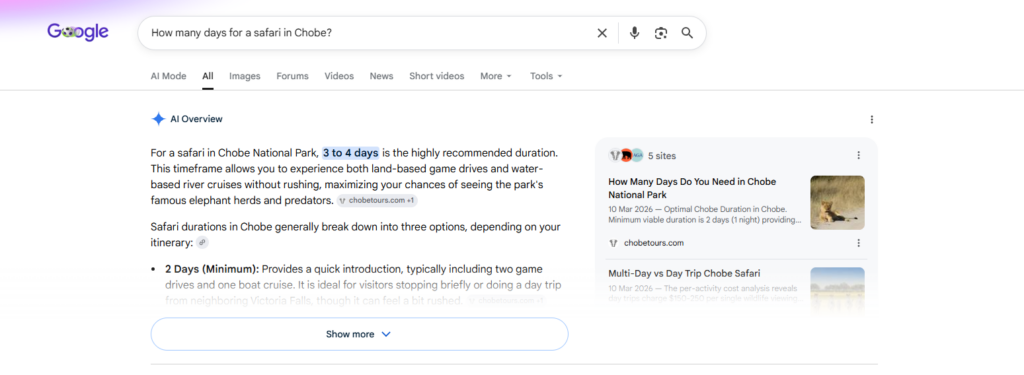
If the answer appears immediately in a featured snippet, knowledge panel, map result, calculator, weather box, AI Overview, or other search feature, the user may leave without visiting any website.
That is zero-click search.
But here is the important part: zero-click does not mean zero value.
It means the search journey has changed. Visibility is no longer only about winning the click. It is also about being the source that shapes the answer.
Why Zero-Click Search Matters Now
For years, SEO was largely measured through a simple path:
A user searches. A website ranks. The user clicks. The website receives traffic. The business tries to convert that traffic.
That path still exists, but it is no longer the whole story.
Search engines now answer more questions directly inside the search results. Google’s AI Overviews and AI Mode have accelerated this shift. Google’s own guidance says pages that are indexed and eligible for snippets can appear as supporting links in AI Overviews and AI Mode, with no special technical requirement beyond normal search eligibility. Google Search Central
Recent industry research also shows why this matters. SparkToro reported that 58.5% of U.S. searches ended without a click in 2024. SparkToro
Ahrefs found that the presence of an AI Overview correlated with a 58% lower average click-through rate for the top-ranking page in its December 2025 data. Ahrefs
Pew Research also found that users who encountered an AI summary clicked traditional search results less often than users who did not see one. Pew Research Center
The direction is clear: search is becoming more answer-led, more AI-assisted, and less dependent on the old model of “rank first, get the click automatically,” which means organic search traffic is declining as more queries are resolved on the results page and overall search traffic reaches fewer websites.
That does not mean SEO is dead. It means marketers are shifting toward stronger brand visibility on the results page, not just chasing clicks.
What Counts as a Zero-Click Result?
A zero-click result is any search experience where the user gets enough information on the results page and does not need to visit another website.
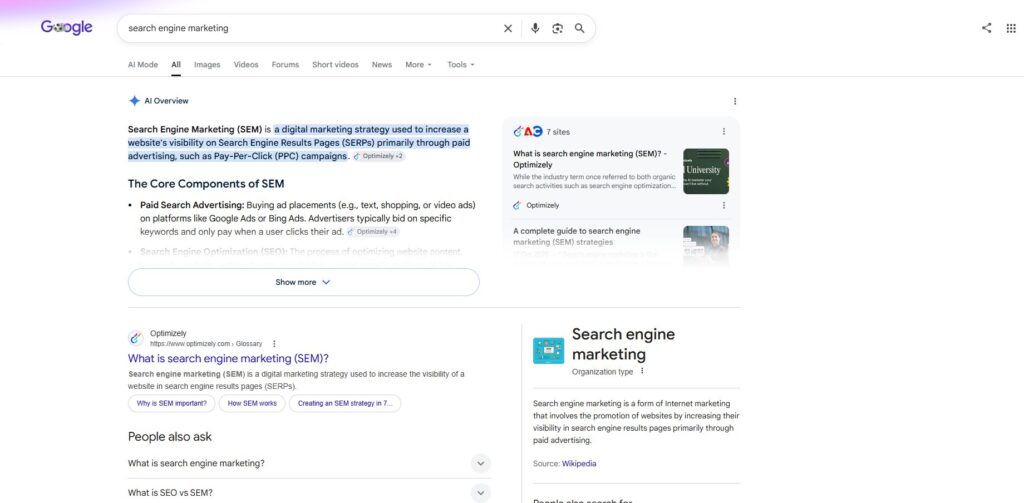
Common examples include:
Featured Snippets
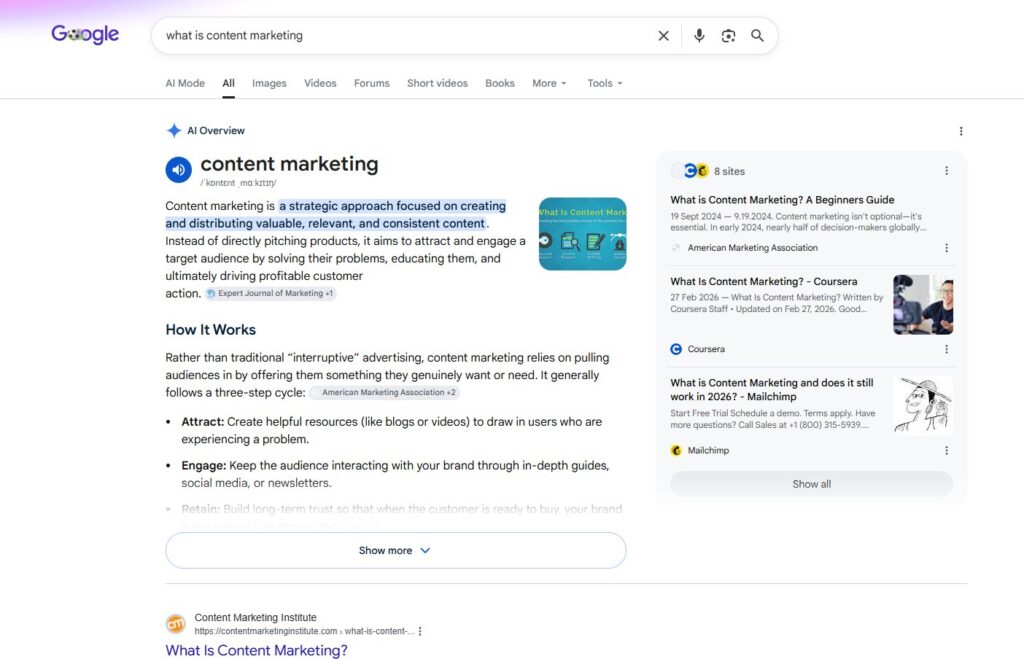
A featured snippet is a highlighted answer pulled from a webpage and displayed near the top of Google’s results.
If someone searches “what is content marketing,” Google may show a short definition from a website. Featured snippet eligibility improves when content gives direct answers to specific user queries. The user reads the definition and leaves. The website earned visibility, but not necessarily a visit.
Knowledge Panels
Knowledge panels appear for people, brands, organizations, places, and entities. They often include summaries, images, social profiles, business details, and related information.
For brands, this matters because Google is not just ranking pages. It is building an understanding of who you are.
Local Packs and Map Results
If someone searches “restaurants near me,” “hotel in Maun,” or “digital marketing agency in Gaborone,” they may interact with map listings, phone buttons, reviews, opening hours, and directions without clicking a website.
For local businesses and tourism operators, this is one of the most important zero-click environments.
Visibility in local searches improves with local SEO when structured data helps search engines understand key details like business information, increasing eligibility for rich local results.
AI Overviews
AI Overviews generate a summarized answer using Google’s systems, often with links to supporting sources, and they appear in approximately 30% of informational queries. These appear for many informational and complex searches.
This changes how users consume information. Instead of opening five tabs, they may read the AI-generated summary first, then click only if they need depth, trust, a quote, a booking option, or a more specific explanation. Strong ai responses can also shape visibility before the visit, and being cited in an AI Overview can strengthen trust even before a click happens.
Calculators, Converters, Weather, Flights, and Quick Tools
Some searches are purely functional. A user wants a conversion, calculation, forecast, time, or translation.
These are naturally low-click searches. No business should build its entire SEO strategy around queries where the user’s need is fully satisfied by a tool.
Why Zero-Click Search Is Growing
Zero-click search is growing because search engines are trying to reduce friction.
That sounds useful for users, and often it is. If someone wants the weather, they do not need a 1,500-word article. They need the weather.
But for publishers, businesses, bloggers, and brands, the shift is more complicated.
There are four main drivers.
1. Google Wants to Keep Users Inside Its Ecosystem
Google earns attention by being useful. The longer users stay in Google’s environment, the more control Google has over the search experience, advertising space, and user journey.
This is not new. Featured snippets, People Also Ask boxes, map packs, shopping results, and knowledge panels were all part of this direction long before generative AI became mainstream.
AI Overviews simply made the answer layer more powerful.
2. Users Want Faster Answers
Many users prefer fast answers from search engines instead of visiting multiple sites. They are quick checks.
A user may not want to compare five websites just to know what “zero-click search” means. They want the answer now. Search engines increasingly provide instant answers through AI and natural language processing, which is reshaping search behavior.
This is why simple informational content is under pressure. If your article only gives a basic definition, search engines can summarize it easily.
3. AI Can Synthesize Multiple Sources
Traditional search listed sources. AI search summarizes them.
That means content is no longer competing only for position. It is competing to be referenced, summarized, cited, trusted, and used as part of an answer.
This is a major shift for SEO strategy.
4. Search Results Are Becoming More Visual and Interactive
Modern search results include maps, videos, product listings, reviews, images, FAQs, filters, AI-generated summaries, and direct actions.
The search results page itself has become a destination.
For businesses, this means your digital presence is not only your website. It includes your Google Business Profile, reviews, structured data, social proof, citations, brand mentions, and the clarity of your content across the web.
Is Zero-Click Search Bad for SEO?
Not automatically.
Zero-click search is bad for SEO when your strategy depends on shallow traffic from low-intent queries.
It is less threatening when your strategy is built around authority, trust, commercial intent, brand demand, and content that earns deeper engagement.
The mistake is thinking every lost click has the same value.
Some clicks were never going to become customers. Zero-click searches can reduce overall website traffic, but they can also filter more of the remaining visits toward higher-quality leads from stronger-intent searches. A person who searches “what is SEO” may read a definition and leave. That visit may inflate traffic, but it may not help the business.
A person who searches “SEO consultant for tourism business” or “how to increase direct bookings for a lodge” is different. That search has more intent, more context, and more business value.
Zero-click search forces marketers to ask a better question:
Are we chasing traffic, or are we building demand, trust, and qualified visibility?
The Difference Between Traffic and Visibility
In the old SEO mindset, traffic was the prize.
In the new search environment, visibility has layers.
A brand can appear in:
- Traditional organic results
- Featured snippets
- AI Overviews
- Local packs
- Image results
- Video results
- Review platforms
- Social search
- Answer engines
- Industry directories
- Comparison content
- Brand mentions across trusted sources
Some of those appearances will produce clicks. Some will increase brand recognition through zero click visibility even when no click occurs. Strong search visibility can also influence a later direct visit. Some will help a user choose your brand without ever reading your blog post.
Semrush can help you find these gaps and successes by showing you where your brand is being mentioned.
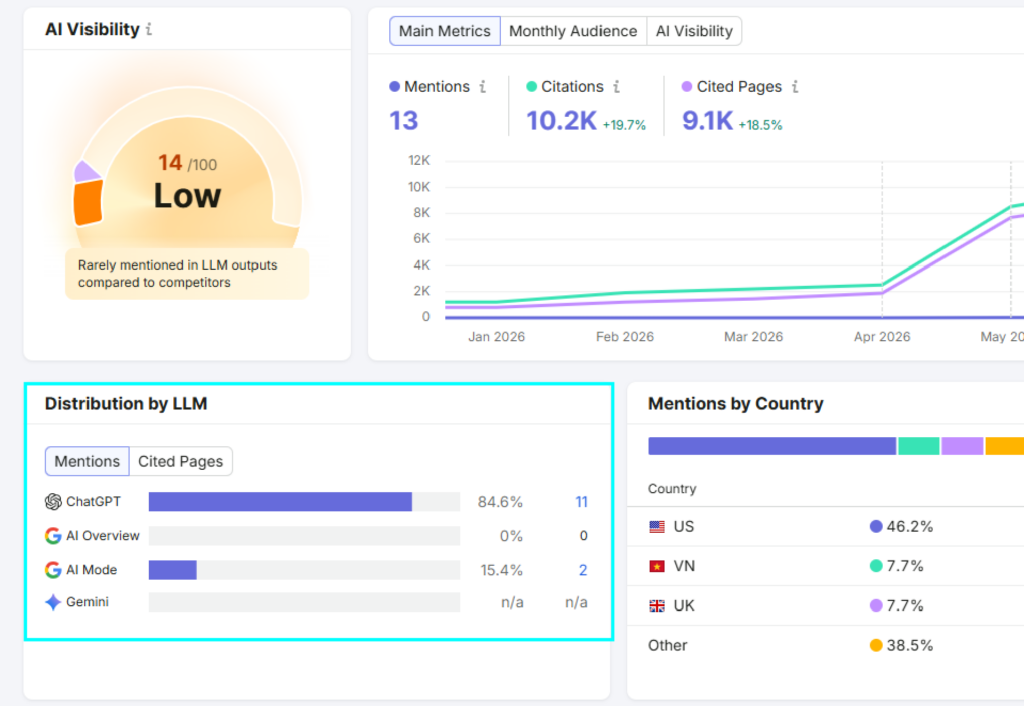
This is why attribution becomes harder.
A customer may discover your lodge in a Google result, see your name in an AI answer, check your reviews, view your Instagram, and later search your brand directly. If you only measure the final click, you miss the real journey.
Zero-click search makes brand memory more important.
What Types of Content Are Most at Risk?
Not all content is affected equally.
The most vulnerable content usually has one or more of these qualities:
Basic Definitions
Articles that only answer “what is X?” with a simple definition are easy to summarize.
That does not mean definition content is useless. It means the definition must lead into something more valuable: examples, strategy, implementation, mistakes, frameworks, and decision-making guidance.
Simple Fact-Based Answers
Dates, prices, locations, formulas, exchange rates, weather, and short factual answers often do not require a click.
If your content is only a container for basic facts, it is vulnerable.
Generic Listicles
Thin listicles with predictable points are also easy for AI systems to compress.
If an article says the same thing every other article says, it gives the user little reason to click.
Top-of-Funnel Content With No Strategic Depth
Educational content is still valuable, but it must carry a stronger point of view.
A basic article called “What Is Digital Marketing?” may struggle. A more useful article like “What Digital Marketing Means for Tourism Businesses That Depend on Direct Bookings” has a sharper audience, clearer commercial relevance, and more defensible value.
What Types of Content Still Earn Clicks?
Clicks do not disappear. They become more selective.
People still click when they need:
Depth
AI summaries are useful, but they are not always enough.
A serious reader still clicks when they need a complete explanation, examples, templates, screenshots, comparisons, or a practical process.
Trust
For topics involving money, health, legal issues, business strategy, travel planning, or major decisions, users often want to verify the source.
Trustworthy brands, expert authors, transparent sourcing, and clear experience matter.
Original Insight
AI can summarize common knowledge. It struggles more with lived experience, original frameworks, strong opinion, proprietary data, and specific field expertise.
This is where good content becomes more valuable, not less.
Tools and Actions
Users click when they need to book, buy, download, compare, calculate, request a quote, view availability, or speak to someone, so while zero-click search can reduce visits and make it harder to drive traffic, these action-oriented pages often attract higher-quality leads when users are ready to act.
A tourism business, for example, should not only publish destination guides. It should connect those guides to itineraries, availability, enquiry paths, packages, and direct booking opportunities.
Brand Preference
If people know your name, they are more likely to search for you directly or choose you from a crowded results page.
Brand is not separate from SEO. Brand is what makes SEO more resilient.
How Businesses Should Adapt Their SEO Strategy
The answer to zero-click search is not to stop creating content.
The answer is to create content that deserves to exist beyond the summary.
Here is the practical shift.
1. Build Content Around Search Intent, Not Just Keywords
A keyword tells you what someone typed. Intent tells you what they need.
For example, the keyword “zero-click search” could mean several things:
- A beginner wants a definition.
- A marketer wants to know why traffic is dropping.
- A business owner wants to know if SEO is still worth investing in.
- A content strategist wants to know how to adapt.
- A publisher wants to understand AI Overviews and click loss.
A strong article should satisfy the obvious definition, then move into the deeper business problem.
This is where many blogs fail. They answer the keyword but not the reader’s real concern.
2. Create Answer-Friendly Sections
If search engines and AI systems are extracting answers, make your content easy to understand.
Use clear headings and bullet points where appropriate. Define terms directly, and optimize content so sections can be pulled into featured snippets and AI Overviews. Answer common questions in plain language. Avoid hiding the main point under long introductions.
This does not mean writing robotic content. It means respecting the reader’s need for clarity.
A good structure helps humans first. AI visibility is the secondary benefit.
3. Go Beyond the Definition
For a topic like zero-click search, do not stop at “what it is.”
Cover:
- Why is it happening
- What types of results cause it
- How it affects SEO reporting
- Which content is most vulnerable
- How brands should respond
- What metrics to track
- How it connects to AI search and answer engines
This is how a basic article becomes a strategic asset.
4. Strengthen Entity Signals
Search engines need to understand who you are, what you do, where you operate, and why you are credible. Schema markup helps search engines understand entities, and the FAQPage schema may improve visibility in AI Overviews when it fits the content.
For a business or personal brand, that means keeping your entity signals consistent across:
- Website copy
- About page
- Author bio
- Google Business Profile
- Social profiles
- Industry listings
- Podcast appearances
- Guest articles
- Schema markup
- Reviews and testimonials
- Organization and person descriptions
The goal is not only to rank a page. The goal is to help search systems understand the brand behind the page.
5. Optimize for Click-Worthy Value
If the search result already gives the basic answer, your page must offer the next level.
That could include:
- A practical checklist
- A decision framework
- A downloadable template
- A comparison table
- Original examples
- A step-by-step process
- A local or industry-specific perspective
- A strong expert opinion
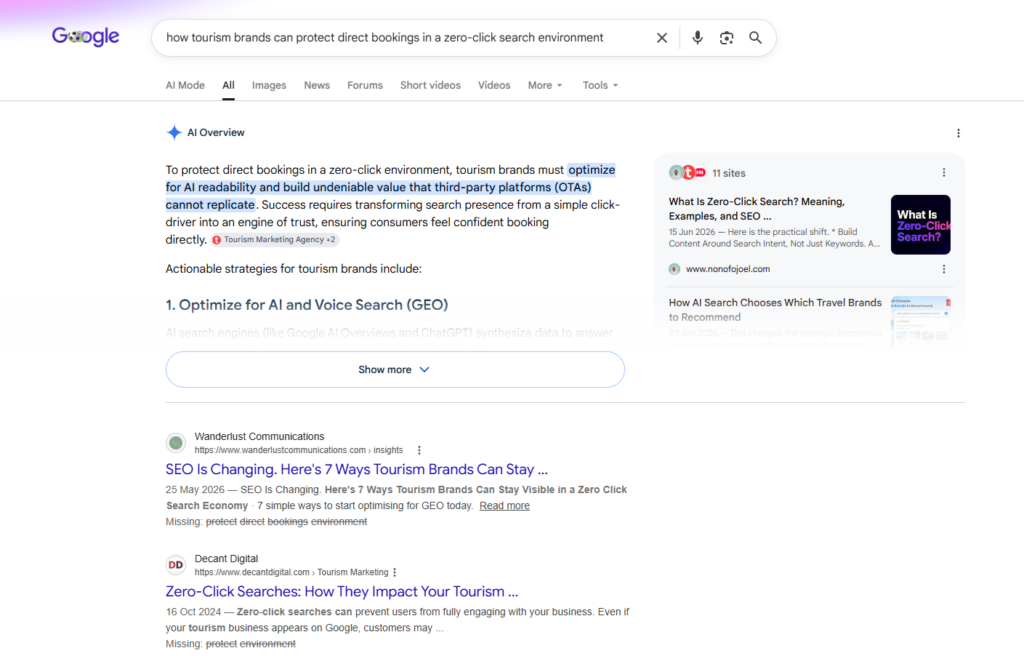
For example, “what is zero-click search” is broad. But “how tourism brands can protect direct bookings in a zero-click search environment” is more specific, more useful, and more commercially meaningful.
6. Treat Local Search as a Conversion Surface
For local and tourism businesses, zero-click search often happens in maps and business listings.
A user may never visit your website before calling, requesting directions, reading reviews, or comparing photos.
That means your Google Business Profile is not a side task. It is a conversion asset.
Keep these elements strong:
- Accurate business categories
- Updated opening hours
- High-quality photos
- Clear service descriptions
- Review generation and responses
- Booking links
- FAQs
- Location relevance
- Consistent name, address, and phone details
For hospitality and tourism brands, this can directly influence bookings.
7. Measure More Than Organic Clicks
If you only track clicks, zero-click search will make your SEO look weaker than it really is.
You should still track organic traffic, but also watch:
- Search impressions
- Branded search growth
- Assisted conversions
- Direct traffic trends
- Google Business Profile calls and direction requests
- Enquiries from organic landing pages
- Ranking visibility across search features
- Mentions in AI Overviews or answer engines
- Newsletter signups
- Lead quality
- Revenue influenced by organic discovery
The mature question is not “Did this blog post get traffic?”
The better question is “Did this content increase qualified visibility, trust, and demand?”
Zero-Click Search and AI Search Are Connected
Zero-click search existed before AI. But AI has changed its scale and character. AI Overviews appeared for 13.14% of queries in March 2025, underscoring how quickly this layer is scaling.
A featured snippet gives a short extracted answer.
An AI Overview can synthesize a fuller explanation from multiple sources, add context, and guide the user through a topic without requiring an immediate click.
That means businesses need to think beyond traditional SEO and into AI visibility across Google, ai search engines, and ai platforms.
AI visibility is about making your brand, content, and expertise easy for AI systems to identify, trust, summarize, and cite. It also means being identifiable and citable inside AI-generated answers and AI-generated responses across modern search platforms.
This includes classic SEO fundamentals, but it also requires stronger information architecture, clearer topical authority, better source credibility, and more consistent brand signals.
Google’s guidance is still clear that SEO remains relevant for generative AI search because these features are rooted in Google’s search ranking and quality systems. Google Search Central
So the path forward is not to abandon SEO.
The path forward is to make SEO more strategic.
A Practical Zero-Click SEO Framework
Here is a simple framework businesses can use.
1. Defend
Protect the search terms that already matter to your business.
This includes branded searches, service pages, location pages, high-intent commercial keywords, and local listings.
Make sure the people already looking for you can find accurate, persuasive, up-to-date information.
2. Deepen
Upgrade thin informational content into genuinely useful resources.
Add examples, frameworks, industry context, original thinking, and next steps.
If an AI summary can fully replace your article, the article probably needs more depth.
3. Differentiate
Bring a specific perspective.
A generic article about “SEO tips” is easy to ignore. An article about “SEO strategy for safari lodges that want more direct bookings” has a sharper reason to exist.
Specificity is a competitive advantage.
4. Distribute
Do not depend only on Google.
Use email, social platforms, partnerships, guest publishing, YouTube, podcasts, webinars, and community channels to create demand beyond search.
The strongest brands are not only found. They are remembered.
5. Convert
Make the next step clear.
If a reader does click, do not waste the visit. Give them a useful path: subscribe, enquire, book, download, compare, request an audit, or read the next strategic guide.
Traffic without conversion architecture is just movement.
What Zero-Click Means for Content Strategy
Zero-click search is a signal that content strategy must mature.
The old approach was to publish many articles around many keywords and hope traffic would compound.
That still works in some cases, but it is weaker than it used to be.
A stronger content system is built around topical authority, business relevance, and reader usefulness. Broader visibility can still support downstream brand demand, and some teams reported branded search volume increased by 21% after AI Overviews launched as they adapted their seo efforts.
For example, a digital strategist writing about AI search should not only publish isolated articles like:
- What is AI search?
- What is zero-click search?
- What is AEO?
Those articles are useful, but they should connect into a larger content architecture:
- AI visibility strategy
- SEO and AI search for small businesses
- Content systems for answer engines
- Brand authority in search
- Measurement beyond clicks
- Practical guides for industries like tourism, nonprofits, and service businesses
That is how a website becomes more than a collection of posts.
It becomes a knowledge base that supports authority, trust, and business growth.
The Biggest Mistake Businesses Make
The biggest mistake is reacting to zero-click search with panic.
The second biggest mistake is ignoring it.
The right response is a strategic adjustment. The zero-click trend has grown steadily, with 62.41% of searches ending without a click in 2021, up from 54.11% in 2017. Mobile zero click behavior is even more pronounced, with 77% of mobile queries ending without a click in early 2025.
Do not assume every lost click is a lost customer. But do not assume visibility without clicks is enough either.
Your job is to understand where clicks still matter, where visibility has value without clicks, and where your content must become stronger to earn deeper engagement.
A basic answer may win a search feature.
A useful, trusted, specific, well-structured resource can win the reader.
That is the real goal.
Zero-Click Search Is Not the End of SEO
Zero-click search is not the death of SEO. It is the end of lazy SEO.
In a zero-click world, voice search also shapes discovery, and about 70% of voice search answers pull directly from featured snippets.
It challenges businesses to stop treating search as a traffic machine and start treating it as a visibility, authority, and demand-building system in a landscape where search features and voice interfaces shape discovery.
The brands that will benefit are the ones that understand the new search journey:
- Be visible where answers are formed.
- Be credible enough to be cited.
- Be useful enough to earn the click when the reader needs depth.
- Be memorable enough to win the direct search later.
- Be strategic enough to connect content to business outcomes.
Zero-click search changes the scoreboard.
Traffic still matters. But authority, trust, brand demand, and conversion quality matter more than ever.
Frequently Asked Questions (FAQs)
What is zero-click search?
Zero-click search refers to search queries in which users find their answers directly on the search engine results page (SERP) without clicking through to any external website. This happens through features like featured snippets, knowledge panels, AI Overviews, and local packs.
How does zero-click search affect website traffic?
Zero-click search can reduce organic traffic because users find answers immediately on the SERP and do not click through to websites. However, it can increase brand visibility and trust by showing your content in search features and AI-generated answers.
What are common zero-click search features?
Common zero-click features include featured snippets, knowledge panels, local packs, AI Overviews, calculators, converters, and People Also Ask boxes. These features provide direct answers or actions within the search results.
How can website owners optimize for zero-click search?
Website owners can optimize by creating clear, concise content that directly answers user questions, using structured data like schema markup, targeting relevant keywords, and building strong brand authority across multiple digital channels.
Are zero-click searches only a Google phenomenon?
While Google dominates, zero-click search features are also present on other search engines and AI platforms. A comprehensive search strategy includes optimizing for Google as well as other search engines and AI tools.
How do zero-click searches impact SEO professionals?
SEO professionals must shift focus from purely driving clicks to enhancing visibility, brand authority, and engagement metrics. They should track zero-click metrics alongside traditional SEO KPIs to measure success effectively.
What metrics should businesses track in a zero-click search environment?
Businesses should monitor visibility metrics, branded search volume, zero-click metrics, engagement metrics, assisted conversions, and data from tools like Google Analytics and Google Search Console to understand the full impact of zero-click searches.
Can zero-click searches be leveraged for ecommerce sites?
Yes, ecommerce sites can benefit by optimizing product listings with schema markup, appearing in shopping carousels, and ensuring accurate local business information to capture zero-click traffic that drives conversions.
How are AI tools changing zero-click search?
AI tools like Google AI Overviews synthesize information from multiple sources to provide complete answers on the SERP, increasing zero-click searches. Optimizing content for generative engine optimization helps brands get cited in these AI-generated responses.
What is the future of zero-click search?
Zero-click search is expected to grow as AI and search engines evolve. Website owners and SEO professionals need to adapt by focusing on visibility, brand trust, and creating content that can be used by AI systems and search engines to provide complete answers.