The Agentic Web: What It Means for SEO, Brand Visibility, and Website Strategy
The agentic web is changing how people discover brands online. As AI agents begin handling more research, comparison, and shortlisting, businesses need websites that are easier to understand, verify, and recommend.

For years, digital strategy has revolved around one familiar assumption: a person searches, compares, clicks through a few websites, and eventually decides.
That assumption is starting to change.
We are moving into what many now describe as the agentic web: a web where AI agents do more than answer questions. They can research options, compare products or services, evaluate claims, and increasingly take action on a user’s behalf.
That shift matters because it changes how discovery works.
Instead of relying entirely on human browsing behavior, brands now need to think about how they appear to intelligent systems that may be doing the filtering first.
In that environment, visibility is no longer only about attracting attention. It is also about being easy for AI to interpret, validate, and recommend.
What Is the Agentic Web?
The agentic web refers to an online environment where AI systems play a more active role in decision-making and task completion.
Rather than simply generating responses, AI agents can help users by:
- researching providers
- comparing offers
- checking pricing and features
- scanning proof points
- narrowing down choices
- taking action based on the user’s goals
In simple terms, the web is becoming less passive. People are no longer the only ones doing the searching and evaluating. In many cases, software agents may take on part of that work first.
That creates a new challenge for brands: your business needs to make sense not only to human visitors, but also to systems deciding whether you deserve a place on the shortlist.
Why the Agentic Web Matters for SEO and Digital Visibility
The biggest implication of the agentic web is that discovery may happen before a human even visits your site.
That changes the role of SEO.
Traditional SEO has often focused on ranking pages for searches, capturing clicks, and guiding visitors through the buyer journey. Those fundamentals still matter. But now there is another layer to consider: whether your content and website structure help AI systems understand what you offer and when your business is a good fit.
If an AI agent is helping a user find the best solution, it needs clear information to work with. It must be able to interpret your positioning, compare your offer, and validate your claims.
That means digital visibility is shifting from pure discoverability to discoverability plus interpretability.
The Buyer Journey Is Getting Shorter
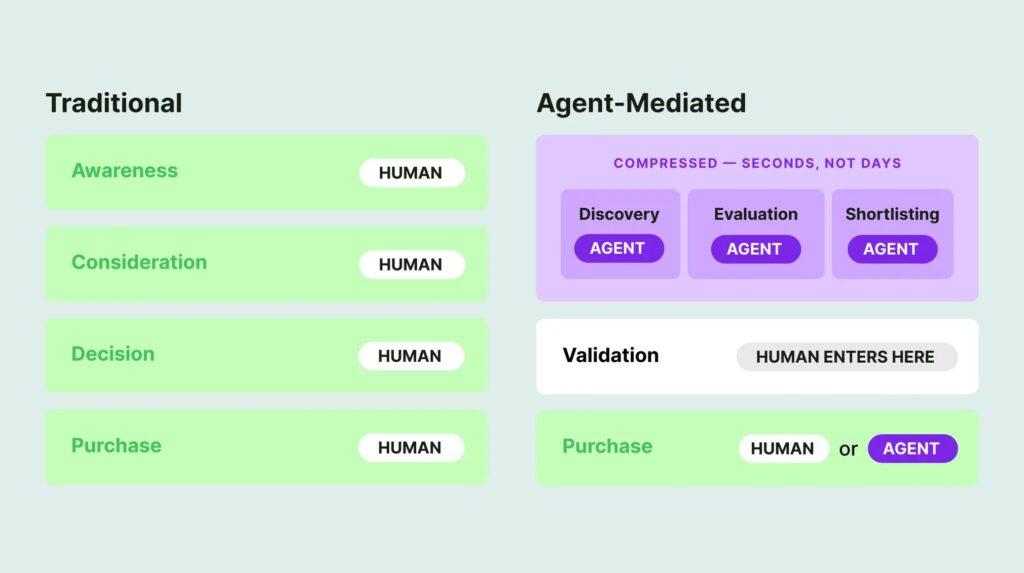
One of the most important effects of the agentic web is that the customer journey may begin to compress.
Traditionally, buyers moved through several stages:
- awareness
- research
- comparison
- decision
- action
But if an AI agent handles most of the research and evaluation, the user may arrive much later in that journey. Instead of exploring dozens of options, they may only review a short list that has already been filtered for them.
At that point, the user acts less like a researcher and more like an approver.
This matters because brands may have fewer chances to shape the decision once it reaches the human. If your website is hard to interpret, vague in its messaging, or weak on proof, you may be excluded before the person ever sees your offer.
Why Your Website Must Work for Both Humans and AI Agents
A website that works well for people is still essential. Clear messaging, good design, and easy navigation are not going away.
But in the agentic web, those strengths need to be supported by something else: clarity that machines can process with confidence.
AI agents need to understand things like:
- what your business does
- who you serve
- what problems you solve
- what your pricing or packages look like
- how your offer differs from alternatives
- what evidence supports your claims
If that information is hidden, inconsistent, or too vague, the AI has to guess. And when systems have to guess, they are less likely to recommend with confidence.
This is why websites now need to be designed for two audiences at once: human readers and intelligent systems.
Specificity Is a Competitive Advantage in the Agentic Web
Generic positioning has always been weak. In the agentic web, it becomes even weaker.
A broad statement like “we help businesses grow online” sounds polished, but it says very little. It does not help an AI agent determine whether your business is relevant for a specific need.
Specificity is far more useful.
The clearer you are about your offer, the easier it becomes for AI systems to match your business to the right user. That includes being precise about:
- your industry focus
- your audience
- your core services
- your use cases
- your business model
- your outcomes
For example, “SEO strategy for tourism brands” is far stronger than “digital marketing services.” It signals a clear fit. It gives both the user and the AI a better basis for evaluation.
This is where many businesses will need to improve. The brands most likely to benefit from the agentic web may not be the broadest. They may be the clearest.
Proof Signals Matter More Than Ever
If AI agents are going to compare and recommend brands, they need trust signals they can detect and interpret.
That makes proof more valuable.
Strong proof signals include:
- testimonials
- case studies
- reviews
- pricing transparency
- service detail pages
- use-case pages
- process explanations
- FAQs
- documented outcomes
These assets are no longer only useful for persuading a human visitor. They also help AI systems validate whether your claims are credible and whether your business fits the request.
A site with clearer proof may be easier for an AI system to trust than a site built around high-level claims and polished visuals alone.
What Businesses Should Change Now
You do not need to rebuild everything at once. But you do need to become far more deliberate about how your digital presence communicates value.
In the agentic web, clarity becomes a competitive advantage. AI agents are more likely to recommend brands that are easy to understand, easy to verify, and easy to match to a specific need. That means the goal is no longer just to have a professional-looking website. The goal is to have a website that reduces uncertainty for both people and intelligent systems.
Here are five practical places to start.
1. Sharpen your positioning
Make it immediately clear what you do, who you serve, and where you are strongest.
Many websites still rely on broad language that sounds polished but says very little. Phrases like “we help businesses grow” or “we provide innovative solutions” may feel safe, but they do not create enough clarity for a buyer or an AI agent trying to assess fit.
Your positioning should answer a few basic questions quickly:
- What exactly do you offer?
- Who is it for?
- What kind of problem do you solve?
- In what context are you strongest?
The more specific your language, the easier it becomes for your business to be matched to the right opportunity. This is especially important in a world where AI systems may be filtering options before a person ever lands on your site.
2. Reduce ambiguity across your website
Clarify your services, process, pricing, and outcomes. Remove avoidable friction.
Ambiguity creates work. And both humans and AI agents tend to avoid unnecessary work when better-defined options are available.
If your website makes visitors guess about what you do, how you work, what your service includes, or what happens next, you are creating friction at the exact moment trust needs to increase. The same is true for AI systems trying to interpret your offer.
This does not mean every website needs full public pricing or overly long explanations. It means the essentials should be easy to find and easy to understand. Service pages should explain scope. Process pages should show how engagement works. Outcomes should be stated clearly. Calls to action should feel logical rather than vague.
A clearer site is not just better for conversion. It is also easier for AI to interpret with confidence.
3. Add stronger proof
Use testimonials, case studies, use cases, and FAQs to support your claims.
Claims without evidence are becoming less useful online. In the agentic web, proof matters because intelligent systems need signals they can use to validate whether your business is credible and relevant.
That proof can take different forms:
- testimonials from the right kind of clients
- case studies tied to real outcomes
- use-case pages that show where your offer fits best
- FAQs that answer buyer concerns directly
- examples of results, process, or transformation
The key is relevance. Generic praise is weaker than proof that connects your work to a specific audience, challenge, or result. Strong proof helps a buyer trust you faster, and it gives AI systems more substance to work with when comparing alternatives.
4. Create content around real decisions
Publish articles and landing pages that help users understand when your offer is the right fit.
A lot of content still chases attention without helping people make decisions. But in the agentic web, content that supports evaluation becomes far more valuable.
That means creating content around the questions buyers actually ask when they are trying to choose:
- Who is this service best for?
- When should a business invest in this?
- What are the alternatives?
- What mistakes should be avoided?
- How do I know which option fits my situation?
This kind of content does two things at once. It helps people move forward with more confidence, and it gives AI systems clearer material to summarize, cite, and use in recommendation flows.
Instead of publishing only broad awareness content, businesses should invest more in decision-stage content that makes fit, trade-offs, and next steps easier to understand.
5. Treat AI visibility as a strategic issue
Do not isolate this as a technical SEO trend. It affects messaging, website structure, content, and trust.
One of the biggest mistakes businesses can make is treating AI visibility as if it belongs only to the SEO team. The shift is broader than that.
If AI agents are becoming part of digital discovery, then your ability to appear in those systems depends on much more than metadata or rankings. It depends on how well your business is positioned, how clearly your website communicates, how much proof you provide, and how easy it is to connect your offer to the right use case.
In other words, this is not only a search problem. It is a communication problem, a trust problem, and a strategic positioning problem.
Businesses that understand that early will be in a stronger position. They will not just optimize for traffic. They will build digital ecosystems that are easier to understand, easier to trust, and easier to recommend.
The Agentic Web Is Bigger Than a Search Trend
It is easy to think of the agentic web as just another SEO development. But it is broader than that.
This shift affects:
- brand positioning
- content strategy
- website architecture
- conversion pathways
- trust-building
- digital visibility
In other words, it is not only about whether you rank. It is about whether your business is clearly understood in environments where AI influences the decision before the click happens.
That makes the agentic web a strategic issue, not just a tactical one.
Final Takeaway
The agentic web changes a simple assumption about digital discovery: people may no longer be the only ones doing the research.
As AI agents take on more of the work of comparing, filtering, and shortlisting, brands will need to make their websites easier to interpret, verify, and recommend. That means clearer positioning, stronger proof, better structure, and more useful content.
The next phase of digital visibility will not belong only to the brands that get seen.
It will belong to the brands that are easiest for both people and AI to understand.