Top 10 AI Visibility Tools in 2026
A detailed comparison of the best tools for measuring brand presence in AI search, understanding citations, and improving discoverability across answer engines

AI visibility is quickly becoming its own layer of digital performance. A brand can rank well in traditional search and still be weak in ChatGPT, Google AI Overviews, Gemini, Perplexity, Copilot, and other answer-led environments. That gap is exactly why AI visibility tools are becoming more relevant.
The challenge is that this category is still noisy. Some tools are built specifically for AI search monitoring. Some are extending classic SEO platforms into AI visibility. Others are really content tools, site intelligence tools, or prompt-monitoring products with AI visibility features added on top.
That makes comparison harder than it should be. If you are choosing a tool in 2026, the real question is not simply which platform has the most features. It is which tool gives you the clearest picture of your brand’s AI presence, the most useful competitive context, and the most actionable next step.
This guide breaks down the top 10 AI visibility tools in 2026 in a more practical way: what each tool does well, where it is strongest, where it is limited, and which type of team it fits best.
What are AI visibility tools?
AI visibility tools help brands understand whether they are being surfaced, cited, or mentioned in AI-generated answers. Depending on the tool, that can include prompt-level tracking, citation analysis, share of voice, AI referral traffic, technical accessibility checks, competitor comparisons, and content recommendations.
The best tools do more than report visibility. They help explain why one brand is being surfaced while another is being ignored. That is what makes them useful. Good AI visibility software should move you from observation to diagnosis and then from diagnosis to action.
How to choose the right tool
If you want an all-round platform that connects AI visibility to broader SEO work, look first at Semrush or SE Ranking.
If your workflow is content-first and you want AI visibility tied to publishing, Surfer and Writesonic make more sense.
If you want a specialist AI visibility platform, Rankscale, OtterlyAI, and Peec AI are more focused options.
If your business needs enterprise intelligence around AI traffic and market behavior, Similarweb and Ahrefs Brand Radar are stronger strategic products than many lighter tools.
If you want a free starting point for early experimentation, HubSpot AI Search Grader is one of the easiest entry points.
Quick comparison table
| # | Tool | Best known for | Best fit |
| 1 | SemrushSemrush AI Visibility Toolkit | All-in-one SEO and AI visibility | Agencies, in-house SEO teams, marketing leads |
| 2 | SE Ranking AI Visibility | Value-focused all-rounder | Smaller teams and consultants |
| 3 | Surfer AI Tracker | Content-led optimization | Content teams and editorial marketers |
| 4 | Writesonic AI Visibility | AI search plus execution stack | Lean teams that want one AI-heavy workflow |
| 5 | Rankscale | Specialist AI visibility tracking | Teams that want a dedicated AI search tool |
| 6 | Similarweb AI Search Intelligence | Market and traffic intelligence | Enterprise teams and strategic planners |
| 7 | Ahrefs Brand Radar | Brand-level AI discovery analysis | Advanced SEO and brand teams |
| 8 | OtterlyAI | Accessible GEO monitoring | Small and mid-sized teams |
| 9 | Peec AI | Prompt-based brand visibility analysis | Agencies and focused SEO teams |
| 10 | HubSpot AI Search Grader | Free entry-level visibility check | Beginners and top-of-funnel evaluation |
The Top 10 AI visibility tools in 2026
1. Semrush AI Visibility Toolkit
Best for: Teams that want AI visibility measurement inside a serious SEO workflow rather than in a standalone dashboard.
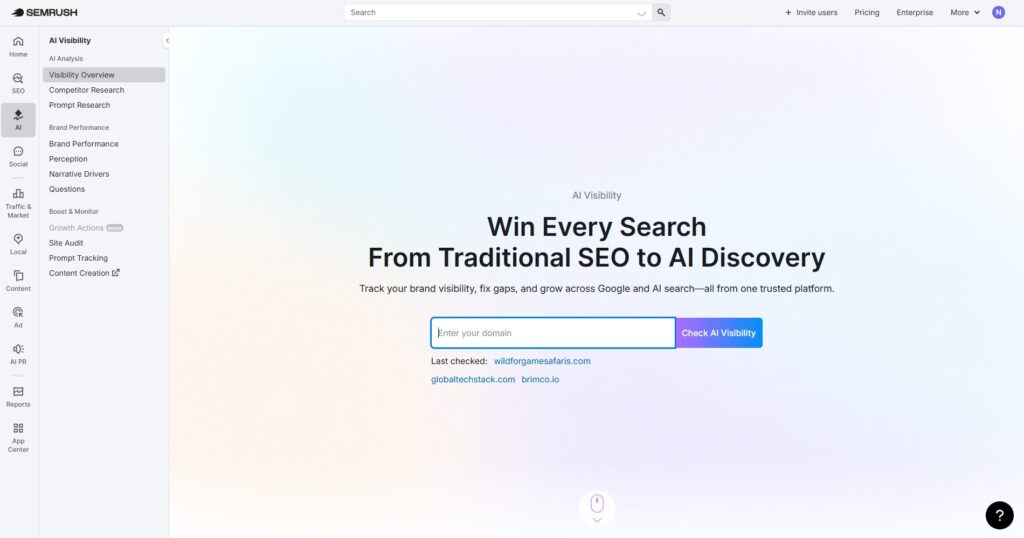
Semrush is one of the strongest options because it combines AI visibility tracking with the rest of the work teams already need to do: keyword research, technical auditing, competitor analysis, rank tracking, content review, and link intelligence.
Its AI Visibility Toolkit is useful because it does not isolate AI search from everything else. It helps you connect AI mentions and prompt opportunities to technical readiness, content gaps, brand strength, and classic SEO visibility.
That matters in practice. Most teams do not need another isolated reporting layer. They need to understand why they are weak in AI search and which existing marketing levers can actually improve that.
Where it is limited
Semrush is rarely the cheapest option, and some smaller teams may feel they are paying for more platform than they need.
If your only goal is lightweight AI answer monitoring, Semrush can feel broader than necessary.
Who should choose it: Choose Semrush when AI visibility is part of a wider SEO and content performance strategy, not a standalone experiment.
2. SE Ranking AI Visibility
Best for: Smaller teams that want a more affordable all-round platform without giving up strategic usefulness.
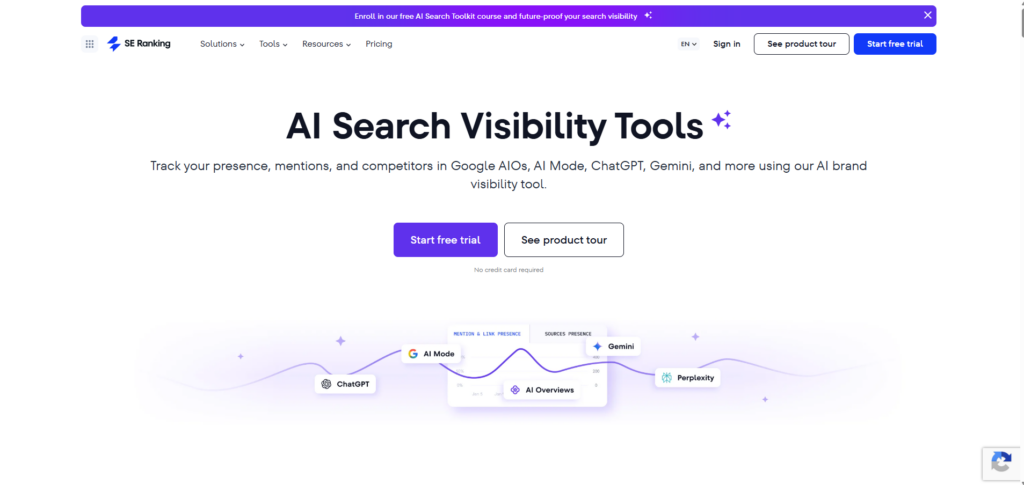
SE Ranking has become a serious contender because it covers a lot of the same operational ground that larger SEO suites cover, while staying easier to justify for smaller teams.
Its AI visibility features are especially useful for teams that want to track ChatGPT, AI Overviews, and other answer environments while still working inside one connected SEO platform.
This is one of the better tools for people who want practical coverage without enterprise cost or complexity.
Where it is limited
It does not have the same market gravity or ecosystem depth as Semrush.
For enterprise reporting or very advanced workflow needs, some teams will still outgrow it.
Who should choose it: Choose SE Ranking when you want strong value, a cleaner learning curve, and enough AI visibility coverage to make smart decisions without overspending.
3. Surfer AI Tracker
Best for: Content teams that want to understand how AI visibility connects to content structure, optimization, and topical coverage.
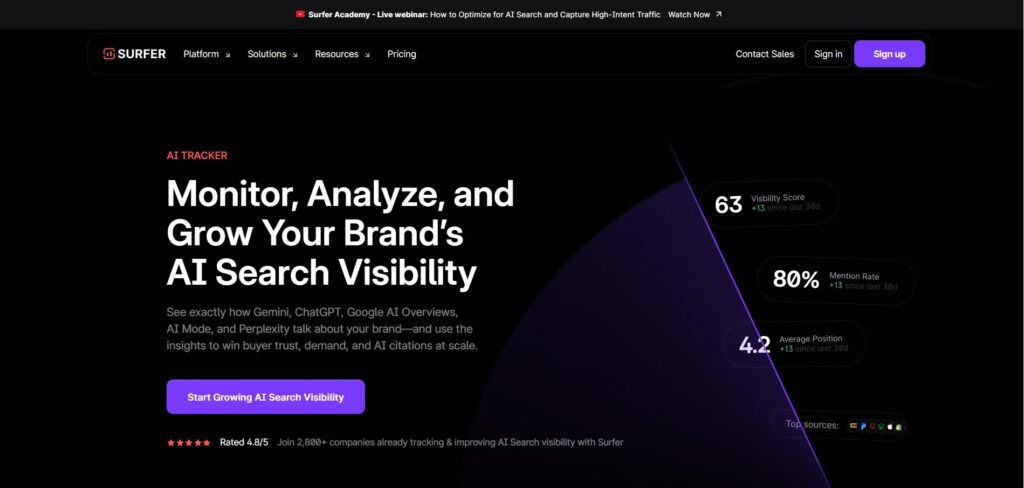
Surfer’s strength is that it naturally fits the workflow of teams already thinking in terms of content performance. Its AI Tracker is less about broad market intelligence and more about how your content is being picked up across major LLM environments.
That makes it especially useful for publishers, content marketers, and agencies that need to connect AI mentions back to on-page changes, internal linking, content expansion, and editorial quality.
If your biggest question is not ‘How big is this market?’ but ‘Why is this page or topic not being referenced?’, Surfer is easier to operationalize than some broader tools.
Where it is limited
Surfer is not the strongest option for enterprise market intelligence or AI traffic analysis.
Teams that are not content-led may find the product more publishing-oriented than they need.
Who should choose it: Choose Surfer when content optimization is the main engine behind your AI visibility strategy.
4. Writesonic AI Visibility
Best for: Lean teams that want one AI-heavy platform covering AI search visibility, content workflow, and execution support.
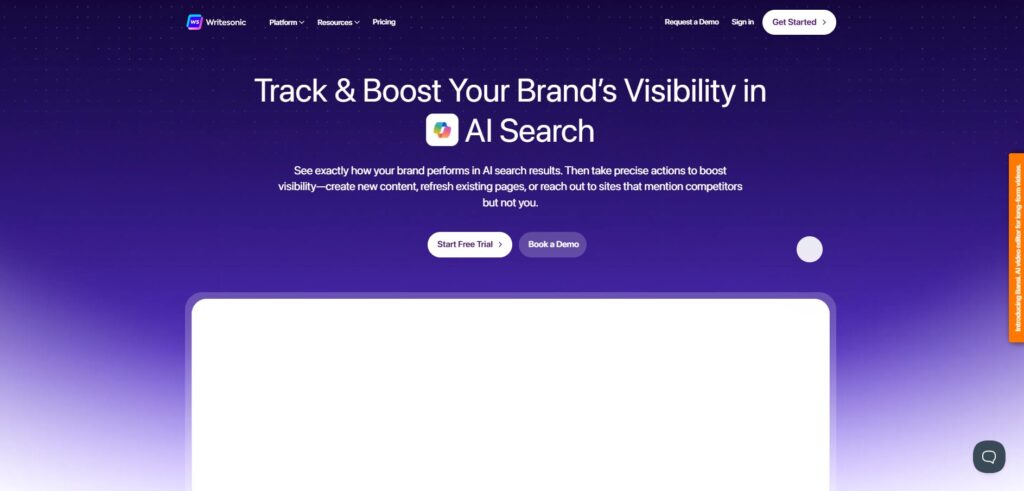
Writesonic has become more interesting because it is no longer only positioned as a writing assistant. It increasingly presents itself as an AI search workflow platform that helps users identify gaps, create content, and respond faster to AI visibility opportunities.
That makes it useful for smaller businesses, startups, and marketing teams that want to keep everything inside one AI-first workflow instead of stitching together multiple tools.
For teams that are comfortable with AI-assisted drafting and experimentation, this can be a very practical option.
Where it is limited
It may not satisfy teams that want deeper technical SEO analysis or more mature enterprise reporting.
Because the platform tries to cover a lot, some users will still prefer more specialized tools for measurement alone.
Who should choose it: Choose Writesonic when speed, AI-heavy execution, and workflow consolidation matter more than specialist depth in one narrow function.
5. Rankscale
Best for: Teams that want a dedicated AI visibility product built around this category rather than a legacy SEO platform expanding into it.
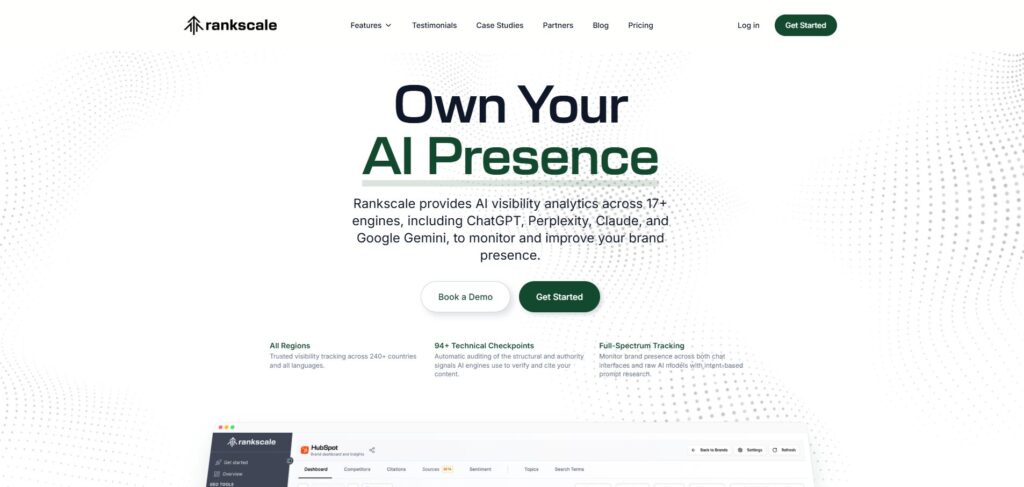
Rankscale is one of the cleaner specialist tools in the space. Its focus on AI rankings, citations, competitors, page audits, and prompt research makes it feel purpose-built for the actual problem of AI discoverability.
That focus is useful because specialist products often make the category easier to understand. You are not digging through unrelated modules to find what matters.
For teams that want a product specifically for AI search measurement, Rankscale is one of the more direct options.
Where it is limited
A specialist tool will usually have less breadth than an all-in-one suite.
If your team still needs broader SEO operations, you may end up pairing it with another platform anyway.
Who should choose it: Choose Rankscale when you want a more focused AI visibility tool and you are comfortable using a second tool for broader SEO work.
6. Similarweb AI Search Intelligence
Best for: Companies that care about AI traffic, brand exposure, market context, and strategic intelligence beyond prompt tracking alone.
What it does well
Similarweb brings a different strength to this category. It is less about acting like a narrow AI tracking app and more about connecting AI visibility to audience behavior, traffic shifts, competitive movement, and AI search demand patterns.
That is especially valuable for larger organizations. At that level, the important question is not just whether a brand appeared in an answer. It is whether AI-driven discovery is changing traffic patterns, competitive share, and market behavior in measurable ways.
If you want broader strategic context, Similarweb is one of the strongest products in this list.
Where it is limited
It is not the easiest tool for smaller businesses to justify on price or complexity.
Teams wanting a lightweight, day-to-day AI monitoring workflow may find it too intelligence-heavy.
Who should choose it: Choose Similarweb when AI visibility needs to be interpreted at the market and business intelligence level, not only the SEO reporting level.
7. Ahrefs Brand Radar
Best for: Brand and SEO teams that want a high-level view of how brand presence, web visibility, and search-backed demand relate to AI discovery.
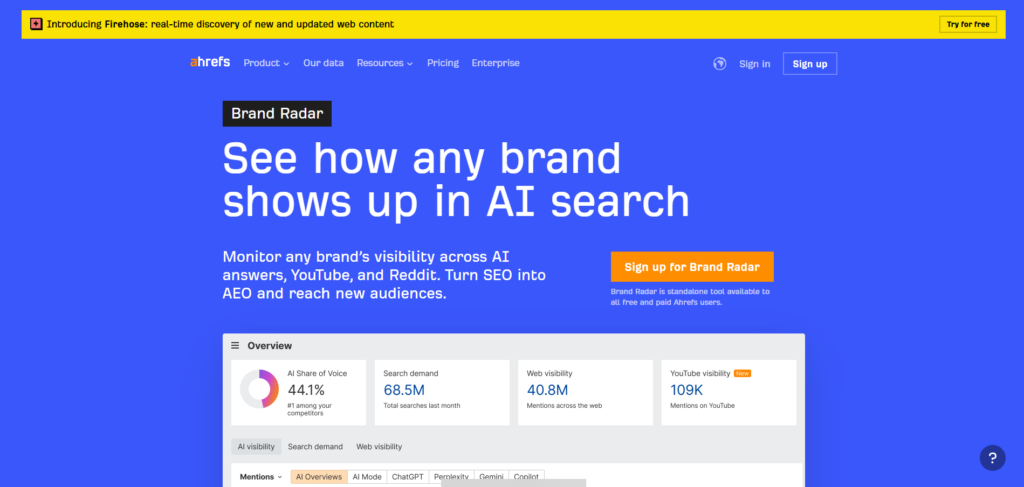
Ahrefs Brand Radar stands out because it expands the conversation beyond prompt monitoring. It looks at a very large query universe and connects AI visibility to the broader brand footprint across the web.
That is a more strategic way to think about AI presence. Strong AI visibility usually does not come from one page tweak. It often comes from stronger brand recognition, better topical authority, and wider third-party presence.
Ahrefs is especially useful for teams that want to understand those bigger patterns rather than only checking whether a few prompts triggered a mention.
Where it is limited
It is not the cheapest option, and it is not built for teams that simply want a small monitoring dashboard.
Because it is broader and more strategic, some users may still need another tool for more granular operational tracking.
Who should choose it: Choose Ahrefs Brand Radar when brand-level discovery matters as much as day-to-day prompt visibility.
8. OtterlyAI
Best for: Small and mid-sized teams that want AI search monitoring without a heavy platform commitment.
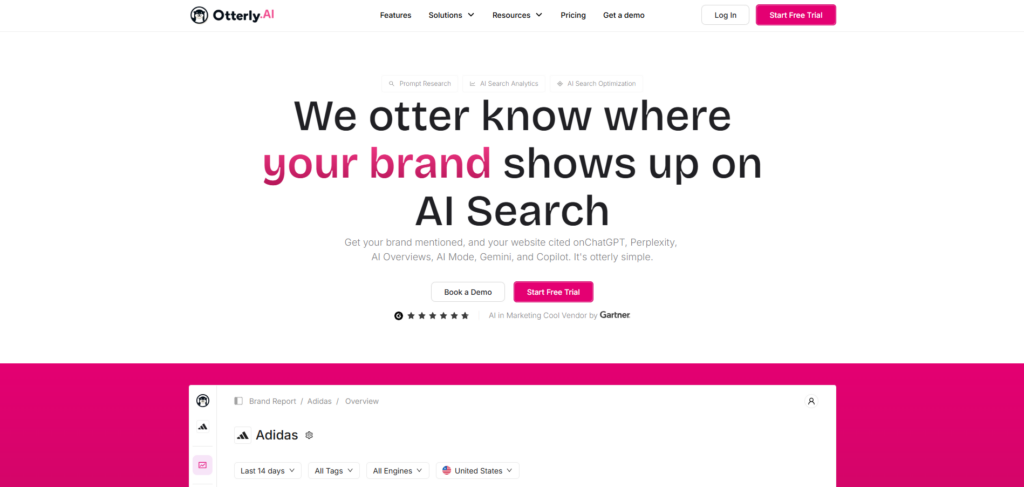
OtterlyAI is appealing because it is easier to approach. It covers the major AI search environments, includes visibility and citation tracking, and is priced in a way that smaller teams can test without major procurement friction.
That accessibility matters because a lot of teams are still experimenting. They want to understand the category without committing to enterprise software immediately.
It is also one of the tools that fits naturally into GEO-style workflows where the goal is to track presence and improve answer-engine discoverability in a focused way.
Where it is limited
It does not offer the same breadth or depth as the larger platforms on this list.
For bigger organizations, it may eventually become a stepping-stone rather than a long-term system of record.
Who should choose it: Choose OtterlyAI when you want an accessible specialist tool and a lighter entry point into AI visibility work.
9. Peec AI
Best for: Teams that want clear, prompt-based visibility tracking with a more focused product approach.
![Peec AI dashboard banner titled 'Your AI Search Analytics for [brand]' with a centered 'Get started' button and a tabbed Competitors table below.](https://www.nonofojoel.com/storage/2026/04/image-17-1024x484.png "image | Nonofo Joel")
Peec AI is interesting because it stays close to the core problem. It helps teams understand where they appear across AI search, how that visibility is measured, and what those changes mean in a prompt-based environment.
That focus makes it useful for agencies and SEO teams who do not want too much product sprawl. There is value in tools that stay disciplined.
Its methodology-driven documentation also helps it feel more serious than some lighter AI visibility products.
Where it is limited
It is still a more emerging tool compared with the biggest software brands in the category.
Some buyers will prefer larger ecosystems for procurement confidence or broader integrations.
Who should choose it: Choose Peec AI when you want focused AI visibility analysis without paying for an oversized platform.
10. HubSpot AI Search Grader
Best for: People who want a free starting point before moving into a more complete AI visibility stack.
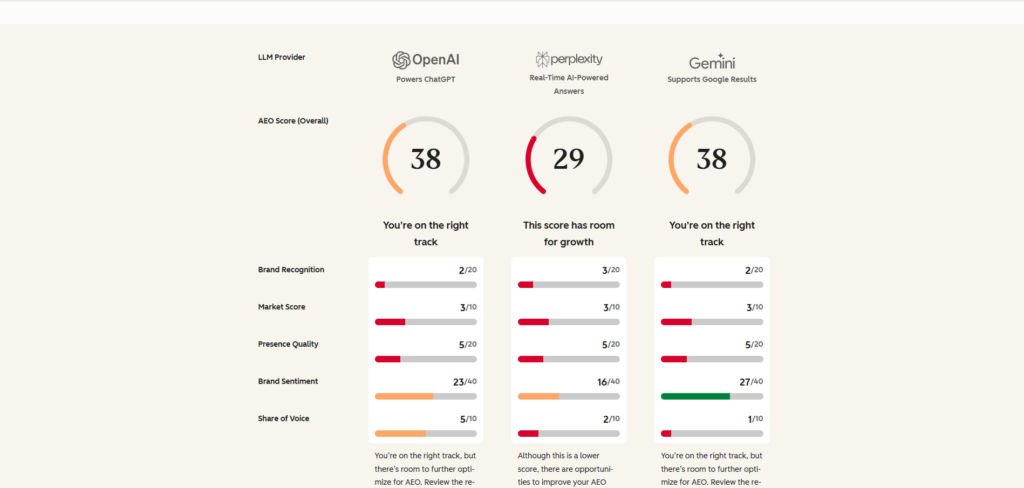
HubSpot AI Search Grader is useful because it lowers the barrier to entry. Not every team is ready for a full AI visibility platform on day one. A free grader can help them understand whether the topic deserves deeper attention.
That makes it a helpful educational tool and a good starting point for marketing teams that need an initial diagnostic rather than a full-time system.
It also works well as a conversation starter for consultants, agencies, and content creators introducing the topic to less technical audiences.
Where it is limited
It is not a full monitoring platform and should not be mistaken for one.
Once a team moves past basic awareness, they will usually need a more complete product from elsewhere.
Who should choose it: Choose HubSpot AI Search Grader when you want a no-cost way to begin evaluating AI visibility before committing to a full platform.
A simple selection framework
Choose breadth if your team needs SEO, content, and AI visibility in one workflow. That points toward Semrush or SE Ranking.
Choose content alignment if your biggest lever is publishing stronger, more answer-worthy content. That points toward Surfer or Writesonic.
Choose specialisation if the goal is focused AI visibility measurement. That points toward Rankscale, OtterlyAI, or Peec AI.
Choose strategic intelligence if leadership needs to understand business-level movement, market share, and AI-driven traffic patterns. That points toward Similarweb or Ahrefs.
Choose simplicity if you are still exploring the category and want a low-friction starting point. That points toward HubSpot AI Search Grader.
FAQ
What is the best AI visibility tool overall?
For most established teams, Semrush is the strongest all-round option because it connects AI visibility to broader SEO and content operations. For smaller budgets, SE Ranking is one of the best alternatives.
What is the best AI visibility tool for content teams?
Surfer is one of the best options for content teams because it links AI visibility more directly to content structure, optimization, and topical coverage.
Do I need a separate AI visibility tool if I already use SEO software?
Not always. If your existing SEO platform has mature AI visibility features, that may be enough. The decision depends on whether you need deeper prompt tracking, citation analysis, or business intelligence than your current stack provides.
What should I measure in an AI visibility tool?
Look for prompt-level presence, citation frequency, competitor comparisons, source pages being referenced, technical accessibility, and changes over time. The most useful tools also help you translate those findings into concrete actions.