The Best 10 AI Search Engines in 2026

AI search is no longer one product category.
It is now a stack of answer engines, search overlays, grounded chat assistants, and retrieval systems that shape how people discover brands, products, and information.
That creates a new problem for marketers, publishers, and business owners. You are no longer optimizing for one search engine and hoping everything else follows. You are now competing across multiple answer layers, each with its own retrieval patterns, citation behavior, and user expectations.
This guide compares the best top 10 AI search engines in 2026 and focuses on three questions that actually matter. How large is each platform based on the latest public data? How does it generate answers? And what can you do to improve your chances of being surfaced, cited, or clicked there?
One important note before we start: these usage numbers are not perfectly apples to apples. Some companies publish monthly active users, some publish weekly active users, some publish query volume, and some do not publish comparable figures at all. Where that happens, I use the latest credible public metric available and label it clearly.
What are AI search engines?
AI search engines are search platforms that use large language models and retrieval systems to generate direct answers, summaries, recommendations, or cited responses instead of showing only a traditional list of blue links.
In practice, that means the engine does more than match keywords to indexed pages. It may rewrite the prompt, run multiple searches, compare sources, synthesize findings, and present a conversational answer with or without citations.
Some AI search engines sit on top of classic web search, like Google AI Overviews or Bing Generative Search. Others are AI-native answer engines, like Perplexity or ChatGPT Search. But the shared idea is the same: they do not just rank pages, they interpret information and assemble an answer layer for the user.
Methodology
Date context: latest public figures I could verify as of April 28, 2026.
Metric note: user counts, website visits, and query counts measure different things, so they should be read as scale indicators rather than a single market-share formula.
Ranking note: for most AI search engines, the real goal is not a classic position-one ranking. It is being crawlable, retrievable, citable, and convincing enough to be used in synthesized answers.
Quick comparison table
| # | Engine | Latest public usage stat | Why it matters |
| 1 | Google AI Overviews / AI Mode | 1.5B+ monthly users for AI Overviews (Google, Apr 24 2025) | The biggest AI search surface because it sits inside Google Search itself. |
| 2 | ChatGPT Search | 700M weekly active users for ChatGPT (OpenAI study, Sep 2025); ~5.35B web visits in Feb 2026 (Similarweb) | The strongest AI-native discovery layer after Google. |
| 3 | Perplexity | 200M daily queries (Perplexity research, Sep 2025); ~170M monthly visits (Similarweb, Jan 2026 data cited Mar 2026) | Still the clearest pure-play answer engine. |
| 4 | Microsoft Copilot / Bing Generative Search | bing.com had 3.2B global visits in Feb 2026 (Similarweb); Microsoft says Copilot daily active usage is up 10x YoY (Mar 2026) | Massive distribution through Bing, Windows, Edge, and Microsoft 365. |
| 5 | Google Gemini | 400M monthly active users for the Gemini app (Google I/O 2025); 1.1B monthly visits by Sep 2025 (Similarweb) | A major assistant with strong Google grounding and distribution. |
| 6 | Claude | ~157M monthly visits (Similarweb, Jan 2026 data cited Mar 2026) | A fast-growing assistant with web search and strong trust among knowledge workers. |
| 7 | DuckDuckGo AI Search | DuckDuckGo says it handles 3B monthly searches | A privacy-first search engine now layering AI answers into search. |
| 8 | Brave Search | 50M daily queries; about one-third trigger AI summaries (Brave official) | The strongest independent privacy-first answer engine. |
| 9 | Grok | xAI has not published a comparable MAU figure; Grok is now available on web, X, iOS, and Android | Fast-moving, real-time, X-connected discovery engine. |
| 10 | You.com | 10M+ daily queries served and 1B+ API calls monthly (You.com official) | Less consumer-famous, but highly relevant in the agentic search stack. |
The Top 10 AI search engines in 2026
1. Google AI Overviews and AI Mode
Best for: Sheer reach, mainstream discovery, and product or service queries that already sit inside Google demand.
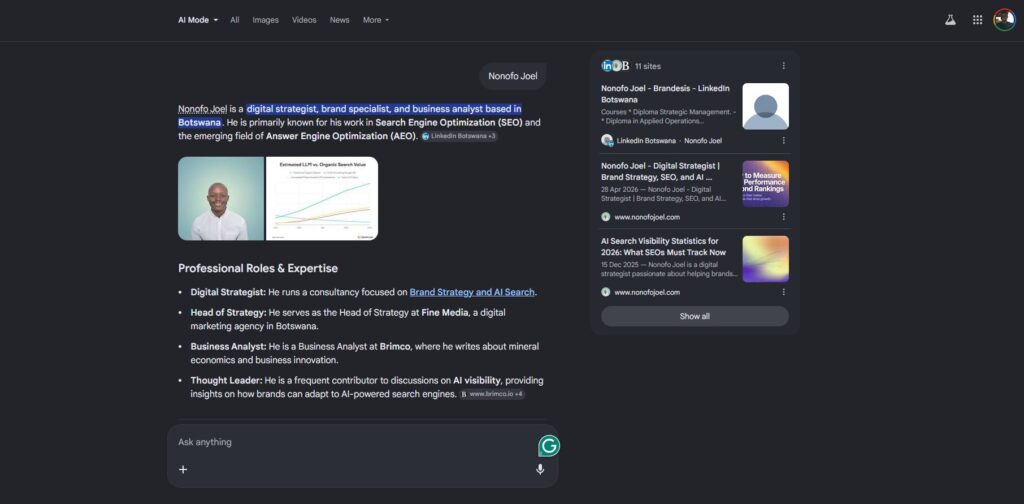
Google said on April 24, 2025 that AI Overviews had more than 1.5 billion users per month. Google also said in May 2025 that millions of people were already using AI Mode in Labs.
How it works:
Google’s AI features sit on top of the existing Search index rather than replacing it. AI Overviews summarize answers and point to supporting links, while AI Mode handles more complex comparisons and follow-up questions.
Google says these features can use query fan-out, meaning one prompt can trigger multiple related searches across subtopics and sources before the final answer is assembled.
How to rank or win visibility:
Treat this as Google SEO first, not a separate channel with mystery tricks.
Make sure the page is indexable, snippet-eligible, internally linked, and technically sound.
Keep important information in visible text, not hidden behind fragile JavaScript or UI elements.
Use clear page structure, strong entity signals, and people-first content that actually resolves the query.
2. ChatGPT Search
Best for: Research-led queries, product discovery, comparison searches, and answer-first exploration before a user clicks through.
OpenAI-backed research published in September 2025 said ChatGPT had 700 million weekly active users. Similarweb’s February 2026 global website ranking put chatgpt.com at roughly 5.35 billion monthly visits.
How it works:
ChatGPT decides when to search the web and may rewrite one prompt into several targeted searches using partner search providers. It then synthesizes the result with inline citations.
OpenAI also expanded shopping and product discovery inside ChatGPT in March 2026, making it even more relevant for commercial comparison journeys.
How to rank or win visibility:
Do not block OAI-SearchBot if you want to be discoverable in ChatGPT Search.
Make product, category, and commercial pages easy to interpret with explicit attributes, pricing context, reviews, and summaries.
Publish clear answer blocks, comparison content, and citation-worthy supporting pages rather than relying only on sales copy.
Track referral traffic with utm_source=chatgpt.com and study which pages get cited most often.
3. Perplexity
Best for: Research-heavy users, citation-driven answers, and users who want a fast answer engine rather than a classic search page.
Perplexity research published in September 2025 said its Search API handled 200 million daily queries. Similarweb’s 2026 generative AI statistics article cited roughly 170 million monthly visits for Perplexity.
How it works:
Perplexity crawls the web, performs multiple searches, synthesizes findings across sources, and presents direct citations alongside the answer.
Its Pro Search workflow is especially strong on multi-source research, and its crawler guidance makes clear that PerplexityBot is specifically designed to surface and link websites in search results.
How to rank or win visibility:
Allow PerplexityBot in robots.txt and make sure your firewall or CDN is not blocking it.
Publish pages that answer specific questions completely enough to deserve citation, not just to rank.
Make source quality obvious through authorship, references, freshness, and useful page structure.
Build third-party mentions as well, because consensus matters more in answer engines than in classic SEO alone.
4. Microsoft Copilot and Bing Generative Search
Best for: Windows and Edge users, Bing-heavy markets, enterprise workflows, and search journeys influenced by Microsoft’s ecosystem.
Similarweb ranked bing.com at 3.2 billion global visits in February 2026. Microsoft said in March 2026 that paid Copilot seats had grown more than 160% year over year and daily active usage was up ten times year over year.
How it works:
Microsoft says Bing’s generative search uses an LLM to review millions of sources, match content from the Bing index, and generate summarized answers with cited links.
That makes Bing’s underlying crawl, index, and ranking systems still central, even when the front-end experience becomes more generative.
How to rank or win visibility:
Invest in Bing SEO, not just Google SEO.
Use Bing Webmaster Tools to monitor indexation, user interaction, and content quality issues.
Bing explicitly emphasizes relevance, quality, credibility, freshness, location, and page load time.
If you ignore Bing, you lower your visibility not only in Bing itself but across Copilot surfaces that depend on Bing’s search foundation.
5. Google Gemini
Best for: Users who want an assistant experience grounded in Google’s ecosystem, especially for productivity, planning, and follow-up research.
At Google I/O 2025, Google said the Gemini app had more than 400 million monthly active users. Similarweb also reported Gemini reaching 1.1 billion monthly visits by September 2025.
How it works:
Gemini is not a classic search engine page, but it frequently grounds responses in Google Search and can use connected Google services and apps to produce richer answers.
For site owners, the practical overlap with Google Search is strong because Gemini inherits much of Google’s information retrieval logic and sourcing environment.
How to rank or win visibility:
Think Google authority, not Gemini hacks.
Create content that is original, trustworthy, and well-structured enough to survive synthesis.
Keep business, merchant, and local data current in Google systems where relevant.
If Google cannot confidently index, parse, and trust the page, Gemini is unlikely to be your breakthrough channel.
6. Claude
Best for: Knowledge workers, researchers, and users who value careful answers, source citations, and a calmer assistant experience.
Similarweb’s 2026 generative AI statistics article cited roughly 157 million monthly visits for Claude. Anthropic also made web search available globally across Claude plans in 2025.
How it works:
Anthropic says Claude invokes web search when current information is useful, processes multiple sources, and returns conversational responses with citations.
Claude can also conduct progressive, multi-step searches, which makes it more like a guided research assistant than a link-first engine.
How to rank or win visibility:
Optimize for source trust and extractability.
Pages that are well-labeled, factual, and rich in context tend to perform better than vague marketing pages.
Give Claude something easy to cite: direct answers, definitions, frameworks, and clean supporting evidence.
If you work in regulated or expertise-heavy categories, depth and credibility matter even more here.
7. DuckDuckGo AI Search
Best for: Privacy-conscious users who still want fast AI summaries without giving up a traditional search engine workflow.
DuckDuckGo says it handles 3 billion monthly searches. Its AI layer now includes Search Assist in results and Duck.ai for follow-up chat.
How it works:
DuckDuckGo says Search Assist scans the web for relevant content and generates a brief answer with direct source links. For traditional results, it uses multiple sources, including its own crawler and a large supply of Bing results.
That means visibility here is hybrid: part classic search index logic, part AI summary logic, part source selection by DuckDuckGo.
How to rank or win visibility:
If you want to show up in DuckDuckGo AI experiences, Bing visibility still matters.
Write pages that answer common questions concisely enough to be turned into short AI summaries.
Use strong headings, direct answers, and clean crawlability.
For many brands, DuckDuckGo is less about a special playbook and more about not neglecting Bing and answer-friendly formatting.
8. Brave Search
Best for: Privacy-first search users who want cited AI answers from an independent search index rather than Big Tech infrastructure.
Brave says Brave Search answers more than 50 million user queries per day, and about one-third of those queries trigger an AI summary. In February 2026, Brave also said its LLM Context API was powering more than 22 million answers per day inside Brave Search.
How it works:
Brave runs its own independent index and layers Answer with AI and Ask Brave on top of it. It cites sources and emphasizes AI grounding from verifiable web pages.
That independent index matters because Brave is not simply reskinning Google or Bing. It is making its own crawl and ranking decisions.
How to rank or win visibility:
Make sure Brave can crawl the site and that your core pages are easy to index and summarize.
Publish factual, specific content with enough structure to support grounded answers.
Do not underestimate privacy-first engines if your audience overlaps with developers, crypto, security, or tech-savvy users.
If you ignore independent indexes, you shrink your footprint in emerging AI retrieval systems.
9. Grok
Best for: Real-time, newsy, trend-driven queries where X posts and web search together create a different answer environment from Google-style search.
xAI has not published a directly comparable monthly active user figure for Grok. What xAI has made clear is that Grok is now distributed across grok.com, X, iOS, and Android, and is positioned around real-time search.
How it works:
xAI says Grok can decide whether to search public X posts and conduct real-time web search to answer a query. That gives it a hybrid retrieval model: social signal plus web signal.
This makes Grok especially relevant for live events, public conversation, breaking news, sentiment, and topics that evolve in public view before they stabilize on the open web.
How to rank or win visibility:
Think beyond your own website. X visibility matters more here than on most other platforms.
Publish original, quotable, timely content that can spread socially and also live on crawlable web pages.
For fast-moving sectors, your public posts, commentary, and news coverage may influence Grok visibility as much as your SEO pages do.
If your brand is invisible on X and weak on the web, Grok is unlikely to discover you in a meaningful way.
10. You.com
Best for: Agentic search infrastructure, developer workflows, enterprise AI products, and web-grounded agents.
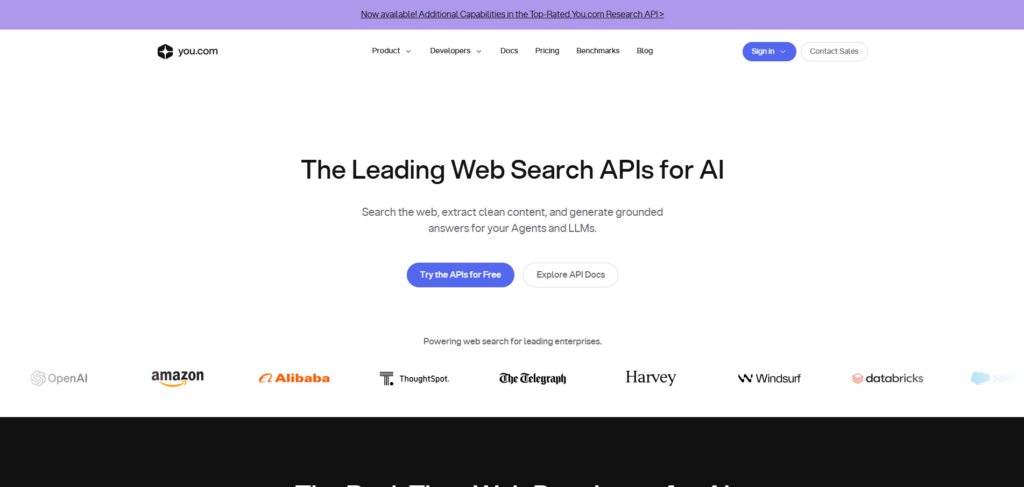
You.com says it serves 10 million or more daily queries at 99.99% uptime and supports more than 1 billion API calls monthly.
How it works:
You.com positions itself as AI search infrastructure. Its Search API returns structured web and news results, LLM-ready snippets, metadata, and full-page content on demand.
That matters because visibility in You.com’s stack can influence not only direct users of You.com but also tools and products built on top of its search infrastructure.
How to rank or win visibility:
Prioritize freshness, structured content, and high-signal pages that work well in retrieval pipelines.
Make articles and resource pages easy to parse into standalone snippets and sections.
If your content is difficult to chunk, cite, or verify, AI infrastructure layers will be less likely to reuse it well.
Winning here is less about vanity traffic and more about being retrieval-ready across the agentic ecosystem.
What the comparison really means
If you care about total reach, Google and ChatGPT are still the two platforms that matter most. If you care about pure answer-engine behavior, Perplexity remains the cleanest model to study. If you care about privacy-first independent search, Brave and DuckDuckGo deserve more attention than most marketers give them.
The bigger strategic lesson is that AI search is not one ranking system anymore. It is a set of overlapping retrieval environments. Some depend heavily on Google or Bing. Some depend on their own crawlers. Some blend web search with app context, commerce data, or social signals. Your visibility strategy needs to reflect that.
That means the safest long-term play is still the same in principle: be crawlable, be clear, be original, be citable, and be present across more than your own website. The brands winning AI search are usually the brands that make retrieval easy and trust easier.
How to rank across AI search engines in practice
Keep all core pages indexable and easy to crawl. If bots cannot reach the page, the rest of the strategy does not matter.
Make key information explicit. Use clean headings, direct answers, summaries, FAQs, comparison sections, and visible factual attributes.
Strengthen technical SEO. Fast pages, stable rendering, internal linking, schema, and descriptive URLs still support visibility across both search and answer engines.
Build off-site authority as well as on-site authority. Consensus across publishers, reviews, communities, and references matters more in AI search than many teams expect.
Measure mentions, citations, and assisted conversions, not just referrals. AI often influences the decision before the user visits the site.
FAQ
Which AI search engine matters most in 2026?
Google still matters most for total reach because AI Overviews and AI Mode sit inside Search itself. But for AI-native discovery, ChatGPT Search and Perplexity matter more than many brands realize.
Are AI search engines replacing Google?
Not fully. Search is fragmenting, not disappearing. Google still closes a huge amount of demand, but AI platforms now shape discovery, comparison, and shortlist creation much earlier in the journey.
Can you rank in AI search the same way you rank in Google?
Partly. Technical SEO, indexing, authority, and strong content still matter. What changes is the end goal: you need to be citable, extractable, and trustworthy enough to be used inside synthesized answers.
What is the biggest AI visibility mistake brands are making?
Treating AI search as a reporting curiosity instead of a content and discovery channel. By the time referral traffic becomes the signal you trust, the visibility gap is often already there.