How Technical SEO Affects AI Search
Why technical SEO is becoming foundational infrastructure for AI visibility, not just background maintenance for traditional rankings


For a long time, technical SEO was treated like maintenance work. Important, yes, but often secondary to content, links, and rankings. That framing no longer holds up.
As AI search platforms reshape discovery, technical SEO is starting to matter in a broader way. It is no longer just about helping Google crawl a site efficiently. It is about making your content accessible, interpretable, and usable across a growing ecosystem of answer engines and AI-assisted search experiences.
What pushed this into sharper focus for me was Semrush’s recent study on how technical SEO factors affect AI search. Based on an analysis of 5 million cited URLs across ChatGPT Search and Google AI Mode, the study points to a pattern many teams need to take seriously: pages cited by AI systems tend to share stronger technical foundations.
That does not mean technical SEO works as a simple ranking lever for AI citations. It does mean the technical layer increasingly shapes whether your content is easy to retrieve, trust, structure, and surface.
Key study signals worth paying attention to
| Signal | Why it matters |
| 5 million cited URLs | The Semrush study analyzed a large sample across ChatGPT Search and Google AI Mode. |
| 17 to 40 characters | Descriptive, concise URL slugs appeared most often among cited pages. |
| Organization, Article, Breadcrumb | These schema types showed up most frequently on AI-cited pages. |
| AI visibility is a KPI | Brand mentions and citation frequency are becoming performance metrics, not side observations. |
The main shift: technical SEO now supports discoverability beyond Google
One of the most useful ideas in the Semrush study is not a single metric. It is the broader implication. Search is splintering. People still use Google, but they are also asking questions inside ChatGPT, Perplexity, Copilot, and Google’s own AI experiences.
That changes the role of technical SEO. Instead of treating it as background cleanup for traditional search, teams need to think of it as visibility infrastructure across multiple discovery systems.
In practical terms, that means your site has to do more than exist. It has to be crawlable, render cleanly, communicate entity context clearly, and present content in ways AI systems can parse with confidence.
What the Semrush study found
The Semrush study does not claim direct causation, and that matters. But its correlations are still useful because they point to the conditions commonly present on AI-cited pages.
First, user engagement patterns were stronger on cited pages. Pages referenced by AI platforms tended to show longer visit durations, lower bounce, and better conversion behavior. That likely reflects quality and usefulness rather than acting as a direct AI ranking signal.
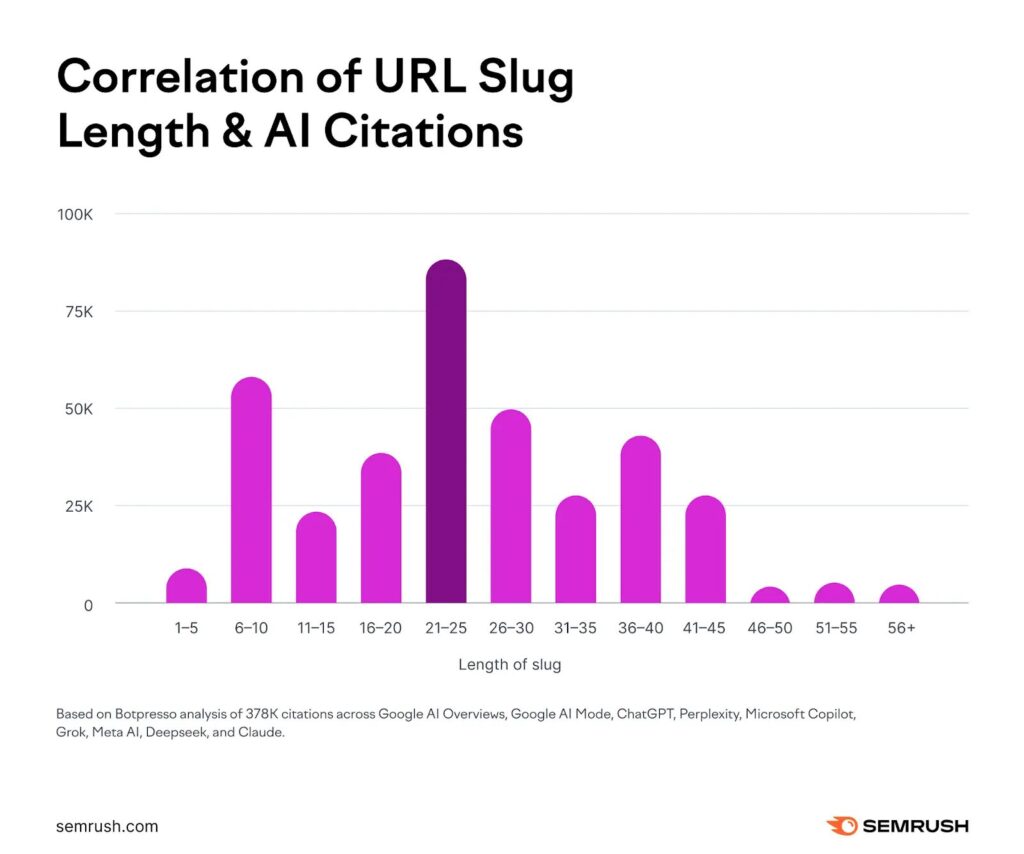
Second, URL structure mattered more than many teams expect. Pages with concise, descriptive slugs, especially in the 17 to 40 character range, appeared most often among cited URLs.
Third, structured data showed a strong pattern. Organization, Article, and Breadcrumb schema appeared most frequently, and Google AI Mode tended to cite pages with stronger schema implementation rates than ChatGPT Search.
The study also noted that Open Graph and JSON-LD were common across cited pages. The takeaway is not to mark up everything blindly. It is to treat structured data as part of the clarity layer that helps machines understand what your content is, who published it, and how it fits into a broader site context.
Why this changes how I think about technical SEO
The biggest mindset shift for me is this: technical SEO is not just about eligibility for rankings. It is increasingly about eligibility for interpretation.
If AI systems are selecting sources, summarizing pages, and deciding what to cite, then clean technical foundations become part of how your content earns visibility in the first place. Not because a schema field magically gets you cited, but because technical clarity reduces ambiguity.
That is a more useful way to think about technical SEO in the AI era. It is not a checklist you finish. It is the underlying system that makes your content easier to access, easier to classify, and easier to trust.
The technical areas I would prioritize now
If I were auditing a site for AI visibility today, I would not start by chasing speculative tricks. I would start with the fundamentals that make the strongest strategic sense across both SEO and AI search.
First, I would check crawlability and rendering. If a site is JavaScript-heavy, poorly rendered, or inconsistent in what crawlers can access, that is a visibility problem before it is anything else.
Second, I would tighten URL structure. Short, descriptive slugs are easier for users and systems to interpret. Bloated, parameter-heavy, or vague URLs create unnecessary friction.
Third, I would implement and validate core schema. Organization, Article, Breadcrumb, FAQ, LocalBusiness, and Product markup should be treated as practical semantic infrastructure where relevant, not optional polish.
Fourth, I would improve page experience and engagement conditions. Fast load times, mobile usability, strong navigation, and clean information architecture shape what users do when they land.
Those engagement patterns may not directly drive citations, but they often reflect whether the page deserves attention.
Fifth, I would review the copy structure itself. Conversational formatting, direct answers, summaries, and well-labeled sections make content easier for AI systems to extract and easier for people to trust.
What this means for brands and content teams
The practical lesson is that AI visibility should not sit in a separate strategic bucket from technical SEO. The two are increasingly connected.
A brand can publish strong content and still lose visibility if the site makes interpretation difficult. It can also have technically clean pages and still underperform if the content lacks clarity, authority, or usefulness. The win comes from combining technical readiness with better content systems.
That is why AI visibility is becoming a more meaningful KPI. It captures something traditional ranking reports miss: whether your brand is actually being surfaced and cited in the environments where more people are now asking questions.
A practical checklist for teams reviewing AI visibility
Review server logs and crawl behavior to understand whether important AI crawlers can access the right sections of the site.
Check whether priority pages render clean HTML and are not overly dependent on client-side scripts for core content.
Standardize concise, descriptive URL structures across key templates.
Validate core structured data on commercial, editorial, product, and brand pages.
Improve internal linking so important pages are easier to discover and contextually supported.
Rewrite weak pages into clearer, better-structured answers with stronger summaries, headings, and entity signals.
Measure AI visibility directly where possible instead of assuming Google visibility tells the whole story.
Final Takeaway
The most important lesson from the Semrush study is not that technical SEO has suddenly become a shortcut to AI citations. It is that technical quality appears to shape the conditions under which AI visibility becomes possible.
That is a more durable way to think about the work ahead. Brands do not need a separate technical strategy for every new platform. They need stronger digital foundations: crawlable sites, clear structure, useful schema, descriptive URLs, and content that is easy to interpret.
In that sense, technical SEO still matters for rankings. But it now matters for something bigger too: whether your content is fit for discovery in an AI-mediated web.
The Semrush study to review
Semrush’s study on technical SEO and AI search is worth reading in full if you want to see how the correlation patterns were framed and where the limits of the data still matter.