What the Semrush Content Marketing Job Market Study Really Reveals
Why content marketing roles are shifting from production to ownership, and what that means for teams, hiring, and careers in 2026


For years, content marketing roles were often framed around output. Could you write the blog post, manage the calendar, coordinate the freelancer, and keep the pipeline moving? That model is clearly breaking down.
Semrush’s recent analysis of 8,000 content marketing job listings shows that the market is not simply asking for more content. It is asking for more ownership. Employers increasingly want content professionals who can connect storytelling to visibility, analytics, strategy, and business impact.
That is the part of the study that matters most to me. The shift is not just about AI showing up in job descriptions. It is about content work being treated less like a publishing function and more like a performance and growth function.
If you work in content, hire content marketers, or manage digital growth, this is the change worth paying attention to.
Why this study matters
A content marketing job market study like this is useful because job listings reveal what companies believe they need right now. They may not capture every reality of the role, but they do show how employers define value, responsibility, and capability.
In this case, the Semrush study is especially revealing because it does not only look at titles. It also looks at skills, responsibilities, salaries, degree requirements, AI expectations, and how all of that has shifted since 2023.
Key numbers from the Semrush study
| Stat | What it shows |
| 34% | Execution-heavy roles now make up 34% of all listings analyzed. |
| 70%+ | Demand for mid-level generalist titles fell by more than 70% compared with 2023. |
| 300-375% | Senior ownership roles such as Head or VP of Content grew by 300% to 375%. |
| 40% | Analytics appears in 40% of senior roles and 36% of non-senior roles. |
| 209% | Content creation requirements rose by 209%, while mentions of writing fell by 28%. |
| 34% | AI now appears in 34% of senior roles and 19% of non-senior roles. |
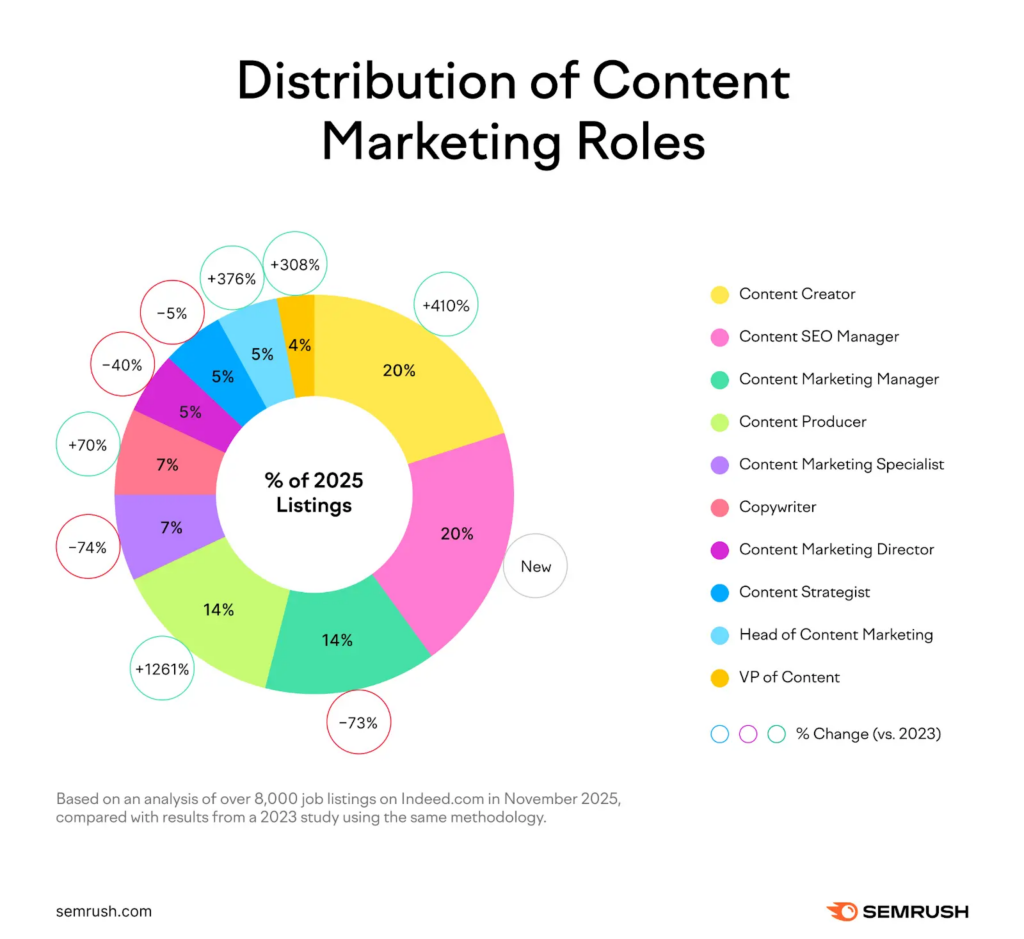
The most important shift is not AI. It is ownership.
The most useful insight in the Semrush study is not that AI is growing in job descriptions. That part was expected. The real signal is that content roles are splitting into two stronger poles: hands-on execution and senior ownership.
On one side, companies are still hiring creators and producers who can make work happen. On the other, they are investing more heavily in leaders who can own content as a strategic function. What is shrinking is the comfortable middle: broad generalist roles that manage content without clearly owning growth, distribution, or business outcomes.
That tells us something important. Content teams are being reorganized around value. If a role is not clearly tied to creation at scale or ownership at a strategic level, it is becoming harder to justify.
Why mid-level generalist content roles are under pressure
The study found that postings for roles like Content Marketing Manager and Content Marketing Specialist dropped by more than 70% compared with 2023. That does not mean those people are no longer needed. It means those titles are losing clarity in the market.
Generalist roles are under pressure because companies now expect content functions to do more than coordinate production. They want sharper accountability. Who owns search visibility? Who owns performance reporting? Who owns narrative consistency across channels? Who owns AI readiness? The more those questions matter, the less room there is for loosely defined middle roles.
That is why this shift is bigger than hiring language. It reflects a wider redefinition of how content work earns budget and influence inside organizations.
Analytics and storytelling are no longer separate skill sets
One of the strongest signals in the study is the combination of analytics and storytelling near the top of requested skills. Analytics appears in 40% of senior listings and 36% of non-senior ones. Storytelling follows closely at 29% and 27%.
That matters because it challenges an older divide in content teams. For a long time, some people were seen as the strategic storytellers while others handled reporting, SEO, or analytics. That distinction is weakening.
Modern content roles increasingly require both. The marketer is expected to understand narrative, but also to show what the narrative is doing. The storyteller now has to defend performance. The analyst now has to understand why message quality and framing still matter.
In practice, that means the modern content marketer is becoming a hybrid operator. Not because every person must be equally brilliant at everything, but because content work now sits closer to business outcomes than before.
The move from writing to content creation is a clue about format, not just wording
The Semrush study found that mentions of writing fell by 28%, while content creation requirements rose by 209%. That is not just a vocabulary change. It reflects a broader shift in what employers want content professionals to produce.
Writing is still central. But writing alone is no longer the full job description in many roles. Teams want people who can think across formats, repurpose effectively, structure assets for visibility, collaborate with design or video, and produce content that travels further than one blog post.
This is one reason AI is changing the market less as a creative replacement and more as a workflow accelerator. If companies can use AI to reduce some drafting friction, they will put more value on the human who can turn raw material into a multi-format, performance-aware content system.
SEO is now part of content literacy, not a separate specialty
Another important pattern in the study is that SEO now appears in 20% of senior listings and 28% of non-senior roles. That is a strong reminder that search knowledge is no longer reserved for a separate specialist sitting outside the content team.
This does not mean every content marketer needs to become a technical SEO expert. It means they are increasingly expected to understand discoverability. They need to know how content gets found, how search intent shapes structure, how internal linking supports visibility, and how AI-driven discovery is changing the path to being seen.
That makes content ownership much broader than editorial planning. Today, owning content often means owning whether content can compete for attention at all.
AI is becoming baseline literacy, not a standalone title
The AI numbers in the study are useful precisely because they are not dramatic in the way many people expect. AI appears in 34% of senior roles and 19% of non-senior roles, but highly specific skills like prompt engineering or AI content creation still show up in less than 1% of listings.
That suggests something important. Companies do not seem to be hiring large numbers of specialized prompt engineers into content teams. They are normalizing AI familiarity instead. In other words, AI is being folded into the general expectations of the role.
That is a much more believable picture of how work changes. The market is not saying every content marketer must become an AI specialist. It is saying they can no longer act like AI is irrelevant to how content is researched, produced, optimized, or distributed.
Salary growth shows that strategic content work is being valued differently
The salary data reinforces the larger shift. Median pay reached $161,500 for senior roles and $80,000 for non-senior roles, with significant growth since 2023 across both levels.
Salaries do not rise this way just because more content is being published. They rise when the market believes the role is tied to more consequential outcomes. Visibility, demand generation, narrative control, cross-functional coordination, and AI readiness all push content closer to business value.
That is why the study should not be read as a narrow hiring update. It is also a signal about where content sits in the value chain now.
What this means for people building content careers
The safest interpretation of the data is not to panic about disappearing roles. It is to understand how the role is being reframed. Content marketers who can show ownership, performance thinking, and cross-functional fluency will be easier to position than those who present themselves only as writers or calendar managers.
That does not mean abandoning craft. Strong writing, editorial judgment, and storytelling still matter deeply. But those strengths now need to be framed in business terms.
What did the content change?
What did it improve?
How did it support visibility, conversion, retention, or authority?
If I were advising someone in content right now, I would tell them to deepen in four directions: analytics, SEO, AI literacy, and strategic communication. Not because they need to become four different specialists, but because those are now part of one stronger professional identity.
What this means for companies hiring content marketers
For employers, the study is a useful warning against vague hiring. If a company wants content to drive business results, the role needs a clearer scope than ‘manage content.’ The strongest teams will be the ones that define ownership more deliberately.
That may mean separating pure production roles from strategic leadership roles more clearly. It may mean tying content roles more closely to SEO, lifecycle marketing, brand strategy, or product marketing. It may also mean creating better systems so execution teams are not buried under the expectation that one person can write, optimize, distribute, analyze, automate, and report everything alone.
In other words, the study is not only about talent trends. It is also about org design. Companies are learning that content becomes more valuable when its ownership model becomes clearer.
The broader lesson: content is no longer judged mainly by output volume
What Semrush’s study ultimately reveals is that content work is being measured differently. The market is moving away from hiring content people simply to keep the publishing engine running. It is moving toward hiring people who can connect creation to distribution, discovery, analysis, and influence.
That is why the most important skill shift is not really about a tool or a platform. It is about business relevance. Content marketers are increasingly expected to own outcomes, not just assets.
That shift will not make the role easier. But it does make it more important.
Source: Semrush study: We Analyzed 8,000 Content Marketing Job Listings: The Shift from Writing to Ownership