AI Search Visibility Statistics for 2026
AI-powered search is changing how users discover brands. This in-depth analysis breaks down the most important AI search visibility statistics for 2026 and explains how SEOs should adapt beyond rankings and clicks.

Key Takeaways from AI Search Visibility Statistics
- AI-powered search is reshaping how users discover brands, with AI Overviews and chat-based tools increasingly answering queries directly.
- Visibility inside AI-generated answers (mentions, citations, summaries) is becoming as important as traditional rankings.
- AI search traffic is growing rapidly and is projected to surpass traditional organic search by 2028.
- Brands that publish clear, structured, authoritative content are far more likely to be cited by AI systems.
SEOs don’t need hype, opinions, or surface-level takes.
What we actually need are clear numbers, explained in plain language, that show how search behavior is changing, why AI platforms are accelerating that change, and what this means for real-world SEO strategy going into 2026.
The AI Search Visibility Statistics below don’t just describe trends. They explain why traditional SEO metrics are breaking down and why visibility inside AI-powered answers is becoming just as important as rankings and traffic.
Top 10 AI Search Visibility Statistics
1. Google AI Overviews Reach 2 Billion Monthly Users
Google AI Overviews have quietly moved from an experimental feature to a core part of the search experience. Today, they reach approximately 2 billion users every month and are available in more than 200 countries.
This matters because AI Overviews sit above traditional organic listings and often provide users with a complete, summarized answer before they even consider scrolling.
In the past, ranking at the top of Google meant capturing attention. Now, being included in the AI-generated summary itself determines whether your brand is even seen.
For SEOs, this means that visibility is no longer limited to blue links. If your content is not structured, authoritative, and clear enough to be summarized and cited by Google’s AI systems, your rankings alone may not translate into real exposure.
2. AI Search Traffic Is Projected to Surpass Traditional Search by 2028
According to Semrush projections, traffic originating from AI-powered search experiences is expected to overtake traditional organic search traffic by 2028.
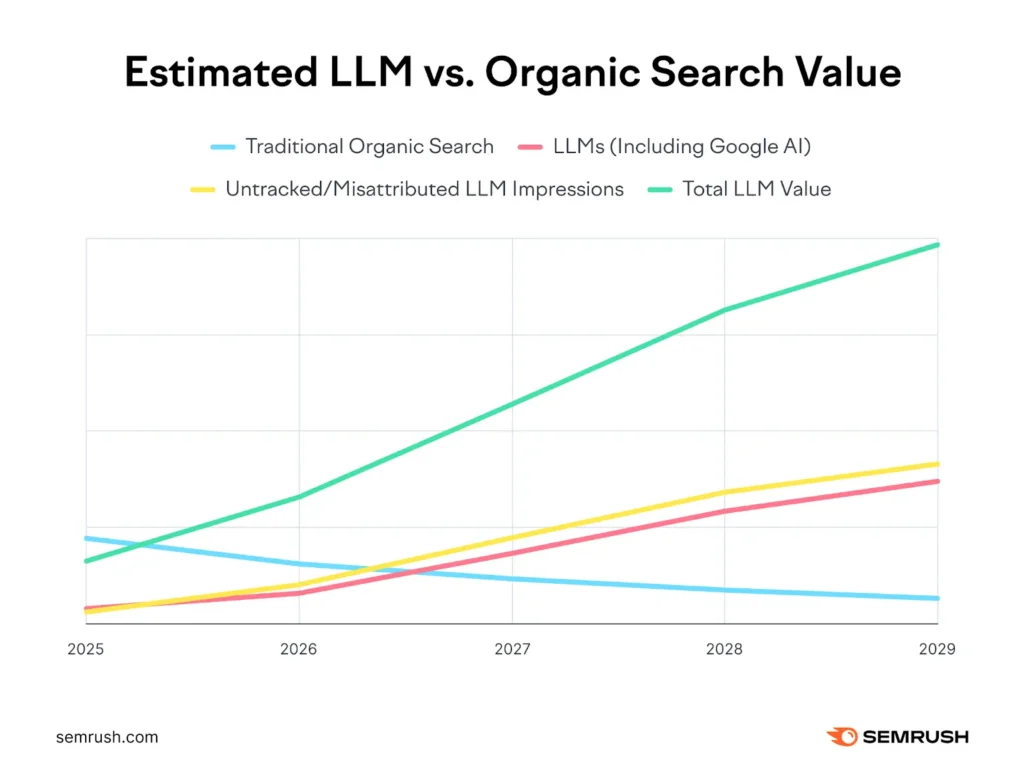
This projection assumes steady adoption. However, if Google accelerates the rollout of AI Mode or makes conversational search the default experience, the shift could happen sooner.
The implication is straightforward but uncomfortable: search demand is moving away from classic keyword-based queries and toward conversational, intent-driven interactions.
Brands that continue to optimize solely for rankings without considering AI visibility are effectively optimizing for a shrinking slice of future search behavior.
3. Roughly 60% of Searches Now End Without a Click
Across traditional search engines, roughly 60% of searches now end without the user clicking through to a website.
AI summaries, featured snippets, and other SERP features increasingly satisfy user intent directly on the results page.
AI Overviews amplify this trend by providing longer, more complete answers that remove the need for further exploration.
This doesn’t mean SEO is dead. It means the definition of success has changed.
Instead of measuring success solely by sessions and clicks, brands must now assess presence, mention frequency, citation visibility, and brand recall within AI-generated responses.
4. Nearly 70% of Businesses Report Higher ROI From Using AI in SEO
Semrush research shows that almost 70% of businesses report improved ROI after integrating AI into their SEO workflows.
This improvement is not due to AI magically ranking content.
It’s because AI reduces friction in time-consuming processes such as keyword research, topic clustering, content outlining, and updating existing pages.
Teams that use AI effectively can publish faster, test ideas sooner, and allocate more human effort to strategy, originality, and expertise, the factors AI systems increasingly reward.
5. ChatGPT Has Approximately 800 Million Weekly Active Users
ChatGPT now operates at a scale comparable to major search engines, with around 800 million weekly active users and billions of monthly visits.
Semrush traffic data consistently places ChatGPT among the most visited websites in the world.
This is important because many users now begin their discovery journey inside AI tools, not search engines.
If your brand is never mentioned or cited when users ask AI tools questions related to your industry, your brand effectively does not exist in that discovery layer.
6. Google AI Mode Has Reached 100 Million Users in the US and India
Google’s AI Mode surpassed 100 million users across the U.S. and India, the first two markets where it was introduced.
This level of adoption confirms that conversational search is not a niche behavior. It is becoming mainstream.
AI Mode blends traditional search results with conversational summaries and source citations, which rewards content that is logically structured, clearly written, and factually precise.
Pages that are vague, poorly organized, or challenging to parse are far less likely to be summarized or cited.
7. AI Search Traffic Is Up 527% Year Over Year
Industry analysis tracking multiple GA4 properties found that traffic from AI platforms increased by 527% year over year.
While AI referral traffic may still represent a small percentage of total sessions for most sites, the growth rate shows that AI platforms are becoming a measurable discovery channel.
More importantly, users arriving from AI platforms tend to arrive with stronger intent and clearer expectations.
8. The Average AI Search Visitor Is Worth 4.4× More Than a Traditional Organic Visitor
Semrush data indicates that visitors arriving from AI-powered search experiences convert at approximately 4.4 times the rate of traditional organic visitors.
This suggests that AI search does not merely replace traffic volume but improves traffic quality.
Users who arrive via AI tools are often further along in the decision-making process, having already consumed summarized information and narrowed their options.
9. Nearly 34% of Gen Z use AI Chatbots to search for Information
In the United States, approximately 34% of Gen Z users now use AI chatbots as a search tool.
This does not mean they have abandoned Google. Instead, they use AI alongside traditional search, social platforms, and video.
For brands, this signals a long-term shift in discovery habits. Visibility inside AI platforms directly influences brand familiarity among younger audiences.
10. Half of ChatGPT’s Citations Point to Business and Service Websites
Semrush analysis shows that 50% of ChatGPT’s cited sources come from business and service websites, rather than news outlets or publishers.
This is a critical insight.
It means brands do not need to become media companies to win AI visibility.
They need to publish accurate, clearly structured, and genuinely helpful content that answers fundamental questions better than generic blog posts.
Final Perspective
AI search does not eliminate SEO.
It changes the surface area of competition.
In 2026, winning brands will be the ones that:
- Publish content that deserves to be summarized
- Structure information so AI systems can extract meaning
- Focus on authority, clarity, and usefulness over volume
- Measure visibility beyond clicks and rankings
This is not a new SEO discipline.
It is the next evolution of the one we already know.