ChatGPT Is Not Replacing Google, It’s Expanding Search: A Deep Dive Into the New Era of Hybrid Search Behavior

Artificial intelligence has reshaped almost every part of our digital lives, but no domain is shifting faster or more quietly than search behavior. For years, marketers braced themselves for a zero-sum showdown: ChatGPT vs. Google.
But the latest data from SEMrush finally puts the myth to rest.
ChatGPT is not replacing Google. It’s an expanding search.
This fundamental insight has enormous implications for SEO, content strategy, digital marketing, and the future of consumer decision-making.
What SEMrush uncovered is not a minor shift. It’s a structural transformation in how people discover information, evaluate options, learn, plan, and make decisions.
This article breaks down the findings and explains their implications for marketers seeking to maintain visibility in the era of AI-driven search.
1. The SEMrush Study: What the Data Actually Reveals
SEMrush analyzed the behavior of millions of users across multiple cohorts in February 2025, March 2025, January 2024, and comparison groups. The goal was to understand how search habits change when someone starts using ChatGPT.
The results were consistent across all groups.
Before ChatGPT usage:
- 10.5 Google searches per week
- 0 ChatGPT sessions
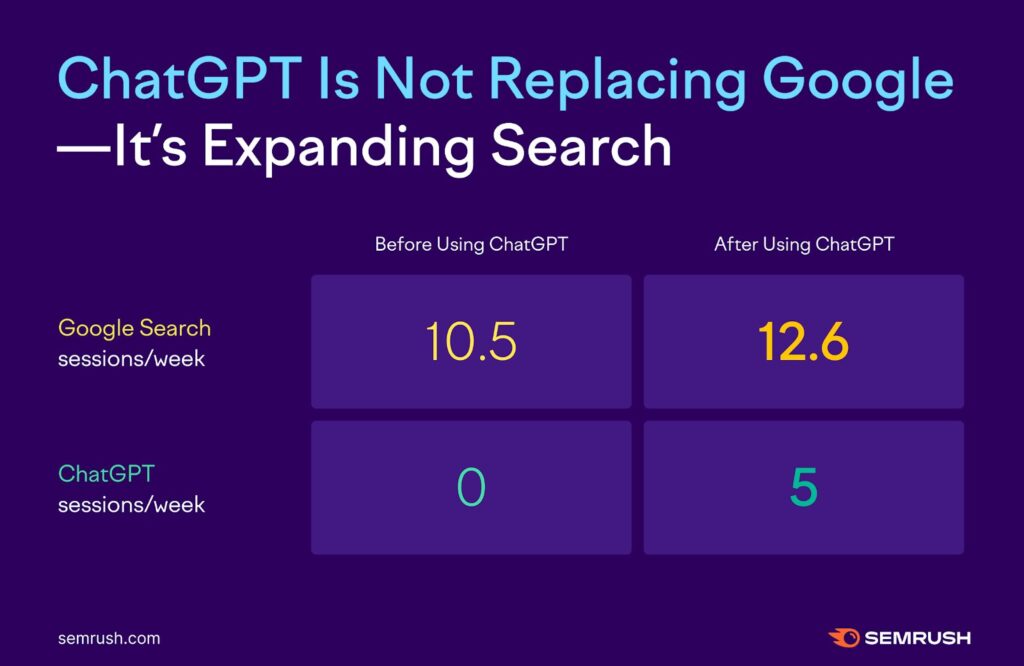
After ChatGPT usage begins:
- 12.6 Google searches per week
- 5 ChatGPT sessions per week
This data destroys the common misconception that ChatGPT cannibalizes Google.
Instead, it shows:
AI tools create more search behavior, not less.
Users don’t choose between Google and ChatGPT. They fluidly navigate between both, depending on the task, the context, and the depth of understanding required.
2. Why Both Google and ChatGPT Increase After Day 0
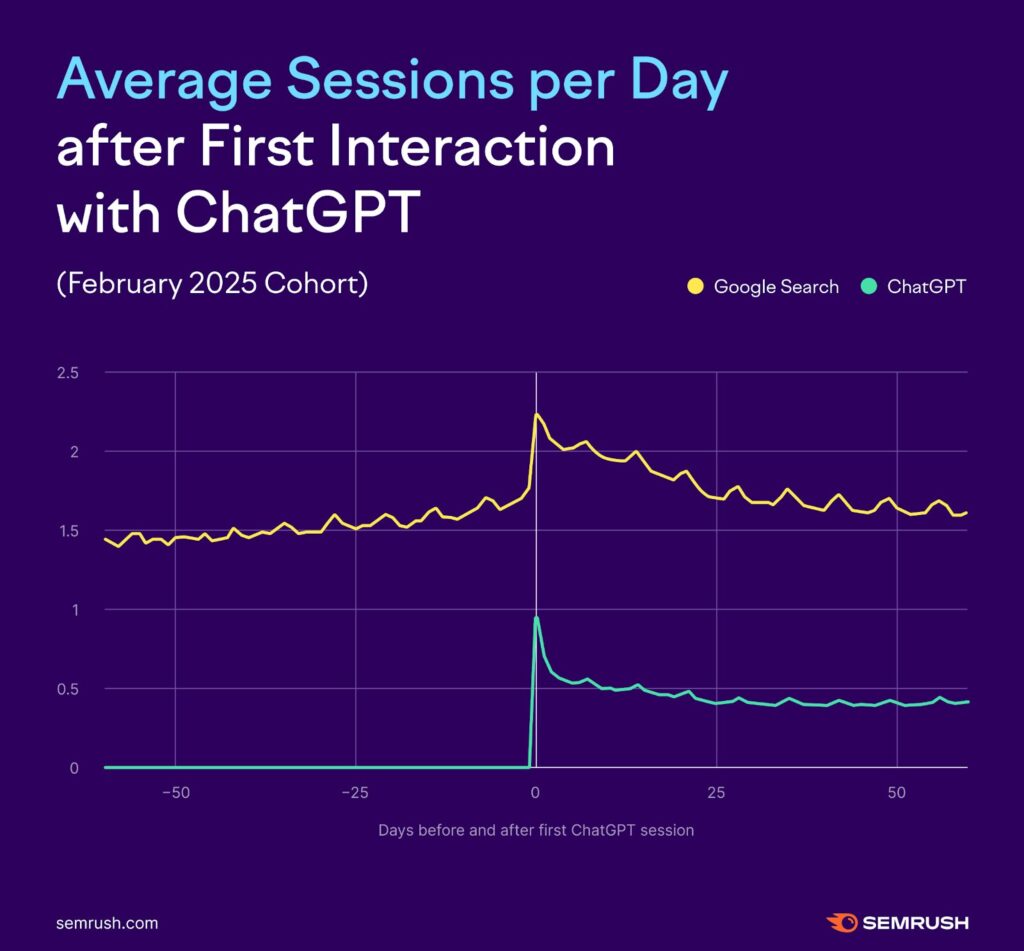
Day 0: The moment a user tries ChatGPT for the first time creates a massive behavioral spike.
What the cohort graphs show:
- Google searches spike at the exact moment ChatGPT is first used
- ChatGPT usage skyrockets immediately
- Both remain elevated long after the initial interaction
Why does this happen?
Because ChatGPT isn’t replacing search—it’s enhancing it.
It fills gaps that Google doesn’t fully satisfy, such as:
- Breaking down complex concepts
- Comparing multiple results in a single response
- Drafting ideas, emails, plans, or summaries
- Offering conversational explanations
Users still rely on Google for:
- Verification
- Additional sources
- Product/company research
- News and recency-sensitive queries
- Navigational searches
This creates a powerful dual-engine effect.
3. The Contrast: Users Who Never Try ChatGPT
SEMrush included a crucial control group: people who had never used ChatGPT.
Their Google usage stayed flat.
No spikes. No increases. No new patterns.
This confirms that the behavioral expansion is directly caused by AI adoption, not by changes in Google’s platform or algorithm.
In other words:
AI adoption rewires user behavior more than any Google update ever has.
4. The Psychology Behind Hybrid Search Behavior
Why are users adding more tools instead of replacing old ones?
Because each tool satisfies different psychological and informational needs.
Google satisfies:
- Urgent information retrieval
- Source validation
- Product or company research
- Navigational queries
- SERP comparisons
ChatGPT satisfies:
- Understanding (deep learning)
- Creativity (idea generation)
- Clarification (explanations)
- Personalization (tailored responses)
- Summarization (condensing complexity)
This mirrors how people learn in real life:
- You read articles (Google)
- You ask someone to explain it simply (ChatGPT)
- You check other sources to confirm (Google)
It’s a natural cognitive cycle, and AI fits perfectly into it.
5. What This Means for SEO: A Total Paradigm Shift
Search is no longer a single channel it’s a multi-tool ecosystem.
SEO is no longer just about ranking on Google. It’s about ensuring your brand or content is:
- Visible in AI-generated answers
- Credible enough for AI models to reference
- Structured clearly enough for LLMs to interpret
- Deep enough to stand out in both AI and traditional SERPs
Three new layers now determine content visibility:
1. Traditional SEO:
Rankings, CTR, on-page optimization, backlinks.
2. AI Visibility:
Whether your content appears:
- In ChatGPT summaries
- As source material for AI responses
- In AI-powered search products (Perplexity, Gemini, Copilot)
3. Entity Authority:
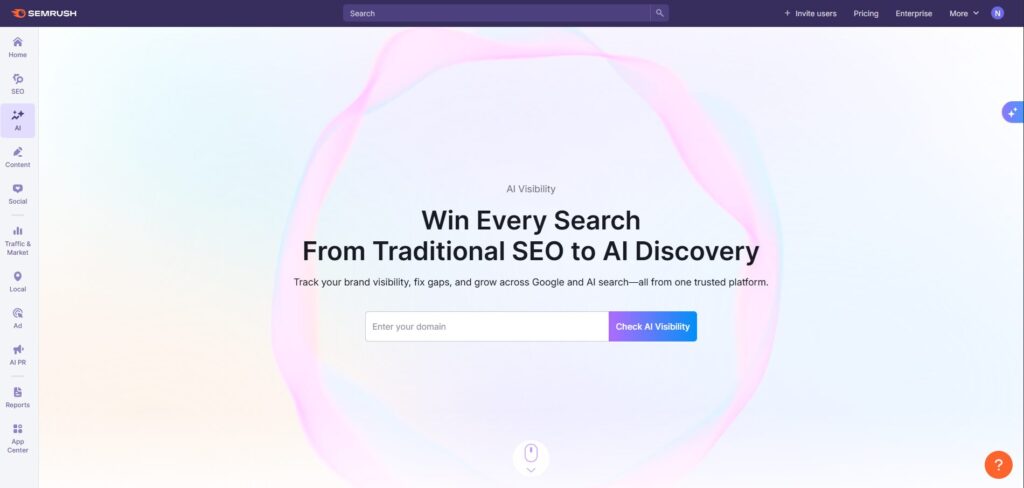
How well AI models understand your brand, expertise, and niche. Use Semrush’s AI Overview on the Semrush one plan
This is the next frontier of SEO.
6. New KPI: AI Visibility Score
SEMrush’s findings highlight the need for new metrics.
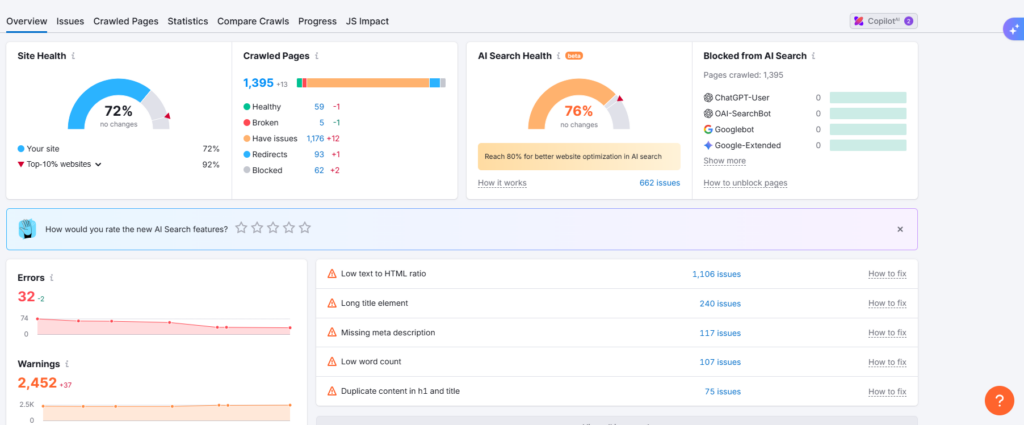
Relying solely on ranking positions is no longer sufficient.
AI Visibility Score could include:
- Mentions in AI-generated answers
- Brand references in conversational responses
- Citation frequency across AI tools
- Inclusion in multimodal search outputs
- Prompt-driven visibility
This will become a universal KPI within the next 24 months.
7. How to Adapt Your Content Strategy for Hybrid Search
Here’s what I’m implementing across all my brands (Tecko Host, Global Tech Stack, Brimco, Go Do Africa, and more):
1. Create content clusters designed for both Google and AI
AI rewards topical depth and structured internal linking.
2. Write more context-rich, problem-first content
AI systems extract meaning from clarity.
3. Create content that explains, not just informs
ChatGPT favors content with educational depth.
4. Optimize for entities, not just keywords
This improves AI interpretation.
5. Map Google and AI search journeys separately
Different tools = different intent stages.
6. Track AI exposure as aggressively as organic traffic
What gets measured gets improved.
8. The Future: The Search Stack Era
We are entering the Search Stack Era, where a user’s journey involves multiple search surfaces:
- YouTube
- ChatGPT
- Gemini
- Perplexity
- Social search (TikTok, Instagram, Reddit)
Each layer influences different stages of awareness, consideration, and decision-making.
Marketers who map and optimize for all layers, not just Google, will dominate visibility.
AI Is Not Competing with Search; It’s Completing It
The SEMrush study is one of the clearest indicators of the future of digital discovery.
ChatGPT didn’t kill search. It evolved it.
Google remains the backbone. AI becomes the brain.
And users now rely on both seamlessly.
If you’re a marketer, founder, writer, or SEO professional, this is your moment to adapt and lead.
We’re not watching a decline in search.
We’re witnessing an expansion.
The only question now is: Are you optimizing for both worlds?